Maintaining the artifact library
The operating library you maintain and every agent reads from. Eight templates to start, versioning on every save, and why this is a quarterly RevOps item.
The library you own
Artifacts is the canonical place for the material your revenue team runs on: messaging guides, case studies, product material, value propositions, competitive guidance, playbooks, policies, scripts and templates. Agents reference these when they generate work.
The sentence that matters most: they do not fill this library in for you. What you put here is what they have to work from, which makes this the one surface in the product where the quality ceiling is set entirely by you.
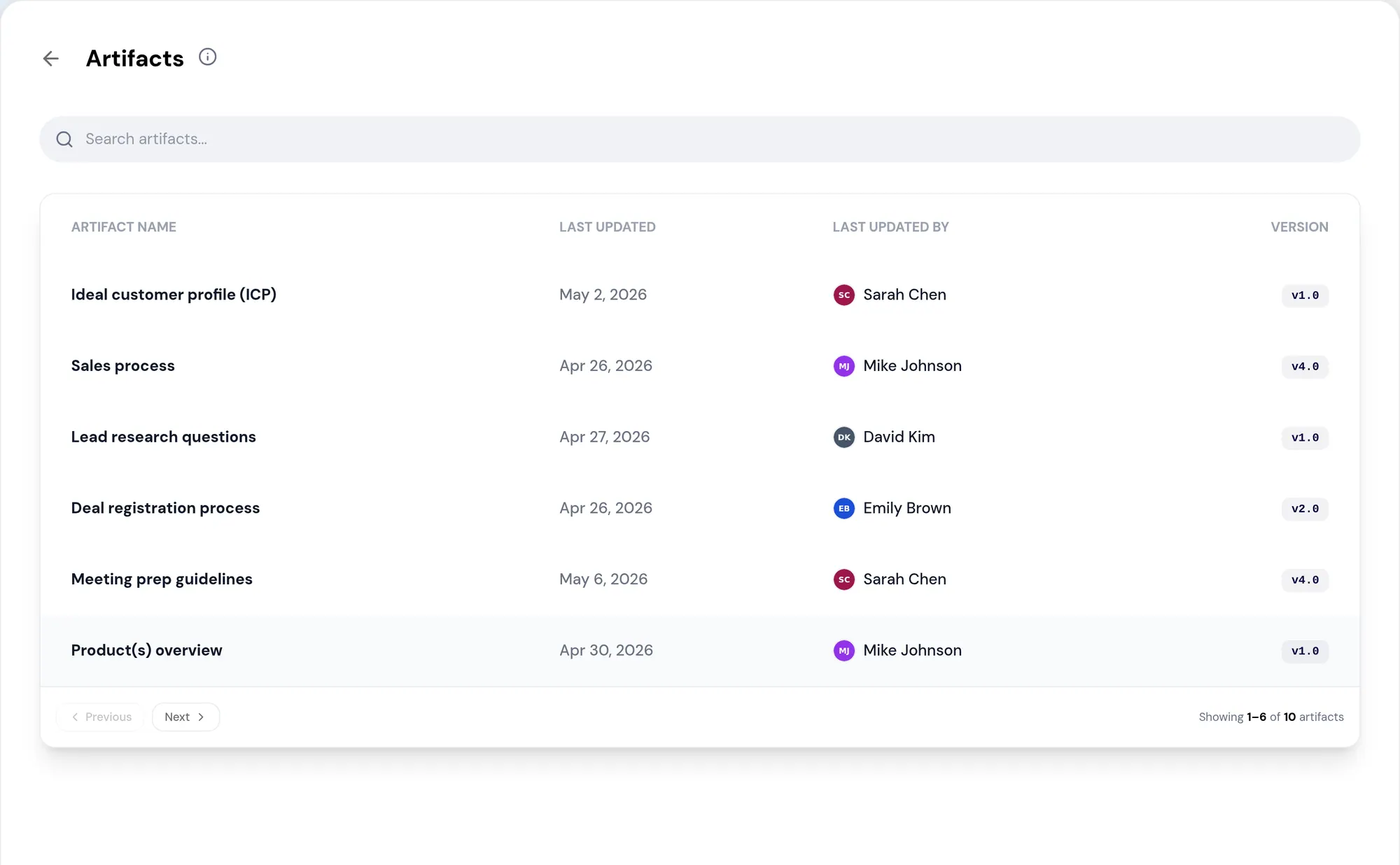
The eight you start with
New workspaces start with eight foundational templates — ICP, Sales Process, Lead Routing, Deal Registration, Meeting Prep, Product Overview, Account Plan, and Lead Research questions. They exist so the library is never an empty page, and they are explicitly starting points to fill in and extend rather than a finished set.
The failure mode is leaving them as shipped and concluding that agent output is generic. It is generic because the ICP artifact still describes a generic company.
Versioning is the audit trail
Each row is one artifact with its owner, last-updated date and version stamp; clicking in opens the rich-text content, and every save creates a new version. That gives you something more useful than a backup: a record of how your operating model actually evolved, with dates.
When agent output changes character and nobody can say why, the version history on the artifact it draws from is usually the answer.
One source, everywhere it shows up
The artifact you publish here is the same artifact referenced from plays, account plans and QBRs. That is the point of a library rather than a folder. A messaging change lands everywhere at once, and there is no second copy quietly disagreeing with it.
It also means a bad artifact propagates just as efficiently as a good one, which is the argument for the review rhythm below rather than an argument against the design.
The quarterly rhythm
Keeping artifacts current is what keeps agent output on-message, and it is work that belongs to a person rather than to the system. Treat the highest-leverage artifacts, ICP, Sales Process and Lead Routing, as quarterly review items in your RevOps cadence.
Those three are named specifically because they feed the most downstream work. An out-of-date meeting-prep template produces one awkward brief; an out-of-date ICP quietly misdirects targeting, scoring and campaign generation at the same time.
What to take away
- Agents reference this library. They do not fill it in for you.
- The eight starting templates are starting points, not a finished library.
- Every save creates a version, so the library is an audit trail of how your operating model changed.
- One artifact, everywhere it appears — plays, account plans and QBRs all read the same source.
- Put ICP, Sales Process and Lead Routing on a quarterly review. Those three move the most output.
Put it to work
Jobs this page is behind
- Working the queueSend the follow-up without writing it“I want to get follow-ups out the same day without writing each one from scratch.”
- SellingKeep an account plan that is actually current“I want to have a real plan for each strategic account that does not go stale in a month.”
- DemandWork the best leads first“I want to know which leads are worth calling first, and why.”
- DemandLaunch a campaign whose collateral arrives written“I want to run a campaign without the content backlog deciding what we can run.”
- DemandHave every message sound like us“I want to have outreach that is personal to the account and consistent with our voice.”
- Governance and administrationMake drafted work sound like your company“I want to get drafted work that reflects how we actually sell, not generic prose.”
Try the demo.
See agents carry the repeatable work of GTM across sales, marketing, customer success, and RevOps. Every action prepared, reviewed, and recorded. Fictional data, real product.
Explore the demo