Make drafted work sound like your company
The artifact library is the shared input every agent reads. Eight to start, versioned on every save, reviewed quarterly.
The job
“I want to get drafted work that reflects how we actually sell, not generic prose.”
- RevOps
- Marketing
- Sales enablement
The complaint about AI-drafted work is almost always the same: it is fluent and it is generic. That is a diagnosis rather than a verdict, and the thing it diagnoses is an empty library. An agent writing without your ICP, your product framing and your proof points will write what anybody could write.
This is also the highest-leverage maintenance job in the whole system, because it is the one input that every agent reads. A single correction here improves campaigns, sequences, account plans and prepared messages at once, which is a return no amount of editing individual outputs will match.
What it moves
- Brand consistency
- Draft acceptance rate
- Time spent editing drafts
The division of labour
What RevTech does, and where you decide
In the product
How to do it
- Step 1 of 5
Start with the eight that carry the most weight
The library opens with a starting set covering the things agents ask of it most: the ideal customer profile, the sales process, lead research questions, the deal registration process, meeting preparation guidelines, the product overview, the account plan sections and lead routing rules. Filling these is a better first week than adding twenty thin documents.
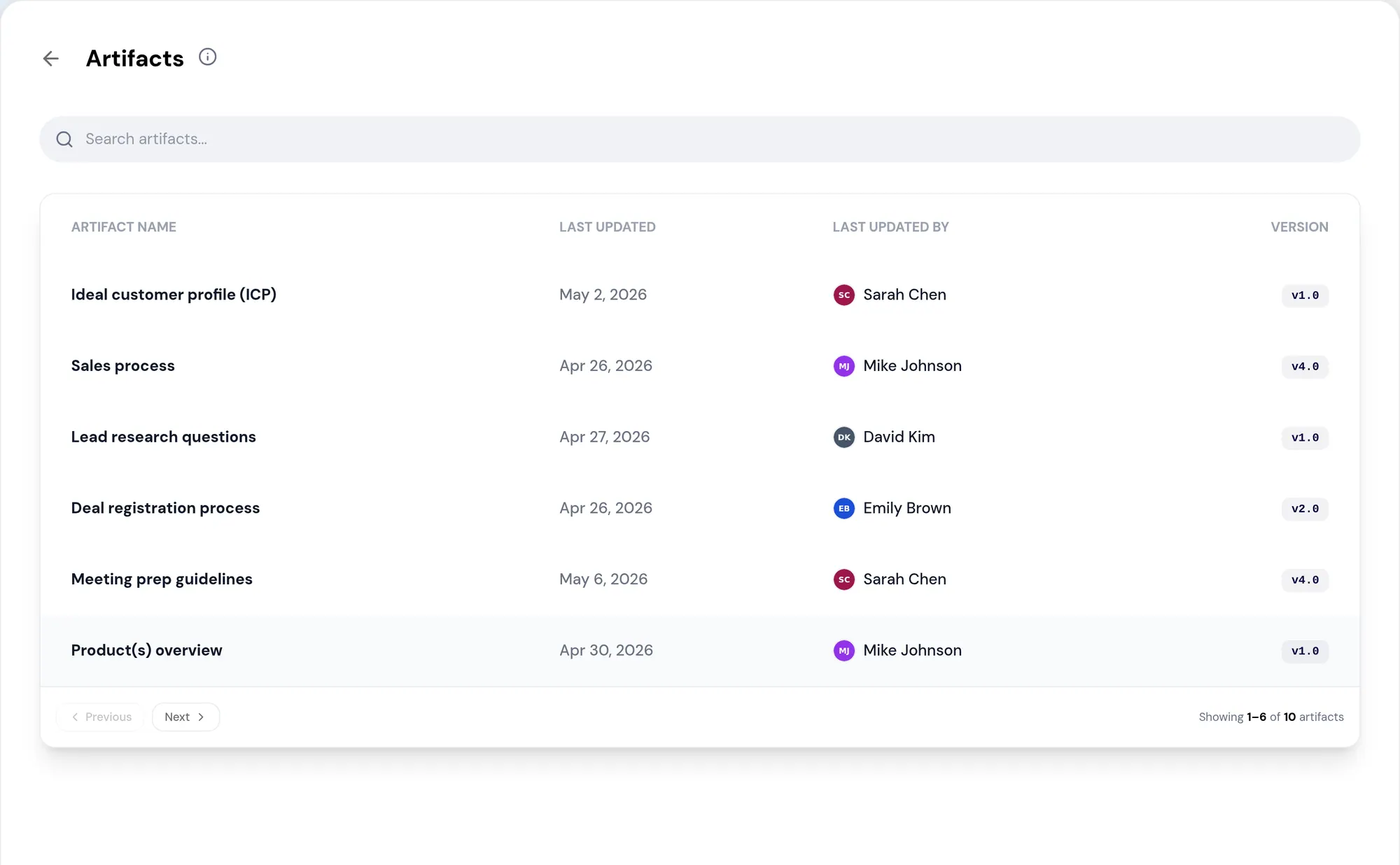
The artifact library: the messaging guides, ICPs and case studies agents draw on, governed in one place. Screenshot of the RevTech application; sample data. The library every agent reads from. One correction here changes every future draft. - Step 2 of 5
Write for an agent, not for a colleague
A document that assumes shared context produces drafts that assume it too. Say the obvious things: what you sell, who it is not for, the words you do not use. The artifact that feels slightly patronising to a colleague is the one that produces good drafts.
- Step 3 of 5
Publish versions rather than overwriting
Every save creates a version, and versions are the audit trail for what an agent was told at the time it wrote something. When a draft from March looks wrong, the question is what the library said in March, and that is answerable.
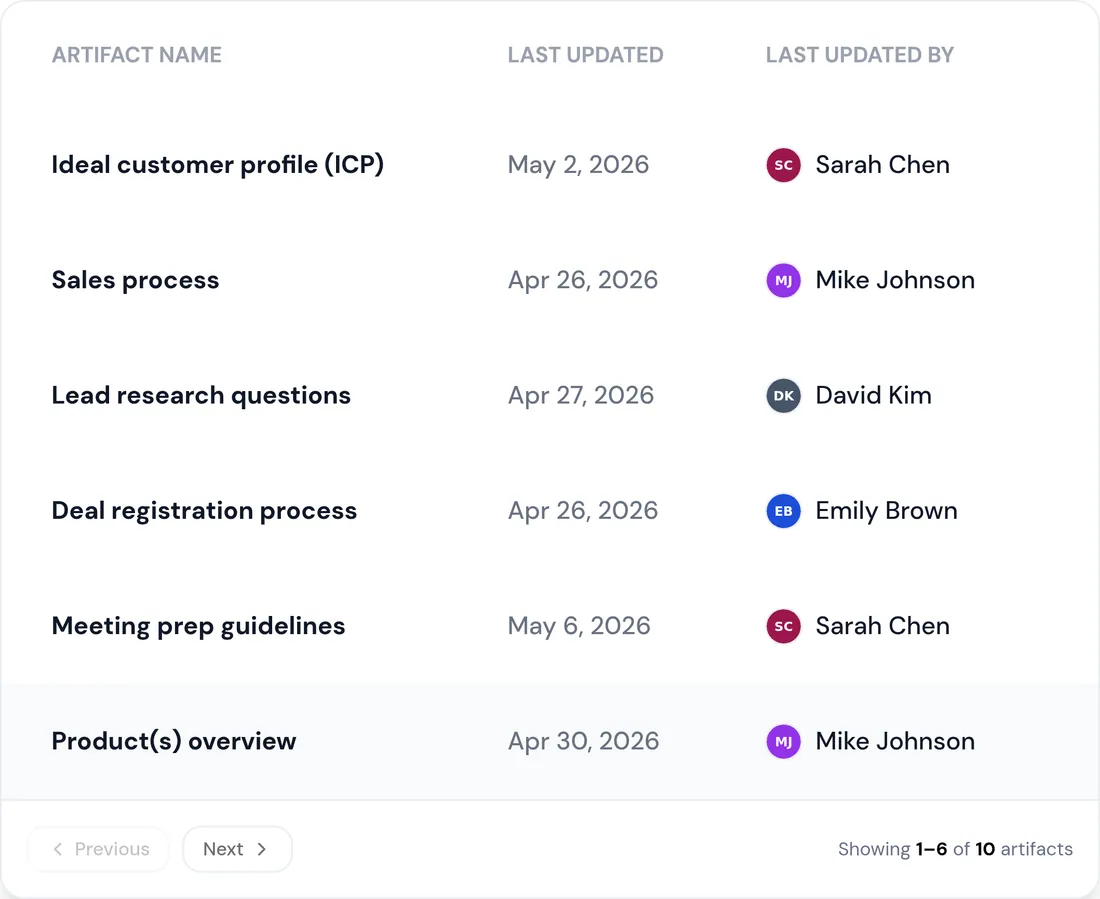
The governed artifact library, retaining what agents produced and drew on so every change has a durable, reviewable record. Screenshot of the RevTech application; sample data. Version history. What the library said when a given draft was written. - Step 4 of 5
Pin agents to versions deliberately
An agent can be bound to a specific version of an artifact rather than always the latest, and health indicators show when a bound artifact has moved on. That is what lets you update a document without changing the behaviour of a live motion in the same instant.
- Step 5 of 5
Review the drafts to find the gaps
Vagueness in generated work is a map of where the library is thin. When several drafts hedge in the same place, that is the artifact to go and fix — and it is a quarterly job for whoever owns revenue operations rather than an occasional one.
What arrives
What this puts in your Action Center
| Item | What is prepared | How it resolves |
|---|---|---|
| ArtifactReview | The drafted new version and a change summary against the published one | The artifact editor |
| AccountAssetReview | An asset written against the library and one account’s own context | The artifact itself |
What to take away
- Generic drafts diagnose an empty library, not a bad model.
- Write down the obvious. The artifact that patronises a colleague produces good drafts.
- Every save is a version, which is how you answer what an agent was told in March.
- Repeated vagueness in the same place names the artifact to fix.
Try the demo.
See agents carry the repeatable work of GTM across sales, marketing, customer success, and RevOps. Every action prepared, reviewed, and recorded. Fictional data, real product.
Explore the demo