Have every message sound like us
You author the framework; the agents write the account-specific message against it. Where the framework lives and how enrolment pins a version.
The job
“I want to have outreach that is personal to the account and consistent with our voice.”
- Marketing
- Sales reps
- RevOps
Templates solve consistency by removing personalisation, and free-form writing solves personalisation by abandoning consistency. Every organisation picks one and complains about the consequence of the choice, usually by asking for more templates and then asking why the messages all sound the same.
Separating the framework from the message is what dissolves that. The framework is the part you want consistent — the purpose of each step, what it may draw on, the style. The message is the part you want specific, and it is written per account at the moment it is needed.
What it moves
- Reply rate
- Brand consistency
- Time spent writing outreach
The division of labour
What RevTech does, and where you decide
In the product
How to do it
- Step 1 of 4
Write a purpose an agent can generate against
A sequence is a framework, not copy. Its purpose is the field doing most of the work: "re-engage a lapsed evaluation by referencing the objection that ended it" produces good drafts, while "nurture" produces the drafts you would expect from the word nurture.
- Step 2 of 4
Say which artifacts it may draw on
The framework names what the drafting may reference. This is where consistency actually comes from: the ICP, the product overview, the case studies. A framework with nothing bound to it produces confident, generic prose.
- Step 3 of 4
Keep the steps to what the motion needs
Up to twelve ordered steps, each with its own purpose and message type, plus the overall style. Twelve is a ceiling, not a target: a sequence with four purposeful steps beats one with eleven whose purposes overlap.
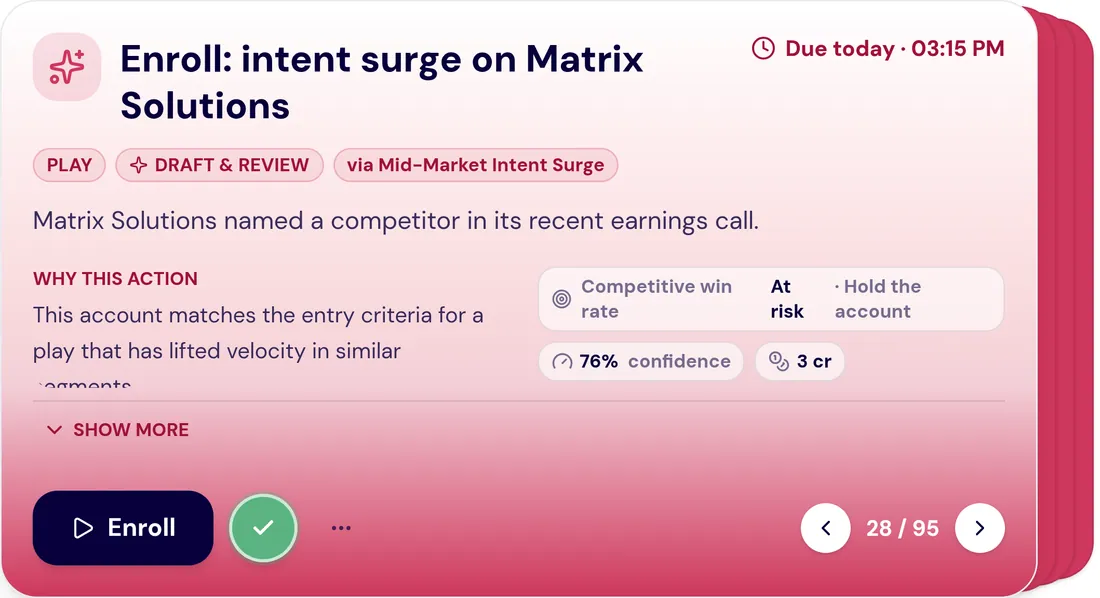
A communication drafted by the agent and held for review, so a human approves the wording before anything is sent. Screenshot of the RevTech application; sample data. A message written from a framework. The framework is consistent; the message is not. - Step 4 of 4
Enrol from the record, and know the version is pinned
Sequences are started from an account, contact or deal. Enrolment pins the published version that was live at the time, so editing a framework changes what future enrolments get and does not rewrite what somebody is already receiving mid-sequence.
- Publications are immutable, and the version history is browsable
- A draft can be reviewed with its own revision history before it is published
- Where the research behind a draft has gone stale, it can be re-run before generating
What arrives
What this puts in your Action Center
| Item | What is prepared | How it resolves |
|---|---|---|
| Email · FollowUpEmail | The message, written against the framework and the account’s context | The message flow |
| ContactScoreImproved | A personal touch drafted from the contact’s own activity | Reach out |
What to take away
- The framework is consistent; the message is specific. That is the whole design.
- Purpose does most of the work. "Nurture" is not a purpose.
- Bind artifacts, or you get confident generic prose.
- Enrolment pins a version, so editing a framework never rewrites a live sequence.
Go deeper
The material behind this
Try the demo.
See agents carry the repeatable work of GTM across sales, marketing, customer success, and RevOps. Every action prepared, reviewed, and recorded. Fictional data, real product.
Explore the demo