Work the best leads first
Fit scoring against your own ICP, a card when a lead crosses the bar with the breakdown behind the score, and a lead that opens straight onto its record.
The job
“I want to know which leads are worth calling first, and why.”
- Business development
- Marketing operations
- Sales managers
Working leads in arrival order is a defensible policy only when every lead is equally likely to convert, which is never. In practice a queue worked top-down means the best lead of the week is reached on Thursday, by which time somebody else has reached them on Tuesday.
Most scoring schemes fail not because the model is wrong but because nobody trusts it. A score that arrives as a number with no breakdown gets ignored the first time it disagrees with somebody’s instinct, and after that it is decoration.
What it moves
- MQL to SAL conversion
- Speed to lead
- Cost per opportunity
The division of labour
What RevTech does, and where you decide
In the product
How to do it
- Step 1 of 4
Write the ICP down as an artifact
The fit model is only as good as the definition behind it, and that definition belongs in your artifact library, under AI Agents → Artifacts, where every agent reads the same one. An ICP that exists in a slide and an ICP that exists as an artifact produce very different scoring.
- Step 2 of 4
Run scoring through an AI flow
Research, scoring and ICP fit run on every lead in an AI lead flow; a basic flow routes without them. That choice is made per flow when it is created, so the leads you want scored need to arrive through a flow set up that way.
- Step 3 of 4
Act on the two crossing cards
A lead crossing the ICP fit threshold arrives with the breakdown behind the score, not just the score. A contact whose score or fit climbs into the hot band arrives as a card whose Reach Out button opens a blank panel for the personal touch you write and save to the action. Both are time-sensitive in the way scores generally are: the band is a description of this week.
- Step 4 of 4
Disagree with the score where it can change
When a score looks wrong, read its breakdown on the card first: it shows which parts of the ICP the lead matched. If the breakdown is right and the score still feels wrong, the ICP artifact is what needs changing, and changing it changes every future score. If the lead is simply not worth working, ignore the card with that reason.
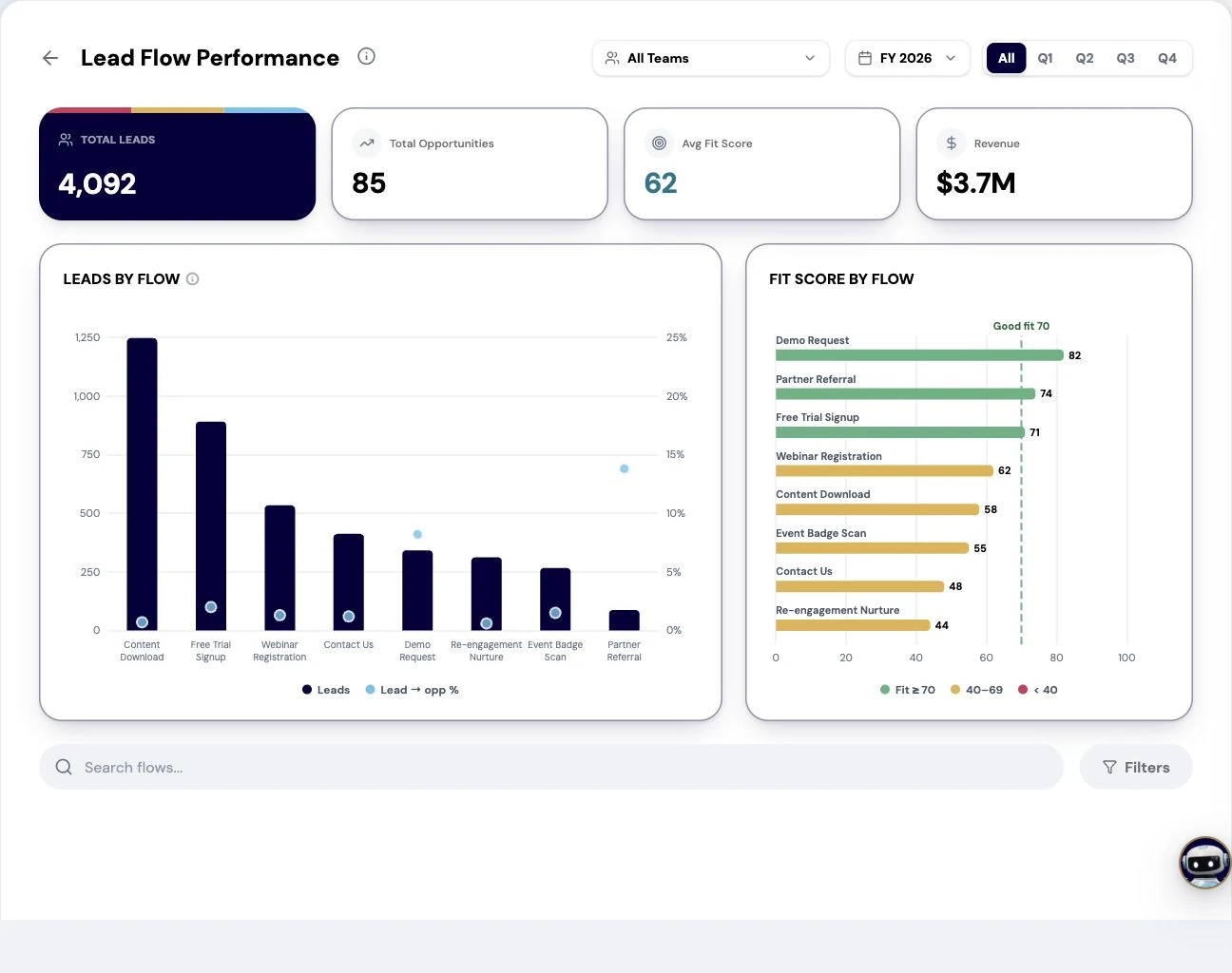
Lead Flow Performance connects inbound lead volume with qualification, opportunities and revenue. Captured from the current application with illustrative sample data. Screenshot of the RevTech application; sample data. Lead Flow Performance: lead volume and quality by flow. Scores are worth having only when you can see what produced them.
What arrives
What this puts in your Action Center
| Item | What is prepared | How it resolves |
|---|---|---|
| HighFitLead | The lead scored against the ICP model, with the breakdown surfaced | The lead |
| ContactScoreImproved | The score move, while the contact is engaged | Reach Out, which opens a blank panel and saves the touch you write to the action |
| LeadAssigned | Enriched, scored and with the first touch drafted | Opens the record it references, in place |
Where this is today
The per-lead record of each enrichment and its revisions (the Processed Leads page) was retired; an assigned lead now opens its contact or account directly. The score column on Contacts is an engagement score from recent activity and meetings, not the ICP fit score.
What to take away
- The ICP belongs in the artifact library, not in a slide. Every agent reads the same one.
- A score without a breakdown gets ignored the first time it disagrees with somebody.
- Disagree upstream: a wrong score with a right breakdown means the ICP needs changing.
- Scoring runs in AI flows. A basic flow routes without it.
Go deeper
The material behind this
See how the work gets done.
Explore how agents prepare work across your revenue teams, and how people review it, guide it and decide what happens next. Fictional data. Real product.
Explore the demo