Working accounts and account plans
Accounts is the gravity well — deals, contacts, pipeline and forecast all hang off it. How to work a book weekly and use the plan as a real deliverable.
Product walkthrough
See it in RevTech
See how RevTech assembles the account plan, maps the people involved, and keeps the buying group current as new evidence arrives.
Why accounts come first
Accounts is the gravity well of RevTech: deals, contacts, pipeline and forecasting all hang off the account record. Which means account hygiene is not a data-quality chore competing with selling. It is the thing that decides whether the forecast is describing your business or a partial copy of it.
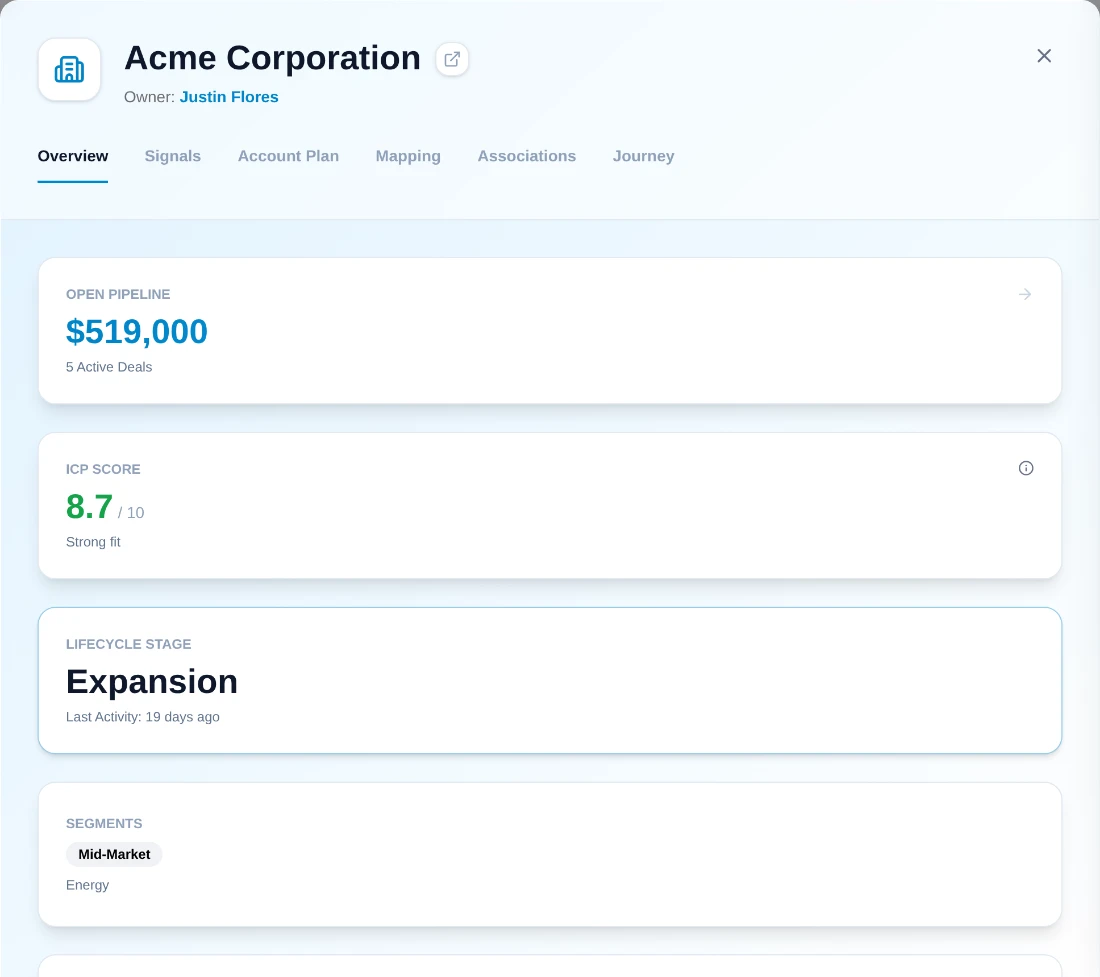
Each row gives a one-glance read through its open pipeline, contacts and deals counts. Any row opens the full picture.
Lifecycle is the operating spine
Filtering by lifecycle is how you decide what your week is about. The stage list runs Open, Engaged, Prospecting, Opportunity, Customer, Expansion, Churned, Seeded and Nurture, and it is a multi-select rather than one stage at a time. Prospecting and Opportunity are the sales week; Customer and Expansion belong to Customer Success; Churned tells you what did not work, and is the filter most teams never open.
Search and filters live in the URL, so a view is a link. Share the link with a manager rather than describing which filters to apply, the same reason the pipeline report is worth pasting into a meeting invite.
The account plan as a deliverable
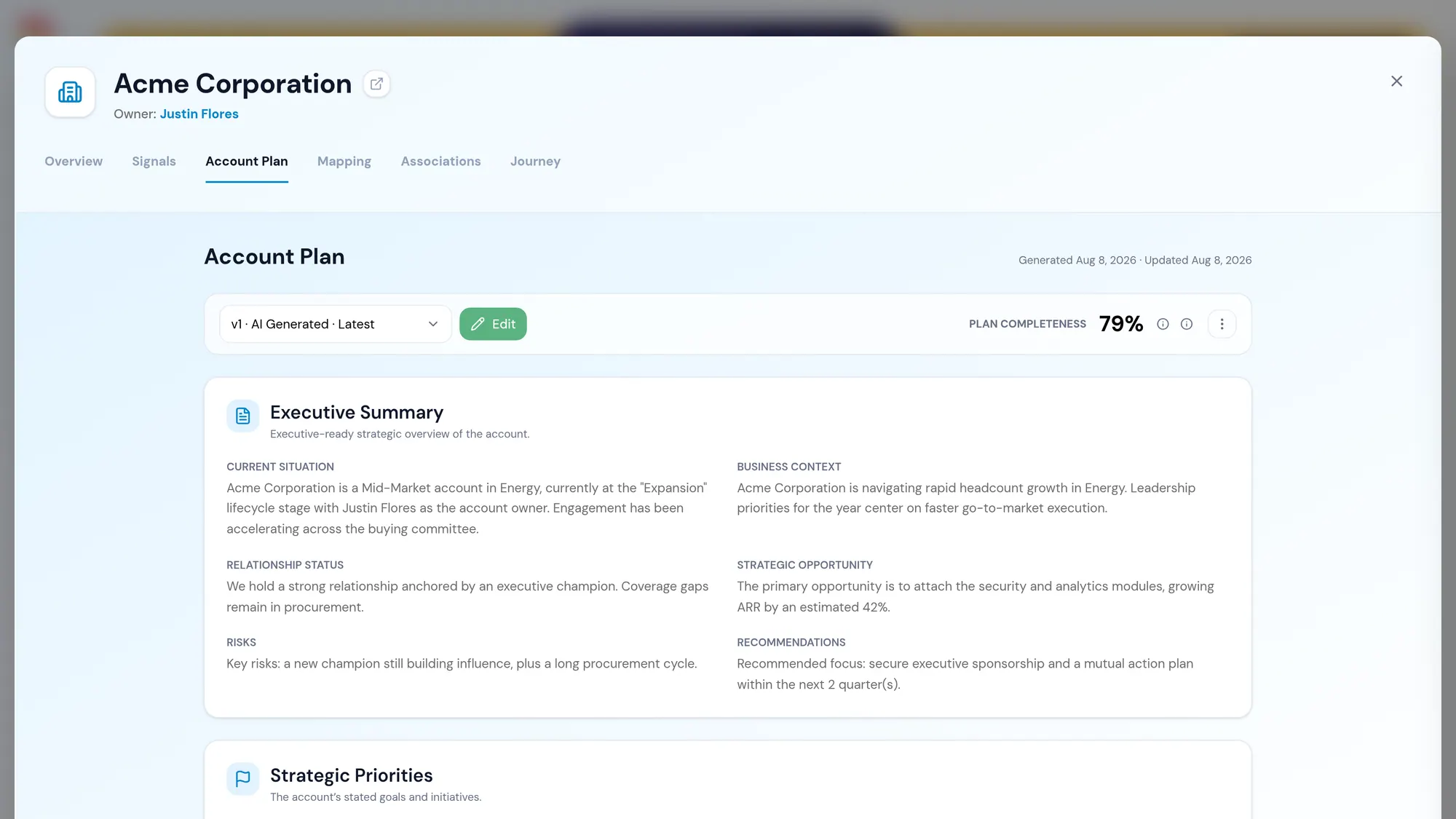
The strategic account plan is AI-grounded: summary, goals, stakeholders, risks and an action plan, assembled from the account record rather than from a template you fill in. Account Intelligence sits alongside it with the summary, strategy and risk read, and Score and Potential anchor priority.
Treat the plan as something you open before every executive touchpoint and regenerate after major changes: a new stakeholder, a lost champion, a changed close date. A plan generated once at the start of a pursuit and never revisited describes an account that no longer exists.
Map the buying committee
The committee is the deal. Mark champions and blockers, and pay most attention to the gaps: the roles you would expect to be involved in a purchase of this shape and cannot name a person for. A gap is the single most predictive thing on the account, and it is the one a pipeline report will never show you.
Suggested contacts come from outside your CRM and can be promoted in one click, which is how a map gets completed rather than merely audited.
Engagement, and the weekly habit
The Journey view is engagement over time. Spikes mean meetings; dips mean ghosting. Its real use is confirming what your gut already suspects early enough to act. A drop-off caught in week two is a conversation, and the same drop-off caught in week eight is a loss review.
The habit that makes all of this pay off is unglamorous: open this view every Monday, filter to your book, action the top five. From the list you can also select multiple accounts to promote them as ABM targets or add them to a campaign, which is the everyday bulk move.
What to take away
- Lifecycle is the operating spine. Filter by it to decide what your week is about.
- The strategic account plan is a deliverable for an executive touchpoint, not a page to admire.
- The buying committee is the deal. Mark champions, blockers and — most importantly — gaps.
- Filters live in the URL. Share the link instead of describing the view.
- Monday, filter to your book, action the top five. That is the whole habit.
Put it to work
Jobs this page is behind
- Working the queueFind any record or report in two keystrokes“I want to get to an account, a deal, a rep or a report without hunting through menus.”
- SellingKeep an account plan that is actually current“I want to have a real plan for each strategic account that does not go stale in a month.”
- SellingHand over a new customer without losing the context“I want to hand a new customer to the team who will keep them, with everything they need.”
- CustomersStart every customer the same way“I want to give every new customer the same start, and know when one is drifting.”
Try the demo.
See agents carry the repeatable work of GTM across sales, marketing, customer success, and RevOps. Every action prepared, reviewed, and recorded. Fictional data, real product.
Explore the demo