Hand over a new customer without losing the context
The handoff is drafted the moment the deal closes. What belongs in it, and how the first ninety days become a motion rather than a promise.
The job
“I want to hand a new customer to the team who will keep them, with everything they need.”
- Sales reps
- Customer success managers
- RevOps
The handoff is where the most expensive context in the company gets thrown away. The seller knows which promises were made, which stakeholder was sceptical and what the customer actually believes they bought. Almost none of that is in a field, and the meeting where it gets transferred is scheduled for thirty minutes about a year of relationship.
What the customer experiences is a competent stranger asking questions they have already answered, three weeks after signing. That is the moment a renewal risk is created, eleven months before it shows up in a report.
What it moves
- Handoff completeness
- Time to first value
- Net revenue retention
The division of labour
What RevTech does, and where you decide
In the product
How to do it
- Step 1 of 4
Start from the card, not from a calendar invitation
A closed-won deal raises an item carrying a drafted customer success handoff. Doing it here rather than in a scheduled meeting matters, because the drafting happens while the deal is still fresh and the seller is still thinking about it.
- Step 2 of 4
Add the three things that are never in a field
What was promised that is not in the contract. Who was sceptical, and about what. What the customer thinks success looks like in ninety days. A generated handoff will carry the facts of the deal; those three are the part only the seller has.
- Step 3 of 4
Regenerate the account plan for the new lifecycle
The plan that got the deal won is a plan for winning it. Regenerating once the account is a customer produces one framed around retention and growth, which is the document the customer success owner should be working from.
- Step 4 of 4
Put the onboarding motion on a play
If the first ninety days matter, they should be a play with a timeline and owned steps rather than a checklist somebody keeps privately. A play whose eligibility is accounts that have just moved into the customer lifecycle carries every new customer through the same sequence, and its steps arrive as work in the right person’s queue.
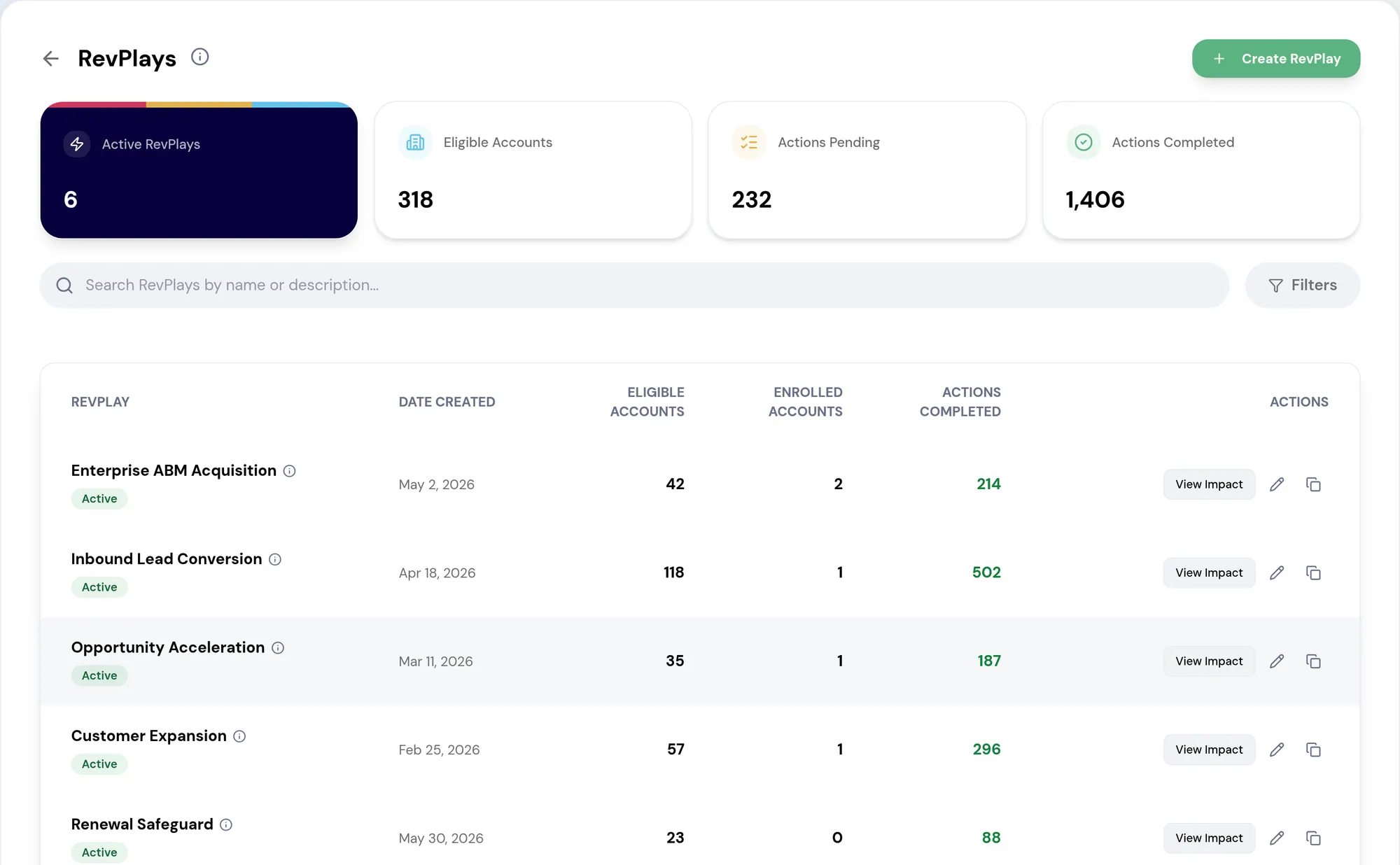
The RevPlays library: repeatable GTM plays, the accounts enrolled in each, and the actions they generate. Screenshot of the RevTech application; sample data. The play library. Onboarding is a motion like any other, and belongs here rather than in a document.
What arrives
What this puts in your Action Center
| Item | What is prepared | How it resolves |
|---|---|---|
| WonDeal | A drafted customer success handoff | The deal |
| AccountPlanReview | The refreshed plan, once it is regenerated for the customer lifecycle | The account plan |
| RevPlayActionInstance | The instruction, the objective and the account context for one step of the onboarding motion | Opens the account; completion goes through the play |
What to take away
- Draft the handoff while the deal is fresh, not in a meeting three weeks later.
- The seller’s job is the three things no field holds: promises, scepticism, what success means.
- Regenerate the account plan — the plan that won the deal is not the plan that keeps it.
- If the first ninety days matter, make them a play rather than a private checklist.
Go deeper
The material behind this
Try the demo.
See agents carry the repeatable work of GTM across sales, marketing, customer success, and RevOps. Every action prepared, reviewed, and recorded. Fictional data, real product.
Explore the demo