Know how much rides on a few accounts
Top Accounts ranks your largest customers by won revenue and open pipeline, and shows the top-5 share. Read the concentration, then plan the accounts it names.
The job
“I want to know how dependent the business is on a handful of accounts, and protect them.”
- CS leaders
- Sales leaders
- Customer success managers
- Finance
Concentration is the risk nobody owns. Each large account has an owner who watches it, but the question of how much of the business rests on five of them belongs to nobody, and it usually comes up only when one of them goes quiet.
The answer is not a chart to look at. It is a short list of accounts that deserve a plan and an owner who works it, and a motion that grows the next tier so the top five carry a little less of the business next year.
What it moves
- Revenue at risk
- Expansion signal conversion
- Account review preparation time
The division of labour
What RevTech does, and where you decide
In the product
How to do it
- Step 1 of 5
Read the concentration first
Open Reporting → Top Accounts. The cards give the won revenue of the top 25 accounts, their open pipeline, the Top 5 share of that won revenue, and the largest single account. Concentration draws each account as a tile sized by won revenue and coloured by its Customer Health segment, so a large tile in a poor-health colour stands out at once.
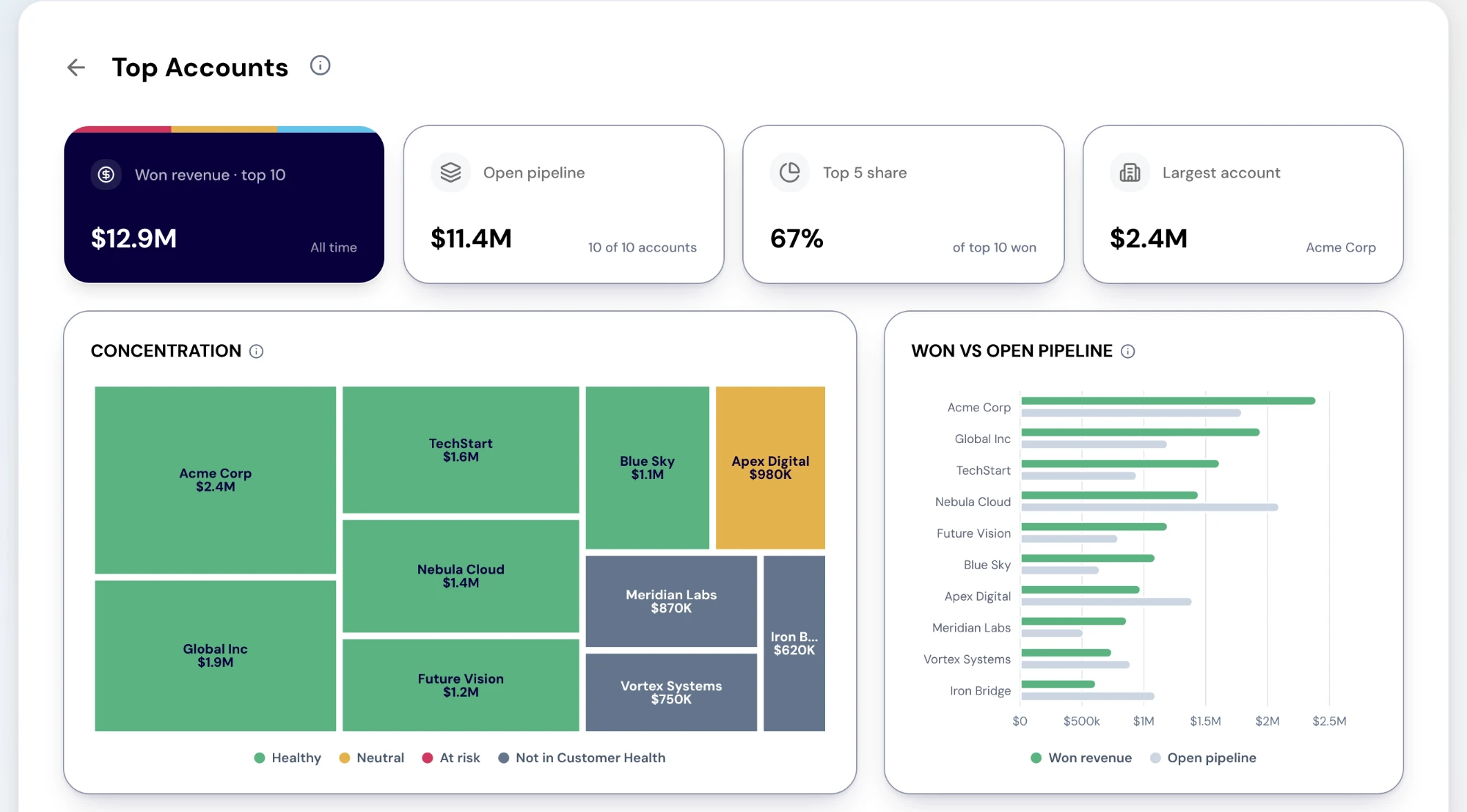
The Top Accounts report. Cards show the largest account and the share of revenue held by the top five. Charts show revenue concentration and each top account’s won revenue against its open pipeline. Sample data. Screenshot of the RevTech application; sample data. Top Accounts in the demo workspace: won revenue, open pipeline and top-5 share above the concentration tiles and won vs open pipeline. - Step 2 of 5
Compare what was won with what is open
Won vs open pipeline sets the ten largest accounts’ won revenue against their open pipeline. A top account with no open pipeline is not growing. One with a large open deal is a forecast dependency as well as a customer.
- Step 3 of 5
Choose the top tier from the table
The Accounts table ranks by won revenue, with open pipeline, share of the top 25, health and open deals. Select an account to open it. The tier is a judgement: the largest accounts, plus any in poor health, plus any whose open pipeline the quarter depends on.
- Step 4 of 5
Give each top account a plan
On the account, the Account Plan tab holds its plan. Run account plan, or Create Account Plan in the header, asks you to confirm first, because a run researches the account and uses credits; nothing generates until you do. When the plan is ready, a review card brings it to you.
- Step 5 of 5
Grow the next tier with a play
Concentration falls when the next tier grows. When an account’s health climbs into the expansion-ready band, a card arrives with sized whitespace and a shortlist of plays to enroll it in. For a deliberate list, select the accounts in Objects → Accounts and use Add to RevPlay, which is offered to people who can decide RevPlay work.
What arrives
What this puts in your Action Center
| Item | What is prepared | How it resolves |
|---|---|---|
| AccountPlanReview | The full plan, once a run you confirmed finishes | Account plan |
| HealthImproved | Sized whitespace and a shortlist of plays | Enroll in an expansion play |
| HealthRisk | An intervention plan: a new-champion map and an executive agenda | The account |
Where this is today
Top Accounts is all-time: it has no Period or Team filter yet, and shares are within the top 25 accounts rather than the whole book.
What to take away
- Concentration is a risk nobody owns until somebody reads it.
- A top account with no open pipeline is not growing.
- Shares are of the top 25, not of the whole book. Read them as relative.
- Every top-tier account gets a plan. The next tier gets a play.
See how the work gets done.
Explore how agents prepare work across your revenue teams, and how people review it, guide it and decide what happens next. Fictional data. Real product.
Explore the demo