Governing the lead flow
A flow is a contract between marketing and sales. Choosing the type, sizing how many you need, and finding the stage where leads actually die.
Product walkthrough
See it in RevTech
Follow a lead from campaign association and routing through personalized follow-up and revenue attribution in one governed workflow.
A flow is a contract
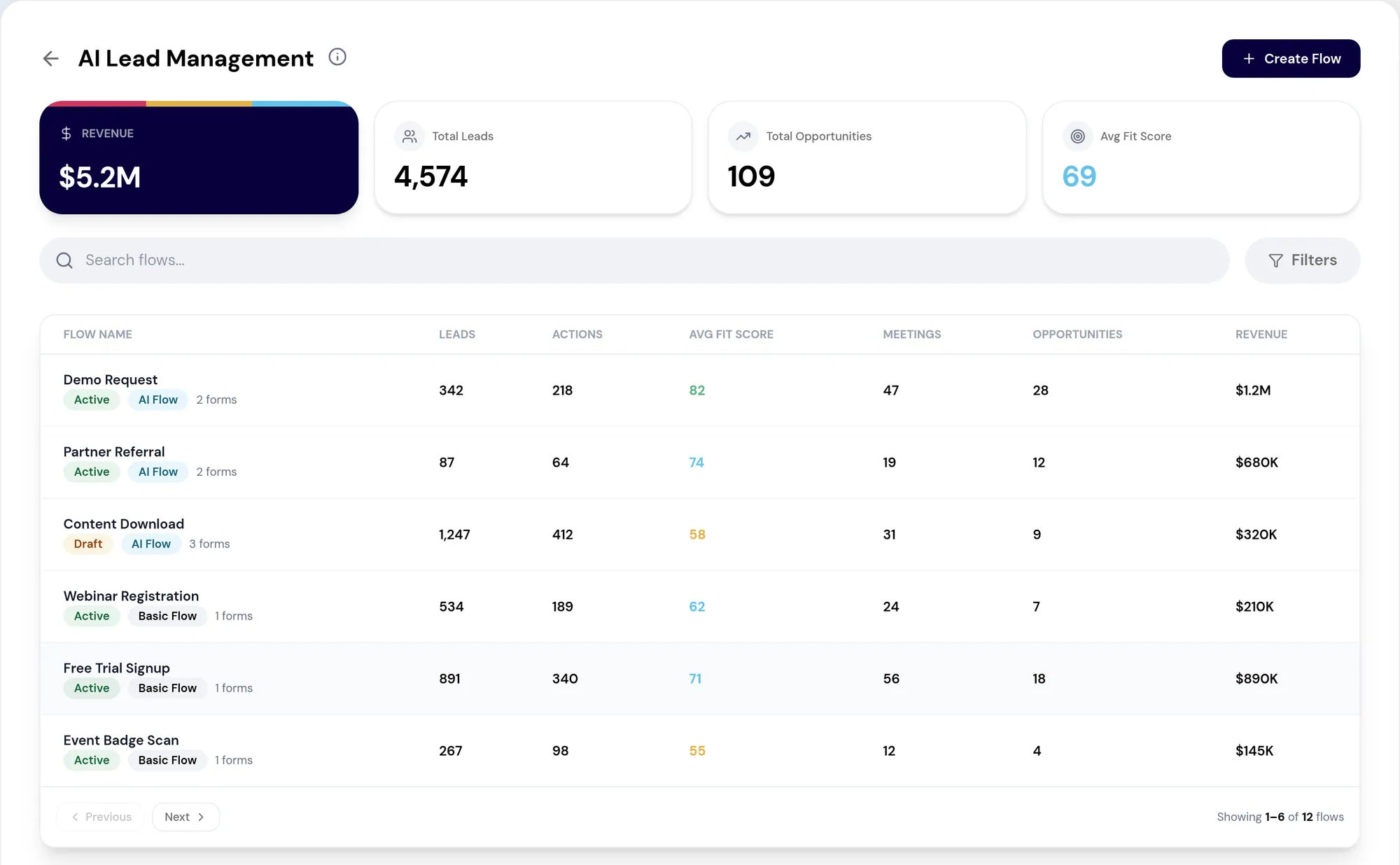
Every lead flow is an agreement between marketing and sales about what happens to a lead: what it gets associated with, how it is treated, and who it lands on. The flow list is the operational inventory of those agreements. You author them here and read their performance in the Leads report, which windows on when a lead arrived and states that basis on the panel rather than leaving you to assume it.
Framing it that way changes how many you build. A contract you cannot describe in a sentence is not one anybody will honour.
Basic or AI: a decision you make once
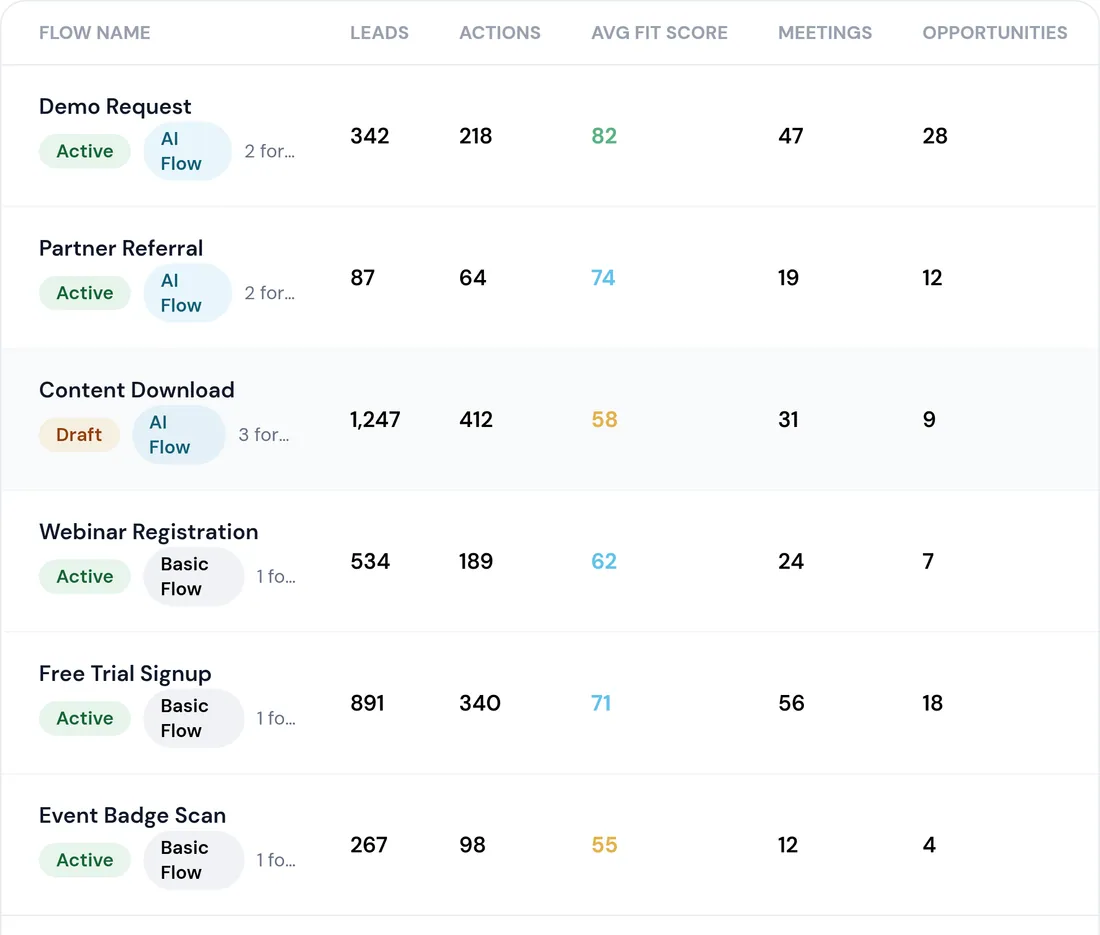
A Basic Flow associates a campaign and forms and routes the lead. No AI. An AI Flow always enriches, researches and scores every lead, and adds AI messaging. The type is locked once the flow exists, which makes this the one genuinely expensive choice on the page.
The question to ask is not which is better but whether the enrichment and scoring change what happens next. If every lead in a flow is routed the same way regardless of score, an AI flow is buying you a score nobody acts on.
How many flows you actually need
Create a new flow when you have a meaningfully different treatment — not when you have a new form. Forms that get the same treatment should share a flow. The instinct to mirror the form inventory produces a portfolio nobody can audit, where twelve flows differ only in which form fed them.
And run the test simulation before publishing, every time. A flow is the one object here that starts affecting real leads the moment it goes live.
Finding where leads die
Inside a flow, the funnel shows conversion rate and drop-off by stage. The biggest drop is your bottleneck, and it is worth being blunt about what that means: a funnel leak is a decision nobody has made yet. Leads are not disappearing. They are arriving at a stage where the agreed treatment does not exist or is not being honoured.
Put that number in front of marketing ops and sales on a weekly rhythm. It is one of the few metrics where both functions can see their own contribution in the same chart.
- Leads-to-opportunities and opportunities-to-revenue are the two figures that pay an inbound program back
- Form conversion cards show which forms are pulling their weight within a flow
- The contacts list shows every person who went through the flow — click through to the record, not just the count
Routing is where governance lands
Routing decides who owns a lead, and it is configuration you set rather than a default you inherit. That makes it the place lead governance actually bites: a scoring model nobody disputes and a routing rule nobody agreed to will still produce arguments about lead quality, because the argument is really about ownership.
Settle routing with sales before you tune scoring. The order matters more than either decision.
What to take away
- A flow is a contract between marketing and sales, not a form handler.
- Basic or AI is locked once the flow exists. Choose deliberately.
- One flow per meaningfully different treatment — not one per form.
- Always run the test simulation before publishing.
- The biggest drop-off in the funnel is a decision nobody has made yet.
Put it to work
Jobs this page is behind
- DemandMake sure no lead waits“I want to have every inbound lead enriched, routed and followed up inside the SLA.”
- DemandWork the best leads first“I want to know which leads are worth calling first, and why.”
- DemandTrust what a campaign is credited with“I want to be able to defend the number next to each campaign.”
Try the demo.
See agents carry the repeatable work of GTM across sales, marketing, customer success, and RevOps. Every action prepared, reviewed, and recorded. Fictional data, real product.
Explore the demo