Reach an account while it is in market
Intent, web and ad activity, CRM activity and ICP match, correlated into one card with the play it qualifies for.
The job
“I want to get to a target account during the window when they are actually looking.”
- Sales reps
- Marketing
- Business development
Buying windows are short and unannounced. An account that is evaluating this month will have a shortlist by next month, and the difference between being on it and not is often whether anybody at your company noticed the evaluation had started.
The signals that would have told you are usually all present and all separate: a spike in content consumption, activity from a job title that has never engaged before, a return to pricing. Individually each is noise. Correlated, they are a window, and correlation is exactly the work nobody has time to do by hand across a book of accounts.
What it moves
- Pipeline created
- Account engagement to pipeline
- Account penetration
The division of labour
What RevTech does, and where you decide
In the product
How to do it
- Step 1 of 4
Know what counts as a signal
Four sources, and the card names which one it came from: an intent spike, web or advertising activity, activity in the CRM itself, and a match against your ICP. That naming matters, because the right response to a content spike and the right response to an inbound form from a new persona are not the same response.
- Step 2 of 4
Read the correlation, not the individual event
The card carries the correlated set rather than the one event that tipped it over. A single anonymous visit is not a window; three visits from two job functions plus a pricing page is. The evidence is attached so you can tell which one you have.
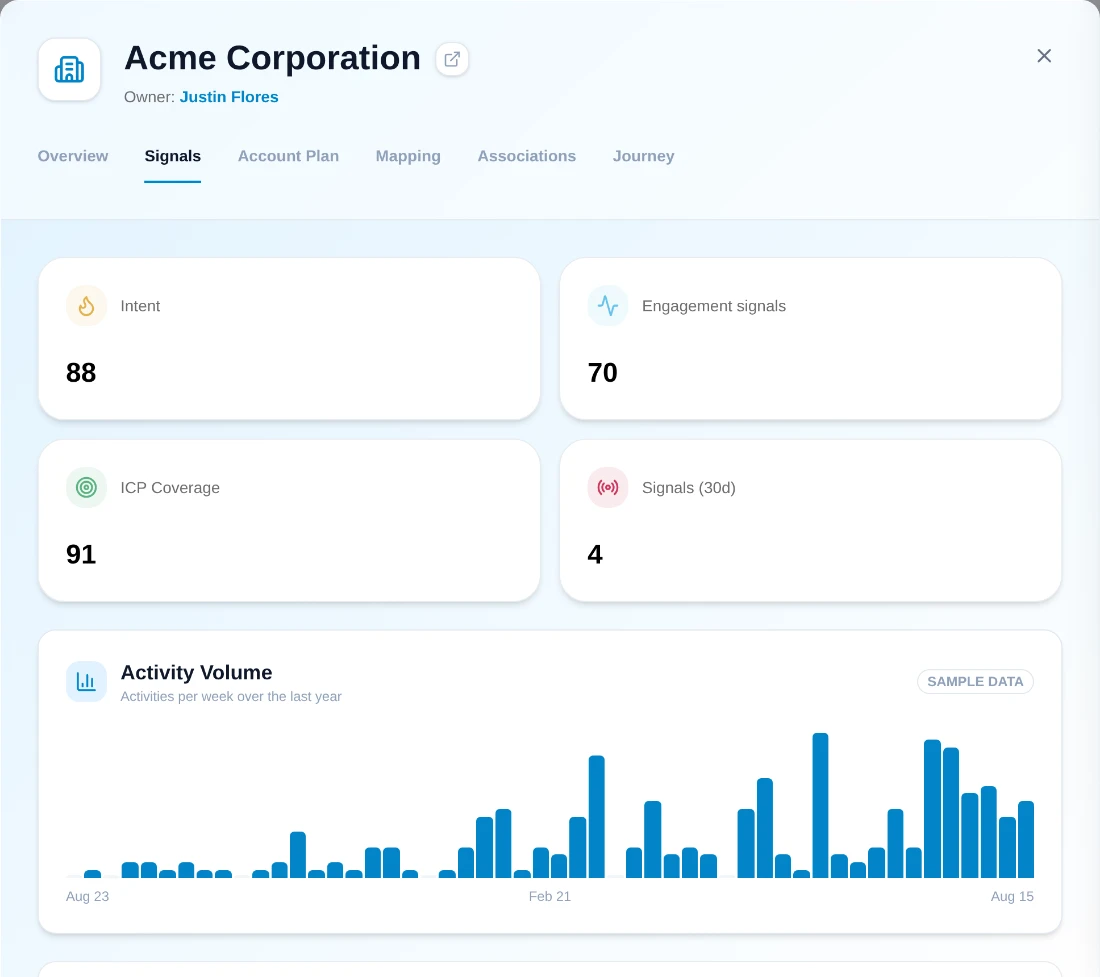
Buying signals collected on an account. Intent and engagement scores, how well the account matches the ideal customer profile, and activity volume plotted across the year: the demand evidence that decides whether an account is worth working now, held on the account record itself rather than in a separate tool. Screenshot of the RevTech application; sample data. Signals correlated on an account, with the full set attached rather than summarised away. - Step 3 of 4
Act on the score crossing, not just the signal
When account engagement crosses into the hot band, the card arrives already matched to the plays that account now qualifies for. That is the moment to enrol rather than to write a one-off email, because a window that justifies a call usually justifies a sequence.
- Step 4 of 4
Close the loop on what the signal was worth
Signals that never convert are worth knowing about. If a source consistently produces windows that go nowhere, its weighting is the problem, and that is a conversation to have with evidence rather than an impression.
What arrives
What this puts in your Action Center
| Item | What is prepared | How it resolves |
|---|---|---|
| AccountSignal | The account’s signals correlated, with the full set attached as evidence; the subtype names the source | The account, on its Signals tab |
| AccountScoreImproved | The account matched to the plays it qualifies for | Enrol in a play while the momentum holds |
Where this is today
The Signals tab on the account record is not switched on for production tenants yet. The signal cards and the evidence on them work; the dedicated tab that gathers an account’s full signal history does not, so read the evidence from the card.
What to take away
- Four sources, and the card says which. The right response differs by source.
- Correlation is the signal. One anonymous visit is not a buying window.
- A score crossing arrives with the qualifying plays attached — enrol rather than sending one email.
- A signal source that never converts is a weighting problem worth raising with evidence.
Go deeper
The material behind this
Try the demo.
See agents carry the repeatable work of GTM across sales, marketing, customer success, and RevOps. Every action prepared, reviewed, and recorded. Fictional data, real product.
Explore the demo