Walk into every meeting prepared
The prep arrives before the meeting does. How to use a briefing you can ask questions of, and what to do with the meeting nobody joined.
The job
“I want to walk into every meeting knowing the account, the people and the history.”
- Sales reps
- Customer success managers
- Sales managers
Meeting preparation is the most reliably skipped work in a seller’s week, and the reason is arithmetic rather than discipline. Doing it properly means opening the account, reading the last three activities, checking which deals are open, remembering who is in the room and what they said last time. That is fifteen minutes, and it lands in the fifteen minutes before the call, which is the part of the day most likely to already be occupied by the previous call.
So it gets done from memory, and the cost is invisible: nobody can see the question you did not ask because you had forgotten which product they had already bought. Preparation that is already written when you open the card changes the economics, because reading two paragraphs is a thing you can do between meetings and assembling them is not.
What it moves
- Meeting preparation time
- Seller readiness
- Follow-up speed
The division of labour
What RevTech does, and where you decide
In the product
How to do it
- Step 1 of 4
Find the meeting in your queue
An upcoming meeting arrives as its own card, and so does a past one that has not been logged. Both are Meeting items, which is deliberate: the two halves of a meeting are one piece of work, and splitting them across two surfaces is how the second half stops happening.
- Step 2 of 4
Open the briefing and keep asking
Preparing opens the assistant on a briefing about the account and the people you are meeting, rather than a static prep document. That difference is the whole point: the first screen answers the questions everybody has, and the follow-up questions are where your specific meeting actually gets prepared. Ask it what changed since the last conversation, or which of the attendees has never been in a call with you.
- The briefing is a conversation, not a modal — the useful part is the second question
- It draws on the same account context the record shows you, so nothing is invented for the occasion
- Attendees come from the meeting, so you are reading about the people who will actually be there
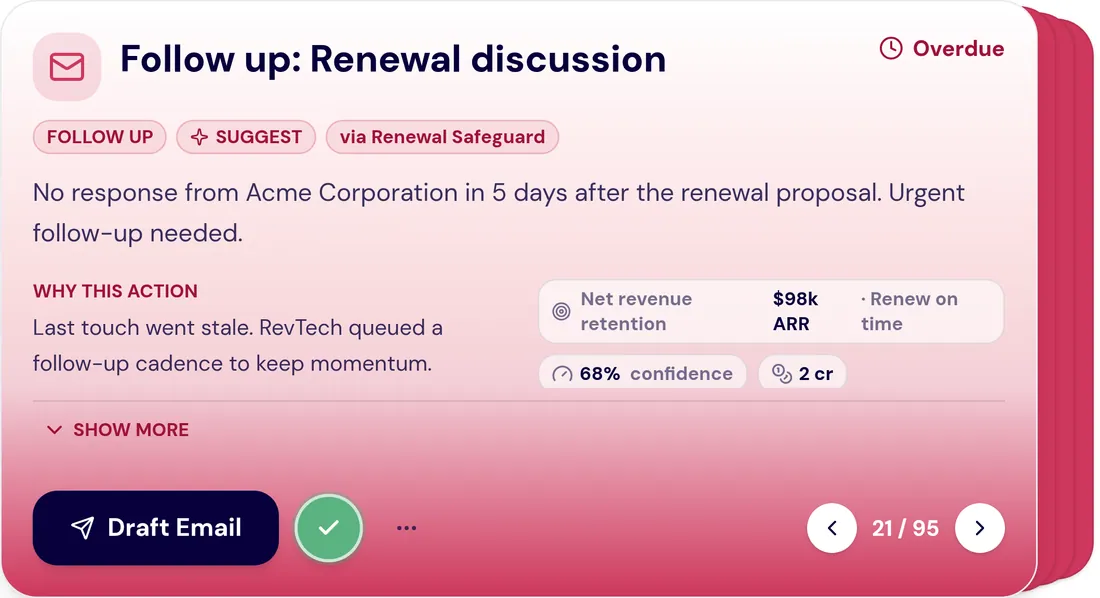
The supporting context assembled for a recommendation, drawn across CRM, engagement and product signals. Screenshot of the RevTech application; sample data. The context attached to an item. A briefing is built from this, rather than from a summary of it. - Step 3 of 4
Log what happened while it is fresh
A past meeting that is still unlogged keeps its card, and resolving it is recording the outcome. The card is the prompt, which is the point: nobody opens the CRM to log a meeting they are no longer thinking about.
- Step 4 of 4
Deal with the one nobody joined
A booked meeting where nobody showed up raises its own item, and it arrives carrying a reschedule note with fresh slots in it. It resolves through the message flow, so the reschedule is a message you read and send rather than a task you write down and forget by Thursday.
What arrives
What this puts in your Action Center
| Item | What is prepared | How it resolves |
|---|---|---|
| Meeting | Prep notes drafted from the account’s CRM context, or the capture flow for one that has already happened | Opens the assistant on a briefing, or logs the outcome |
| MeetingNoShow | A reschedule note carrying fresh slots | The message flow |
Where this is today
Two caveats. Meeting preparation is one of the features that has to be configured for your tenant before it is available; until it is, the surface says so rather than producing a thin briefing. And recording a call or meeting outcome on the card is not available in a production tenant yet — the card opens the record, and the outcome is captured in your CRM. Demo and staging builds keep the on-card capture, so what you saw in a demo is ahead of what you will have on day one.
What to take away
- Prep is a conversation. The first answer is the briefing; the second question is your meeting.
- The unlogged meeting and the upcoming one are the same kind of card on purpose.
- A no-show arrives with the reschedule already drafted. Send it while the slot is still worth offering.
Go deeper
The material behind this
Try the demo.
See agents carry the repeatable work of GTM across sales, marketing, customer success, and RevOps. Every action prepared, reviewed, and recorded. Fictional data, real product.
Explore the demo