Working with AI agents day to day
What actually changes in your week when agents carry the repeatable work, and the one habit that decides whether it sticks.
The work arrives prepared, not done
The first thing people expect from agents is that work disappears. That is not what happens, and expecting it is the fastest route to disappointment. What happens is that work arrives at a different stage: instead of an empty CRM field and a note to yourself, you get a proposed change with the reasoning attached. Instead of an hour of research before a call, you get a brief assembled from the account, the opportunity, the history, and the open questions.
The judgment is still yours. The assembly is not. That division is deliberate and it is the whole operating model. An agent that decided whether to discount would be a liability, and an agent that cannot assemble a meeting brief is not worth running.
Your queue is the interface
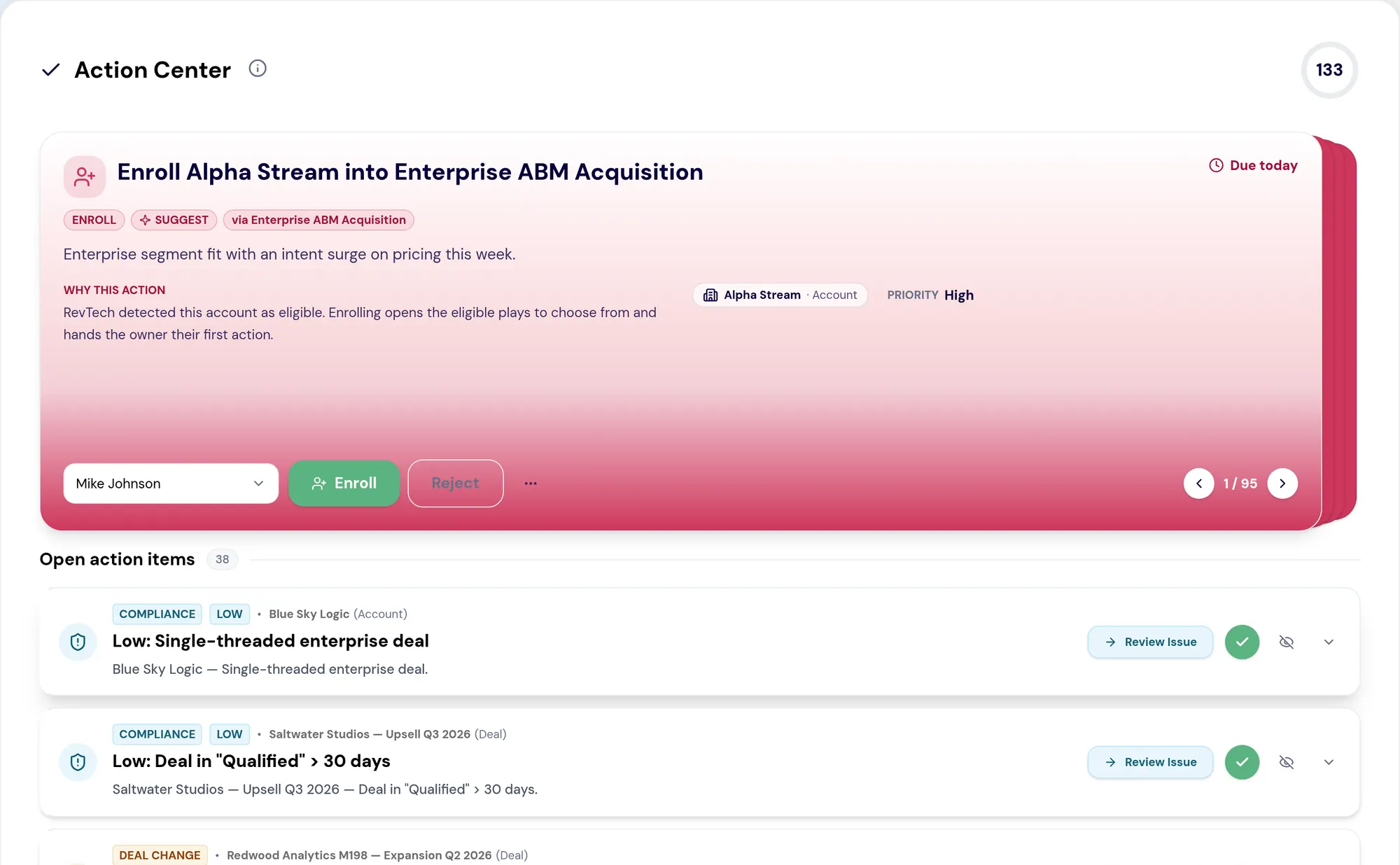
Almost everything an agent produces reaches you the same way: as an item in the Action Center, with a reason it was surfaced, the record it affects, an owner, and controls to approve, edit, or reject it. Learning to work the queue is most of learning to work with agents.
Two habits separate teams who get value from this from teams who do not. The first is working the queue on a rhythm rather than reactively: a pass at the start of the day and one before you finish is enough for most roles. The second is rejecting things properly.
- Approve when the prepared work is right
- Edit when it is close and the correction is faster than an explanation
- Reject when it is wrong, and say why in one line
A rejection is a rule waiting to be written
Rejecting an item without a reason ends the interaction. Rejecting it with one starts a better one. Reasons accumulate, and the patterns in them are what RevOps turns into rules: which severity a condition deserves, which accounts are out of scope, which motions your team does not run.
This is the single highest-leverage habit available to an individual contributor here. It costs a sentence and it changes what the whole team sees next month.
What to expect in the first month
Week one is noisier than week four. Agents start from the rules and context they were given, and the first pass over a real book of business always surfaces things nobody had looked at: stale opportunities, contacts with no owner, deals sitting in a stage past every threshold your process defines.
That backlog is not the steady state. Work it down, keep giving reasons on the rejections, and the queue settles into the ongoing flow of what actually changed. Teams that judge the system on week one are judging the backlog, not the agents.
What to take away
- The work arrives prepared, not done. The assembly is the agent's; the judgment stays yours.
- Work the queue on a rhythm — one pass at the start of the day, one before you finish.
- Reject with a reason. It costs a sentence and it changes what the whole team sees next month.
- Judge the system on week four. Week one is the backlog nobody had looked at.
Put it to work
Jobs this page is behind
- Working the queueKnow what to work first every morning“I want to open one screen in the morning and know what to work first.”
- Working the queueWalk into every meeting prepared“I want to walk into every meeting knowing the account, the people and the history.”
- Working the queueUpdate the CRM by talking to it“I want to get what I know into the CRM without opening six fields after every call.”
Try the demo.
See agents carry the repeatable work of GTM across sales, marketing, customer success, and RevOps. Every action prepared, reviewed, and recorded. Fictional data, real product.
Explore the demo