Writing rules agents can actually enforce
A rule that reads well in a slide is not a rule an agent can apply. How to write standards that survive contact with real records.
Most process documents are not rules
"Keep opportunities current" is a value. "An opportunity in Qualified for more than 30 days without a logged activity is out of compliance" is a rule. The difference is that the second one can be evaluated against a record without a human interpreting it, which is the bar an agent has to clear.
Writing at that bar is uncomfortable at first, because it forces decisions the prose version let you avoid. Thirty days or forty-five? Does a logged email count as activity, or only a meeting? Does this apply to renewals? Every one of those questions was already being answered inconsistently by individual reps. The rule just makes the answer visible.
The four parts of a usable rule
A rule RevTech can enforce needs the same four parts every time. Miss one and the agent either cannot evaluate it or cannot act on the result.
- The object it applies to — account, opportunity, contact, or lead
- The condition, in terms of fields and thresholds rather than intent
- A severity, which decides how loudly a breach surfaces and to whom
- The owner notified when it breaches, by role rather than by name
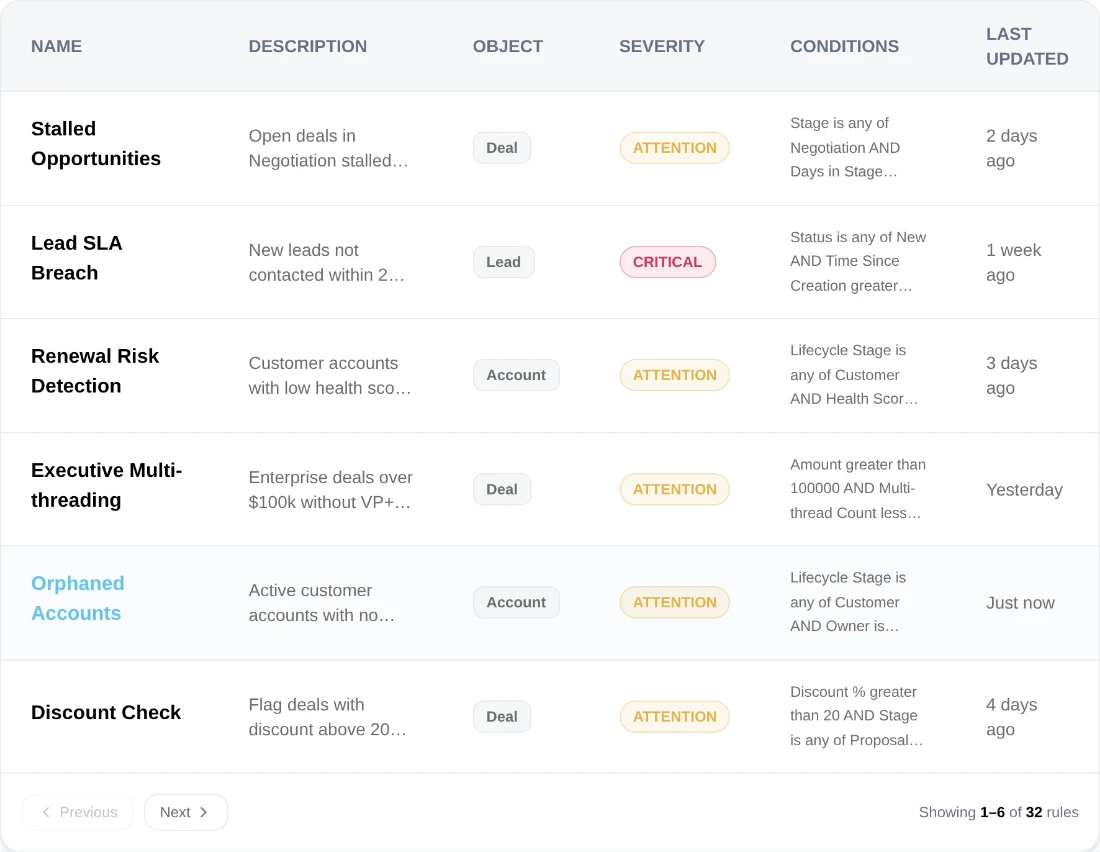
Severity is a budget, not a label
Every rule marked critical competes with every other rule marked critical for the same limited attention. Teams that mark everything critical get a queue nobody works, which is functionally the same as having no rules at all.
A useful discipline: decide how many critical breaches your team can genuinely act on in a week, and let that number cap how many rules carry that severity. Everything else is medium or low, surfaces as routine work, and gets cleared on a rhythm rather than an alarm.
Write it, run it, then tune it
No rule survives its first week unchanged, and it should not have to. Publish it, watch what it catches, and read the rejections. A rule that generates a hundred breaches on day one is either finding a real backlog or is written wrong, and the reasons on the rejections will tell you which within a day.
Tune the threshold rather than deleting the rule. The instinct when a rule is noisy is to remove it; the usual fix is that thirty days should have been sixty for enterprise deals, and the rule is fine everywhere else.
What to take away
- A value is not a rule. A rule can be evaluated against a record without a human interpreting it.
- Every usable rule has four parts: object, condition, severity, owner.
- Severity is a budget. Decide how many critical breaches a week your team can actually act on.
- Tune the threshold rather than deleting the rule.
Put it to work
Jobs this page is behind
- Working the queueHand work to the right person“I want to get an item to whoever should actually own it, without it disappearing.”
- SellingCatch a deal before it slips“I want to hear that a deal is in trouble while there is still time to do something.”
- SellingStop chasing reps for the same three fields“I want to get the process followed without personally chasing anybody.”
Try the demo.
See agents carry the repeatable work of GTM across sales, marketing, customer success, and RevOps. Every action prepared, reviewed, and recorded. Fictional data, real product.
Explore the demo