Pipeline hygiene as a system, not a campaign
Why quarterly clean-up efforts always fail, and what replaces them once inspection runs continuously.
Product walkthrough
See it in RevTech
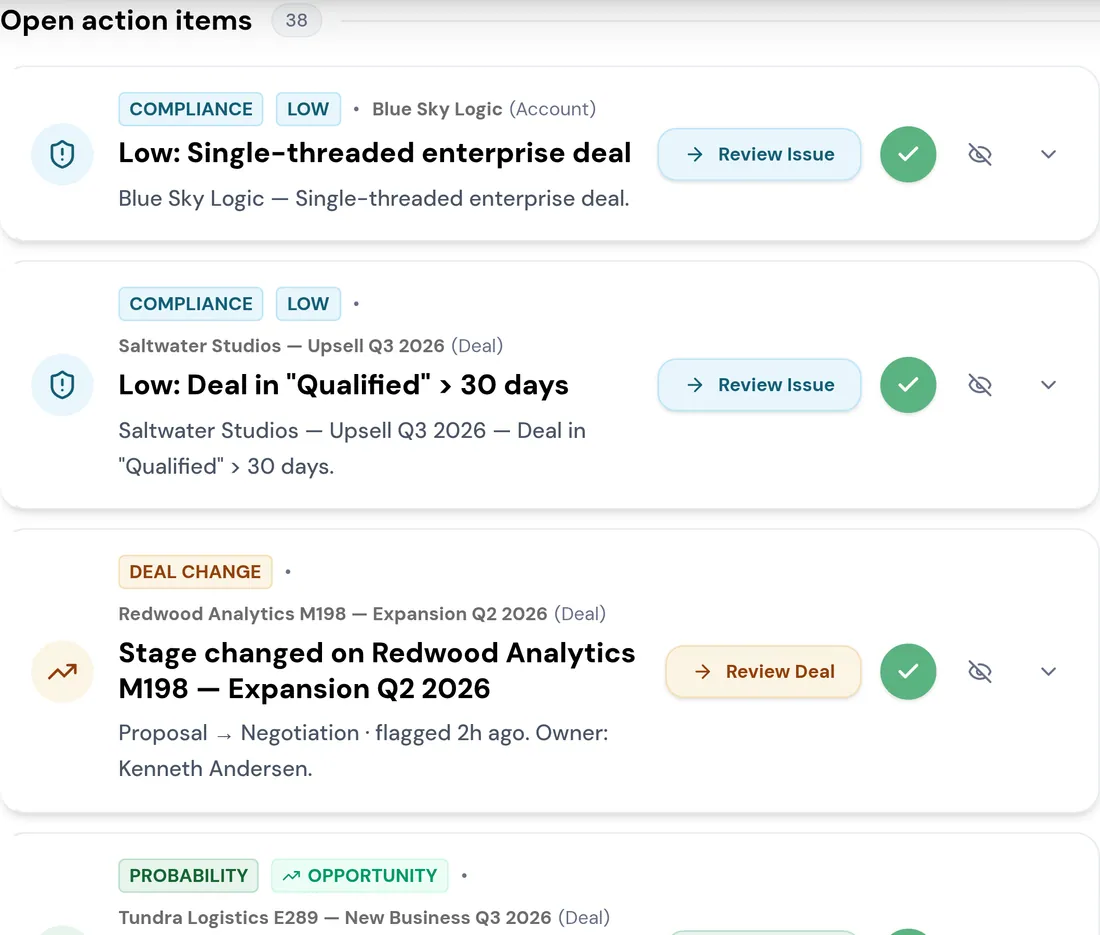
See agents identify stale or incomplete pipeline data, prepare the correction, and route it through the right human control.
The clean-up cycle
Most organizations run pipeline hygiene as a campaign. Someone notices the forecast is unreliable, a clean-up is announced, reps spend a Friday updating close dates, and the data is briefly excellent. Six weeks later it is exactly as bad as before, because nothing about the daily incentive changed. The work of keeping a record current still lands on the person with the least time and the least reason to care.
The campaign model cannot win. It is asking people to do maintenance work at the moment they are furthest from the context that would make it quick.
What continuous inspection changes
When inspection runs continuously, drift surfaces while it is small and while the context is still fresh. A close date that slipped past the current quarter gets flagged the day it slips, to the person who was in the meeting, with the deal in front of them. That is a thirty-second correction rather than a Friday afternoon.
The volume also changes shape. Instead of one enormous backlog four times a year, there is a steady trickle that the team clears as part of working the queue.
Start with the fields decisions rest on
Not every field deserves a rule. The ones worth enforcing are the ones a decision depends on: stage, close date, amount, next step, and owner. Get those right and forecasting improves immediately. Enforce every field on the object and you will teach your team that the queue is noise.
- Stage, because it drives every downstream probability
- Close date, because a slipped date nobody moved is a forecast miss already
- Amount, because pipeline coverage is meaningless without it
- Next step, because its absence is the earliest signal a deal has stalled
- Owner, because an unowned record is the one nobody fixes whatever else you enforce
Measure the backlog, not the breaches
A rising breach count is not a failure — it usually means a new rule found real debt. The number worth watching is the open backlog: whether the team is clearing breaches faster than they appear. A flat or falling backlog means the system is working, whatever the raw breach count looks like.
What to take away
- Clean-up campaigns cannot win. They ask for maintenance at the moment people are furthest from the context.
- Enforce the fields decisions rest on: stage, close date, amount, next step, owner.
- Watch the open backlog, not the breach count. A rising count usually means a new rule found real debt.
Put it to work
Jobs this page is behind
Try the demo.
See agents carry the repeatable work of GTM across sales, marketing, customer success, and RevOps. Every action prepared, reviewed, and recorded. Fictional data, real product.
Explore the demo