How approvals work
The path a prepared change takes from an agent to your CRM, and every point a person can stop it.
Product walkthrough
See it in RevTech
A walkthrough of the approval path: an agent prepares a change, routing sends it to a reviewer, and the CRM is written only after a person releases it.
The path a change takes
Nothing an agent prepares reaches your CRM without passing a person. The walkthrough follows one change the whole way: an agent assembles it with its reasoning, routing decides who reviews it based on the object and the severity, the reviewer approves, edits, or rejects, and only then is anything written back.
The recording also covers what happens when nobody acts. Items do not expire silently or apply themselves after a timeout. An unreviewed change stays unreviewed, which is the conservative failure mode and the correct one.
What is recorded today, and what is staged
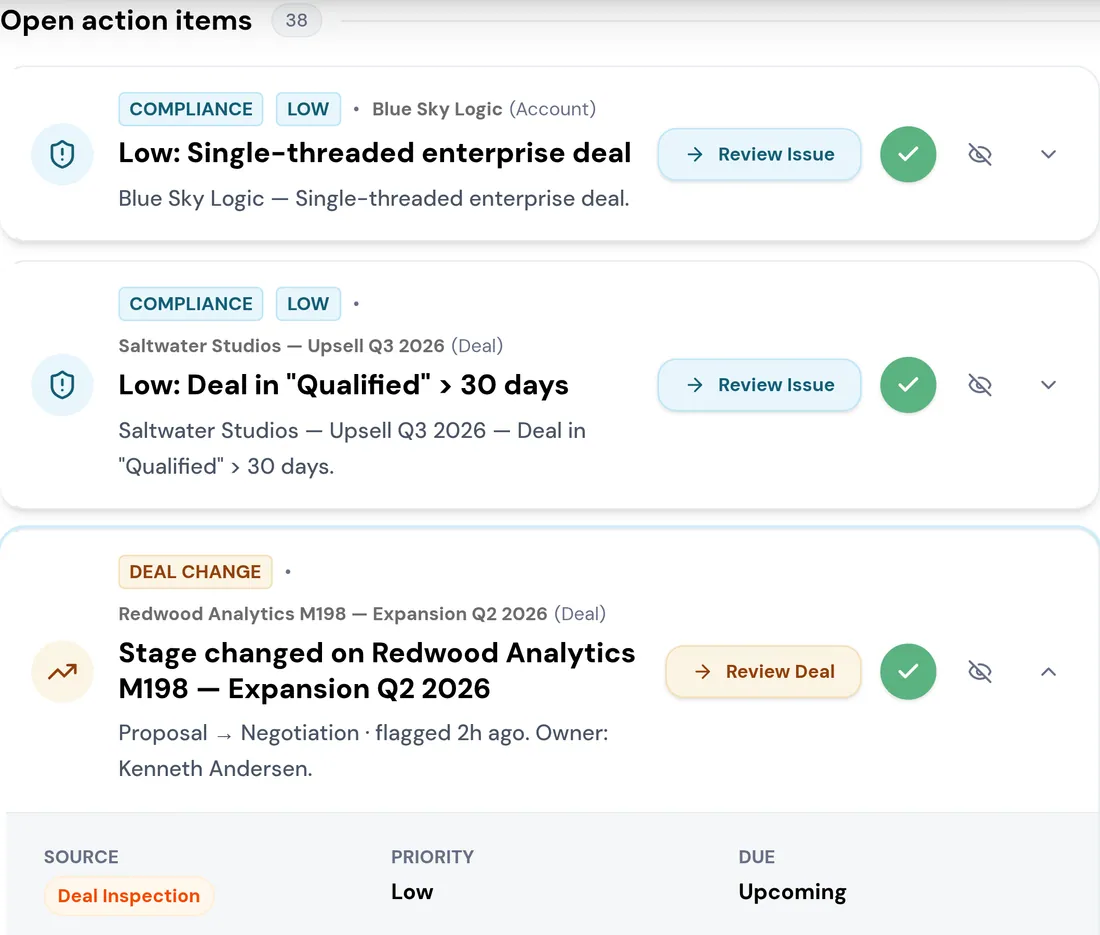
A governance page that overstates what the platform enforces is worse than no page at all, so this is the honest boundary as it stands. Three resolutions are durable in a production tenant: mark the work complete, ignore it with a reason, or escalate it to a named teammate. Those are the decisions that persist, and they are what an audit trail is built from.
A fourth kind of decision is staged. Sign-off on a drafted campaign, on a new version of a play, and on a new analyst question arrives as a Review only item: the card, its evidence and its related records are all there to read, ignore and escalate still work, and there is deliberately no complete button on them, so that having read one can never be mistaken for having approved it. Demo and staging environments simulate the decision so the flow can be reviewed before it ships; a production tenant does not, and it does not pretend to.
Two controls are absent rather than disabled for the same reason. RevTech does not set the owner of a record — a note on the card names the connected CRM, whose owner field the sync reads back — and the outcome of a call or a meeting is captured in the CRM rather than on the card.
- Durable today: complete, ignore with a reason, escalate
- Staged: campaign sign-off, play publish sign-off, new analyst question sign-off — all rendered as Review only
- Absent by design: setting a record owner, capturing a call or meeting outcome on the card
- The one place a person releases a change into the CRM directly is the assistant, where a dictated or typed update comes back as an editable proposal with an Apply button
Who reviews what
Routing is configuration, not a default you inherit. Severity, object type, and team ownership all feed it, and RevOps sets the mapping.
- Low and medium severity typically routes to the record owner
- Critical items route to a manager or RevOps
- Anything customer-facing routes to a person regardless of severity
What to take away
- Nothing reaches your CRM without passing a person.
- An unreviewed item stays unreviewed. Nothing applies itself on a timeout.
- Routing is configuration you set, not a default you inherit.
- Three resolutions are recorded today: complete, ignore with a reason, escalate. Sign-off on a campaign, a play version or a new analyst question is staged, and the card says so rather than pretending.
Put it to work
Jobs this page is behind
Try the demo.
See agents carry the repeatable work of GTM across sales, marketing, customer success, and RevOps. Every action prepared, reviewed, and recorded. Fictional data, real product.
Explore the demo