Find expansion before the customer asks
A health climb arrives with the whitespace sized and the plays shortlisted. Turning a repeating signal into an owned motion.
The job
“I want to find the expansion conversations that are ready, rather than waiting to be asked.”
- Customer success managers
- Account managers
- CS leaders
Expansion is the cheapest pipeline in the business and the least systematically worked. It arrives as an inbound request, which feels like success and is actually a reporting problem: the expansions you can see are the ones the customer initiated, and the ones you missed are invisible by construction.
The signals that precede a real expansion conversation are also easy to confuse with the signals that somebody likes you. Enthusiasm is not readiness. Usage crossing a threshold, a new team appearing, a role being hired that your product serves — those are readiness.
What it moves
- Expansion signal conversion
- Net revenue retention
- Pipeline created
The division of labour
What RevTech does, and where you decide
In the product
How to do it
- Step 1 of 4
Take the health-improved card as a prompt
When health climbs and the account becomes expansion-ready, the card arrives with the whitespace sized and a shortlist of plays it qualifies for. Its primary action is enrolling in an expansion play rather than opening the account, which is the right default: the conversation benefits from a motion behind it.
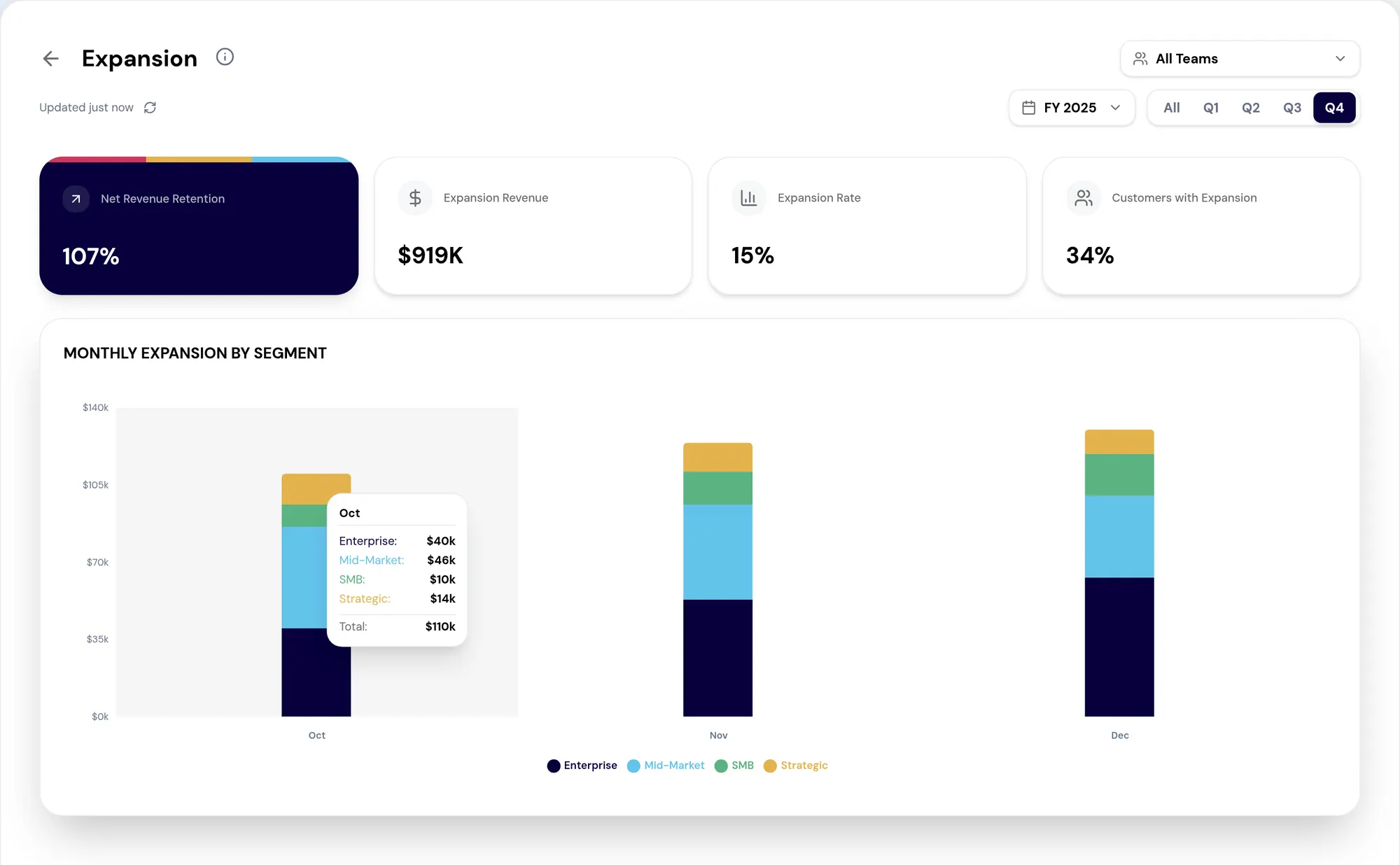
The Expansion view: net revenue retention and expansion broken down by segment, showing where growth inside the existing customer base is coming from. Screenshot of the RevTech application; sample data. Expansion across the book, by segment. The read that tells you where the motion is working. - Step 2 of 4
Use the account map to find the gap
Coverage is the precondition for expansion rather than an afterthought. A relationship that runs through one team cannot expand into another, and the map is where you see that before you build a business case that depends on a door you cannot open.
- Step 3 of 4
Separate readiness from goodwill
The distinction worth being disciplined about: a happy customer is not an expanding customer. Look for a change in their situation — a new team, a threshold crossed, a person hired — rather than a change in their tone.
- Step 4 of 4
Turn the repeating signal into a play with an owner
When the same expansion signal has produced three conversations, it should stop being individual initiative and become a motion. A play whose eligibility is that signal runs it every time, with a named owner and timed steps, rather than depending on whoever happened to notice.
What arrives
What this puts in your Action Center
| Item | What is prepared | How it resolves |
|---|---|---|
| HealthImproved | Sized whitespace and a shortlist of qualifying plays | Enrol in an expansion play |
| EnrollmentRecommendation | The eligibility explanation and a recommended owner | Enrol, or reject — which records a sixty-day cooldown |
| NewContactDiscovered | A person in the buying group who is not on the account yet | The account, on its Mapping tab |
What to take away
- The expansions you can see are the ones the customer asked for. The missed ones are invisible by construction.
- Readiness is a change in their situation. Goodwill is a change in their tone.
- Coverage is the precondition. A relationship in one team cannot expand into another.
- A signal that has produced three conversations should be a play, not individual initiative.
Go deeper
The material behind this
Try the demo.
See agents carry the repeatable work of GTM across sales, marketing, customer success, and RevOps. Every action prepared, reviewed, and recorded. Fictional data, real product.
Explore the demo