Slide 1 of 4
Satisfaction is not readiness
A happy customer is a precondition, not a signal. Readiness is evidence of a need the current footprint does not meet.
Recognize the evidence that an account is ready for an expansion conversation, and tell it apart from evidence that they merely like you.
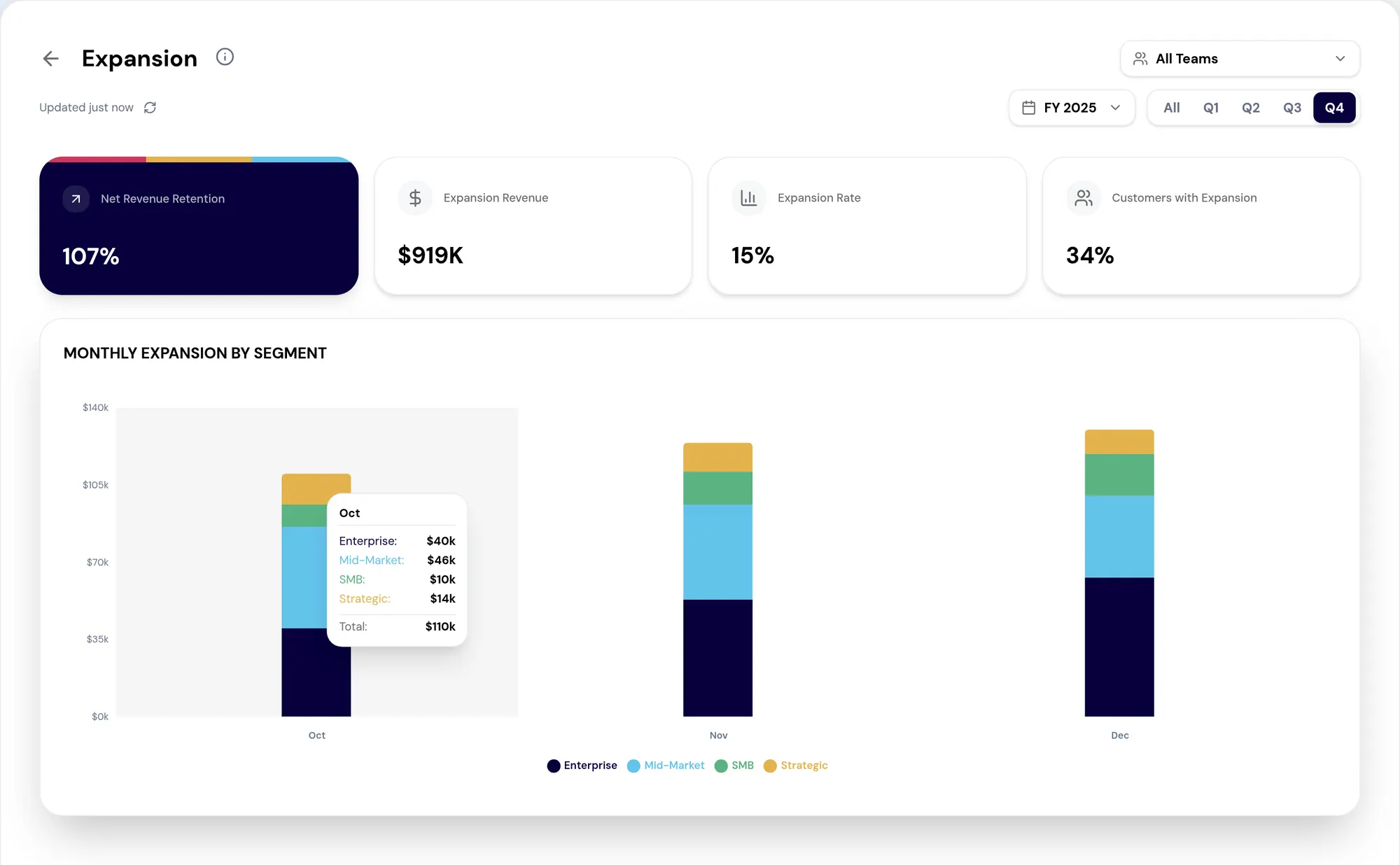
Two surfaces carry the evidence this lesson is about. The signals view on the account record holds intent, engagement, ICP coverage and activity volume over the year, which is the observable record of what the account is doing. And the Expansion tab of Customers holds the aggregate: Net Revenue Retention as the headline, with Expansion Revenue, Expansion Rate and Customers with Expansion beside it, and monthly expansion stacked by segment below.
The discipline of this lesson is to work from those two surfaces rather than from relationship warmth, and to know the difference between the two kinds of signal they show you.
The most common way expansion conversations go wrong is that they are triggered by satisfaction. A customer is pleased, the relationship is warm, and someone concludes there is an expansion opportunity. Satisfaction is a precondition (it is very hard to expand an unhappy account) but it carries no information about whether there is anything to expand into.
Readiness is different in kind: it is evidence of a need the current footprint does not meet. That evidence is usually observable rather than inferred, which is what makes it worth going and looking for rather than waiting to sense.
Four patterns show up repeatedly, and all four are visible on the account rather than dependent on a conversation. The last is the strongest, because the customer has already articulated the gap themselves.
Read them alongside the account map and you have both halves of the question: whether there is a need, and whether anyone exists who could sponsor addressing it.
One reading on the Expansion surface is worth building a habit around, because it is a risk that presents itself as good news. Expansion revenue and expansion rate quantify the motion; the number of customers with expansion is the long-tail signal. When customers-with-expansion lags expansion revenue, one or two large accounts are carrying the segment.
That is concentration risk in growth clothing. The segment looks healthy in the headline and depends on a small number of accounts continuing to grow, and if one of them is also a renewal risk, the exposure is doubled and nobody has said so out loud. Check the two figures together whenever you report expansion, and say which one you are relying on.
Put side by side, the two are easy to separate, and it is worth doing once so the distinction becomes automatic.
Satisfaction sounds like: the champion replies quickly, the QBR went well, the team says they are happy, NPS came back strong. Every one of those is about how the relationship feels, and none of them says anything about whether there is unmet need.
Readiness sounds like the four patterns above — and every one of them describes a gap between what the account has and what it needs, rather than how the relationship feels.
The practical consequence is about where you spend prospecting time. A book sorted by satisfaction puts your warmest relationships at the top, which is comfortable and produces conversations that go nowhere because there is nothing to sell. A book sorted by readiness puts accounts with a demonstrable gap at the top, some of which you have a mediocre relationship with, and that is the harder list and the one that converts.
You should be able to answer each of these from memory before opening it. Recalling the answer is what makes it stick; recognizing it when you read it does not.
Satisfaction is a precondition, since it is hard to expand an unhappy account, but it carries no information about whether there is anything to expand into. Readiness is evidence of a need the current footprint does not meet.
A stated goal the current subscription cannot reach. The customer has already articulated the gap, so the conversation starts from their words rather than your inference.
Concentration risk presenting as growth. One or two large accounts are carrying the segment, and if one is also a renewal risk the exposure is doubled and unstated.
A happy customer is a precondition, not a signal. Readiness is evidence of a need the current footprint does not meet.
Which is exactly why it should be worked from evidence rather than from whoever the CSM enjoys talking to.
When expansion revenue outruns the number of customers expanding, one or two accounts are carrying the segment. That is a risk wearing a growth number.
See agents carry the repeatable work of GTM across sales, marketing, customer success, and RevOps. Every action prepared, reviewed, and recorded. Fictional data, real product.
Explore the demo