Slide 1 of 4
Open on the gap, not the forecast
Gap to Target says how far the quarter is from target and what is still open to close it. Start there and every other number on the call has a job.
Run the forecast call from Gap to Target, the Forecast report and its Forecast by rep table, and end it with a committed number and a plan for the gap.
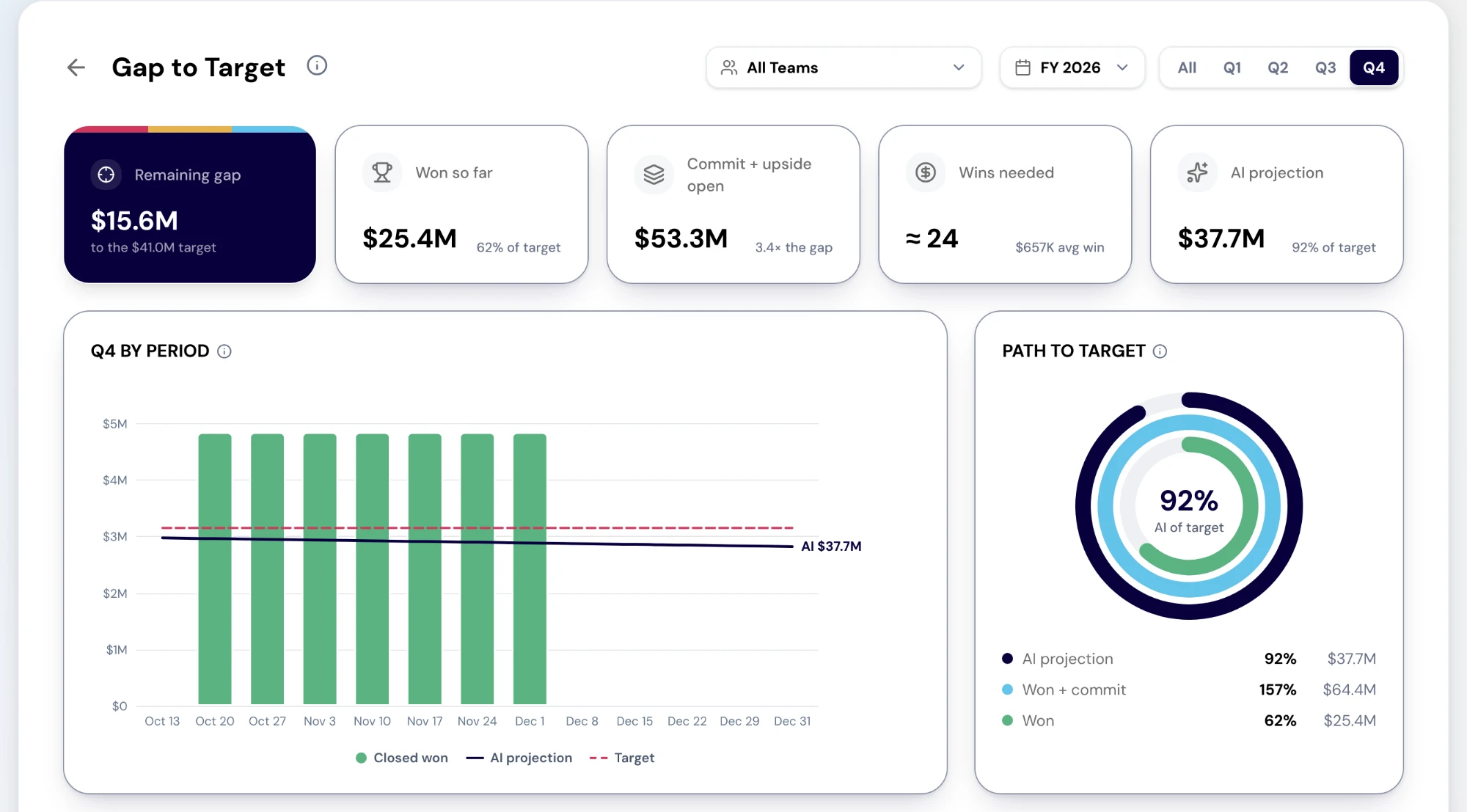
A forecast call that opens on the forecast spends its first twenty minutes on what everyone already believes. Open on Gap to Target instead. Its cards are Remaining gap, Won so far, Commit + upside open, Wins needed and AI projection, so the first thing on screen is the size of the problem and the pipeline available to solve it.
Below the cards, the period chart shows closed won and the AI projection against target, with today marked. Path to target shows how much of the target is won, won plus open Commit, and what the AI projects. How the gap closes draws the target as one bar, with closed won, open Commit and upside stacked against it and the gap nothing covers yet left visible. The per-rep table shows each rep's target, won, gap, and open pipeline as a multiple of their gap.
Two cautions. Wins needed is the remaining gap divided by the average won deal, so it is arithmetic, not a forecast. And the report does not tell you how many new deals you would need to create; that needs a close probability the platform does not serve yet.
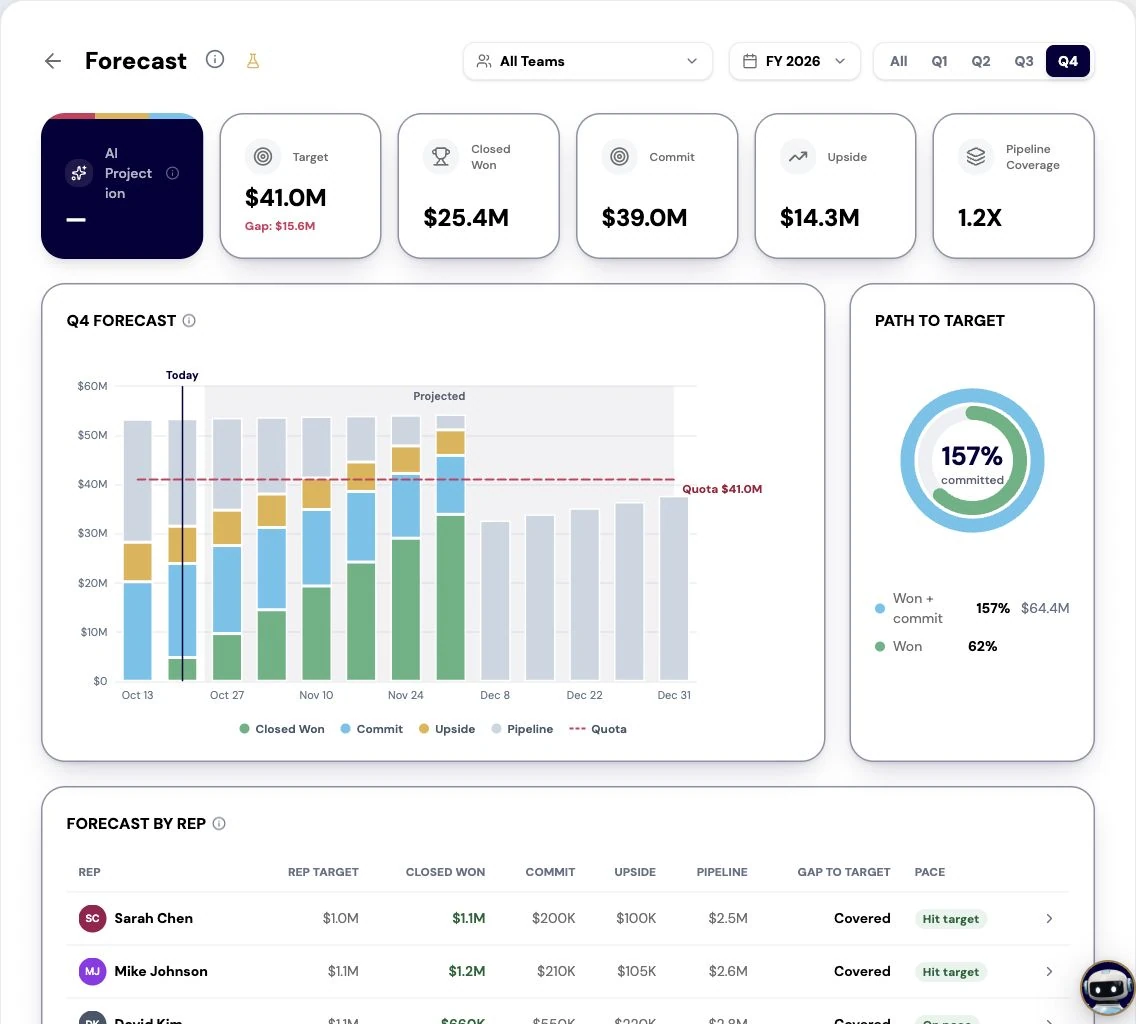
The Forecast report carries the projection. Its cards are AI Projection, Target with the gap beside it, Closed Won, Commit, Upside and Pipeline Coverage. The weekly chart marks today, Path to target repeats the rings, and Forecast by rep is the table the call is run from: each rep's target, Closed Won, Commit, Upside, Pipeline, gap to target and a pace badge of Hit target, On pace, Stretch or At risk.
Work the table from the At risk rows up. For each one, the question is not whether the rep feels good about the quarter, it is which open deals close the gap and what is in their way. Monday's list answers half of that already: a deal that moved out of Commit or picked up a Deal Risk flag is named on this call. Open a rep to see their performance page when the row is not enough.
The call ends on a committed number and a plan for whatever gap remains. The plan is specific: these deals pulled forward with these next steps, these accounts enrolled in a play that runs the close motion, or, if the open pipeline cannot cover the gap however well it is worked, a target conversation now rather than in the last week of the quarter.
Write down what changed since last week's call and why. The Weekly Change Log already holds the deal-level movement; the call adds the judgment about it, and that is what next week's call reads back.
Do this in the product
You should be able to answer each of these from memory before opening it. Recalling the answer is what makes it stick; recognizing it when you read it does not.
Because it puts the size of the problem and the open pipeline available to close it on screen first, so every later number has a job. Opening on the forecast spends the call on what everyone already believes.
The remaining gap divided by the average won deal. It gives the scale of the problem, and it is only as good as the average it divides by. It is not a forecast of how many deals will close.
Gap to Target says how far the quarter is from target and what is still open to close it. Start there and every other number on the call has a job.
It is the remaining gap divided by your average won deal. Useful for scale, and no more precise than the average it divides by.
A committed number, and for the gap that remains, a named plan: which deals get pulled forward, which get a play, or whether the target conversation has to happen now.
Explore how agents prepare work across your revenue teams, and how people review it, guide it and decide what happens next. Fictional data. Real product.
Explore the demo