End the forecast call with the gap owned
Forecast answers one question. Three reports, read in the order the call should go, and a meeting that ends in commitments.
The job
“I want to run a forecast call that ends with somebody owning the gap.”
- Sales leaders
- Sales managers
- RevOps
- Finance
A forecast call has exactly one job: to establish whether the number will be hit, and if not, what is being done about it. The failure mode is a meeting that produces a shared understanding of the number and no shared understanding of who is doing what, which feels productive and changes nothing.
Most of that comes from spending the hour building the picture rather than acting on it. When the projection, the coverage and the renewal book are all current before anybody joins, the meeting can start at the only question that matters.
What it moves
- Forecast variance
- Pipeline coverage quality
- Slipped pipeline
The division of labour
What RevTech does, and where you decide
In the product
How to do it
- Step 1 of 4
Set the scope before you read anything
Team, fiscal year and quarter sit in the report header and travel in the URL. Settling the scope first is not pedantry: most disagreements in a forecast call turn out to be two people looking at different periods.
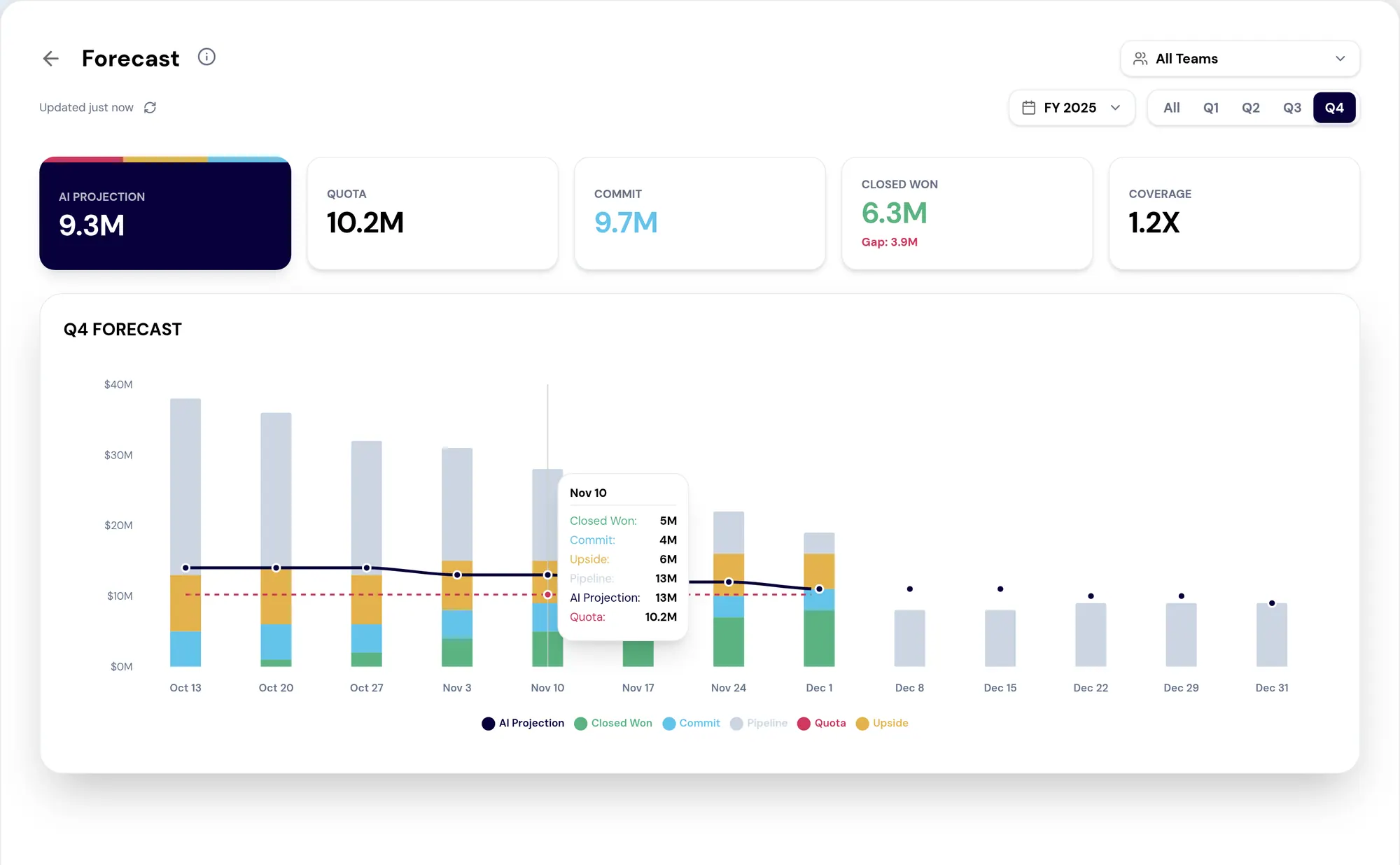
The forecast view: commit, upside and pipeline coverage measured against quota for the period. Screenshot of the RevTech application; sample data. The Forecast report. Scope lives in the header and travels in the link you share. - Step 2 of 4
Read the projection, then the coverage
Forecast gives you the projection and rep-level attainment underneath it. Pipeline Coverage weighs open pipeline against the forecast and the quota, deal by deal, which is what turns "we are short" into "we are short and here is whether there is enough pipeline to fix it".
- Step 3 of 4
Put renewals in the same call
The renewal book is part of the number, and a forecast call that omits it is forecasting half the business. The Renewals report tracks the book by period and drills into the deals up for renewal.
- Step 4 of 4
End on deals with names against them
Every report here drills to deals. The call should finish in that list, with specific deals owned by specific people, because a forecast call that ends at the rollup has produced a shared feeling rather than a plan.
What arrives
What this puts in your Action Center
| Item | What is prepared | How it resolves |
|---|---|---|
| ForecastCategoryChange | The recomputed rollup impact of a deal moving between Commit and Upside | The deal, on its Journey tab |
| ForecastChange | The recomputed rollup, and which deals moved it | That specific report |
What to take away
- Settle scope first. Half the disagreements in a forecast call are two periods.
- Projection, then coverage, then renewals. Coverage is what makes a gap actionable.
- The call ends in the deal list, with names against deals.
Go deeper
The material behind this
Try the demo.
See agents carry the repeatable work of GTM across sales, marketing, customer success, and RevOps. Every action prepared, reviewed, and recorded. Fictional data, real product.
Explore the demo