Answer who changed this, and on what evidence
Six places carry the record: run details, artifact versions, the record journey, play impact, lead revisions and the assistant’s own history.
The job
“I want to reconstruct what happened and why, when somebody asks.”
- RevOps
- IT
- Compliance
- Finance
The question arrives eventually and it always arrives under pressure: who changed this record, what was it before, and on what basis. An organisation that cannot answer it quickly will answer it slowly, in a meeting, from memory, which is the answer nobody wants to give.
Auditability is also the thing that makes the rest of this governable at all. Permissions decide what can happen; the trail is what lets you check what did. Without it, every assurance about agent behaviour is a promise rather than a finding.
What it moves
- Agent action auditability
- Audit readiness
- Time to answer a governance question
The division of labour
What RevTech does, and where you decide
In the product
How to do it
- Step 1 of 4
Start from the object, not from a log
There is no single audit page, and that is deliberate: the record of what happened lives next to the thing it happened to. Knowing which surface answers which question is the whole skill here.
- What a run did and what it cost — credit usage, run detail
- What an agent was told at the time — the artifact’s version history
- What happened to a record and in what order — its Journey tab
- Whether a motion produced anything — the play’s impact report
- How a lead was enriched and scored — its processed-lead revisions
- What the assistant proposed and what a person released — the assistant’s history
- Step 2 of 4
Use the rule evidence for a flagged record
When a record was flagged by a process rule, the finding carries the rule, the condition it matched and the author’s own wording for it. That is a more useful answer than "the system flagged it", and it points at a person who can change the rule.
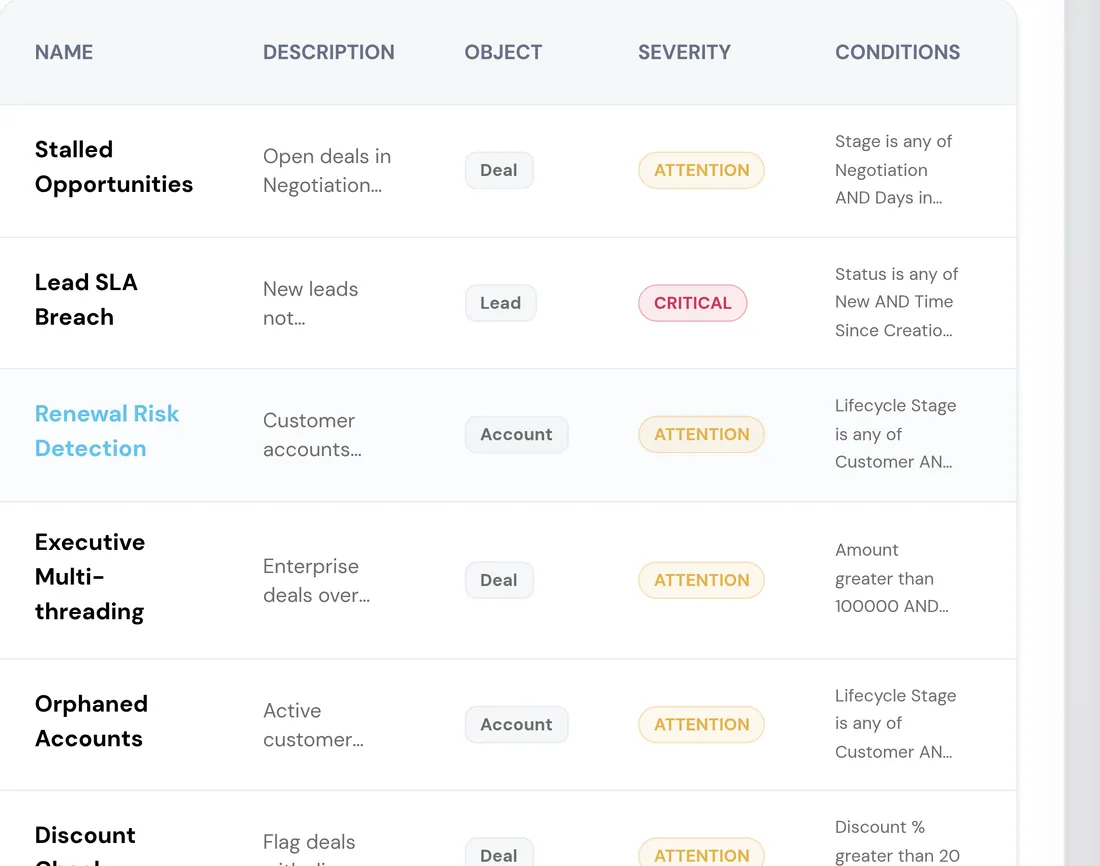
One rule opened in detail: the conditions that constitute a breach, its severity, the predicted deal impact and the roles notified. Screenshot of the RevTech application; sample data. A finding with the rule and the matched condition attached. - Step 3 of 4
Check an analyst number properly before repeating it
An analyst answer carries its evidence and the time the source snapshot was collected. Three things to check: that the question is the one you think it is, that the evidence supports the conclusion rather than merely accompanying it, and that the snapshot is recent enough for the decision.
- Step 4 of 4
Remember what is not written down yet
Sign-off on a campaign, a play version or a new analyst question is not recorded by the platform yet, so those decisions have to be evidenced wherever your organisation records them. Knowing that in advance is better than discovering it during an audit.
What arrives
What this puts in your Action Center
| Item | What is prepared | How it resolves |
|---|---|---|
| Compliance | The issue, the rule that matched and a suggested fix | The flagged record |
| AnalystQuestionUpdate | The re-run analysis with the delta highlighted | That question’s refreshed answer |
Where this is today
Approval decisions on campaigns, play versions and new analyst questions are not recorded by the platform yet; those arrive as Review only. Everything else described here — run details, artifact versions, record journeys, lead revisions and the assistant’s history — is available in a production tenant.
What to take away
- There is no single audit page. The record lives next to the thing it happened to.
- A rule finding names the rule and its author’s wording, which points at somebody who can change it.
- Check the question, the evidence and the snapshot date before repeating a number.
- Sign-off decisions are not written down yet. Record them where your organisation does.
Go deeper
The material behind this
Try the demo.
See agents carry the repeatable work of GTM across sales, marketing, customer success, and RevOps. Every action prepared, reviewed, and recorded. Fictional data, real product.
Explore the demo