Never be surprised by the bill
Credits by run, team and workflow; warnings at three thresholds; and the approval dialog that prices a job before it runs.
The job
“I want to know what agent work costs us and keep it predictable.”
- Administrators
- Finance
- RevOps
Consumption pricing fails in organisations when the consumption is invisible to the people creating it. The person who launches a large generation job is rarely the person who sees the balance, and by the time those two facts meet each other the money is spent.
What makes it manageable is that the cost is attributable — by run, by team, by workflow — and that the largest single expenditures are priced in advance and require somebody to accept the number.
What it moves
- Cost per unit of work
- Credit consumption predictability
The division of labour
What RevTech does, and where you decide
In the product
How to do it
- Step 1 of 4
Read usage by workflow, not just by total
Credit usage breaks down by run, by team and by workflow, with run-level detail showing what each run actually did. The total tells you very little; the workflow breakdown tells you which motion is expensive relative to what it produces.
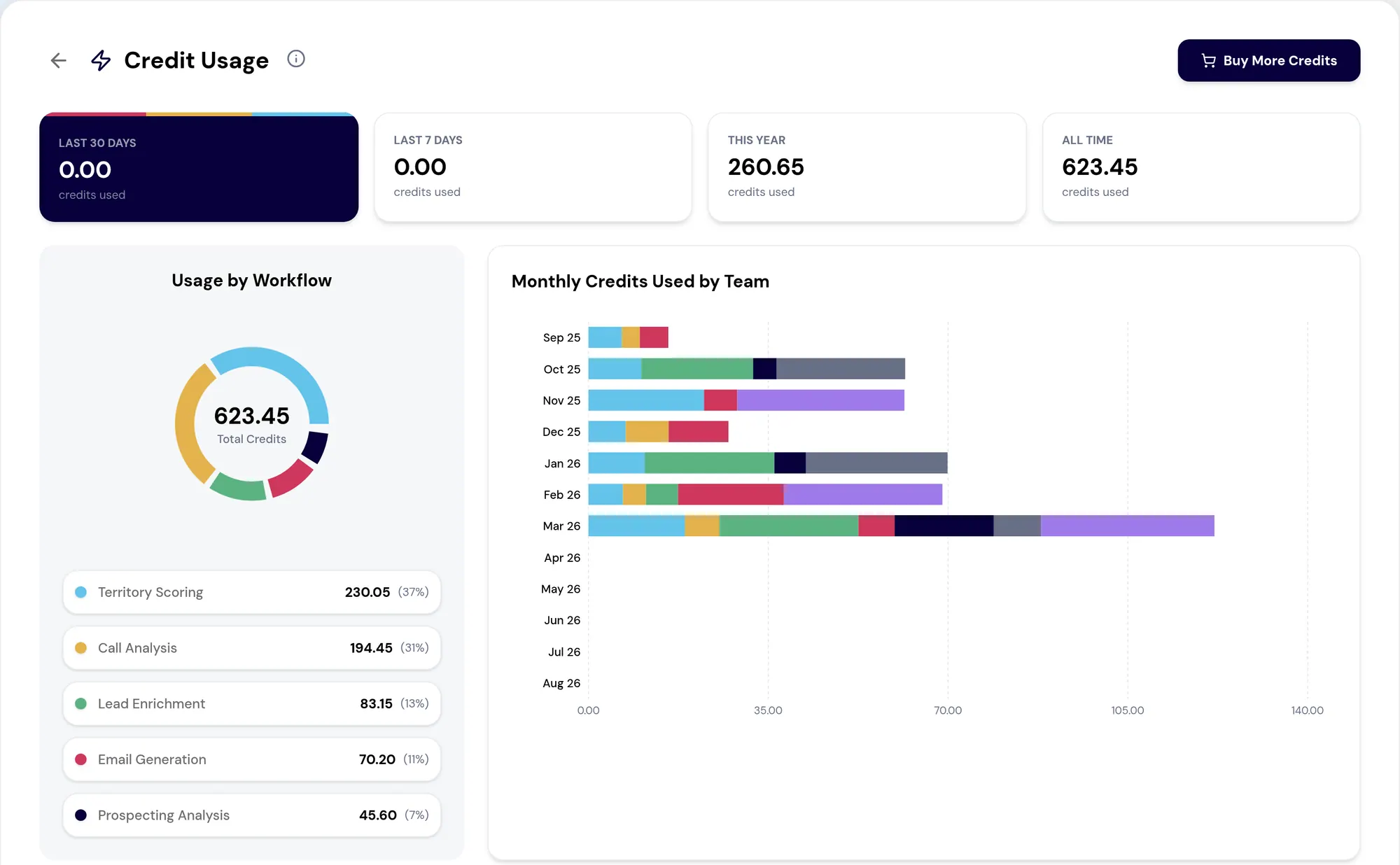
Credit usage broken down by workflow, team and individual run, giving agentic work the same cost visibility as any other system. Screenshot of the RevTech application; sample data. Consumption by workflow over time. The denominator for any honest cost conversation. - Step 2 of 4
Know the thresholds before you meet them
Warnings arrive as consumption crosses eighty, ninety and one hundred per cent of the balance, and service suspends at a hundred and five. The warnings exist so the suspension never arrives as a surprise, and the correct response to the first one is a conversation rather than a purchase.
- Step 3 of 4
Treat the generation approval as the control it is
The largest discretionary spends are campaign generations, and they are priced by the server before they run: what is included, how many account plans will also be generated, the total, and the balance it will draw on. Approving accepts that amount. Where the balance is short, the dialog says so and generates nothing.
- Step 4 of 4
Attribute cost to the team that created it
The by-team breakdown is what turns a central budget problem into a conversation with the people making the decisions. A marketing team that can see its own consumption against what it produced will manage it; one that cannot, will not.
What to take away
- The total is not the number. Cost per unit of work, by workflow, is.
- Eighty, ninety, one hundred, suspension at a hundred and five. The warnings exist to make the last one impossible.
- A generation job is priced before it runs, and approving accepts that exact amount.
- Attribute by team, or the people creating the cost never see it.
Go deeper
The material behind this
Try the demo.
See agents carry the repeatable work of GTM across sales, marketing, customer success, and RevOps. Every action prepared, reviewed, and recorded. Fictional data, real product.
Explore the demo