Planning the revenue year
Bookings, recognized revenue and the ARR bridge — pressure-testing a plan before you commit to it, and keeping it alive after you do.
Product walkthrough
See it in RevTech
See company goals connect to team and individual targets, with progress kept live as the business changes.
A place to pressure-test, not to execute
Planning is where a number becomes a defensible plan. Everything on these pages is non-destructive: it never changes pipeline, never writes to a deal, never moves a target. That is the property that makes it useful: you can model an uncomfortable scenario in a room full of people without anyone worrying about what it breaks.
It is three reports, each on its own page, and they are not interchangeable. Bookings is what is coming in. Revenue is what gets recognized. Recurring is the ARR story. Different audiences care about each, which is the main reason teams talk past each other about "the plan".
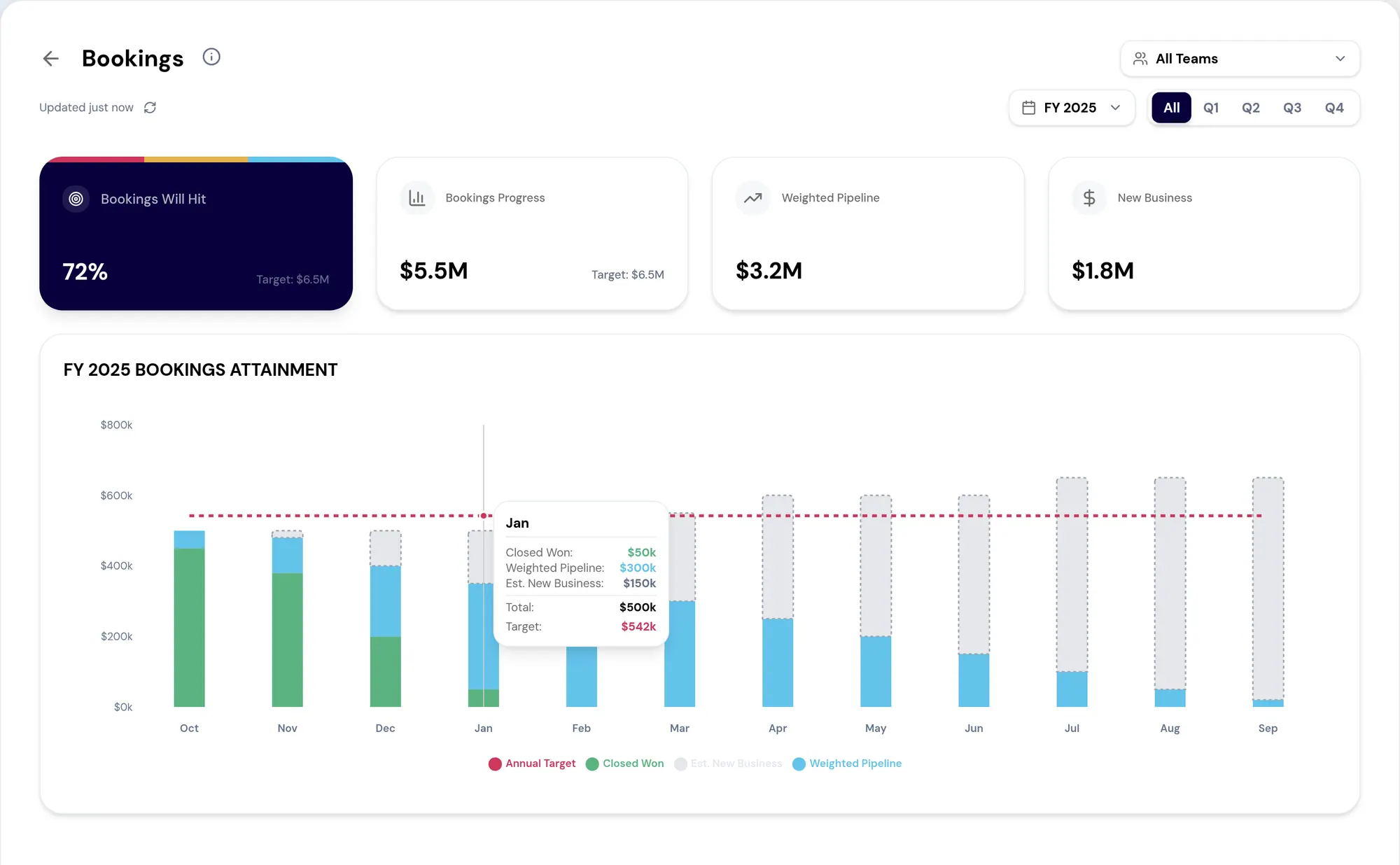
Bookings: the coverage problem
Bookings against target gives you a gap, and a gap has exactly three resolutions: more pipeline, a play that converts what you have, or a re-allocation of the target. Naming which one you are choosing is the work; the page is what makes the choice visible.
Watch the hit-probability card as the early warning. A gap you find in week ten of a quarter has one resolution left, and it is the unpleasant one.
Revenue: what finance is actually asking
Revenue is the recognized-revenue read: what lands in the P&L rather than what gets signed, and the distance between the two is the question finance is really asking. A team can be at plan on bookings and behind on revenue — different problem, different fix, and one that a bookings-only conversation will never surface.
One thing to know before you take a number off it today: there is no revenue-recognition source wired up yet, so the report aliases Bookings and its cards equal the Bookings cards by construction. The formula sheet on the report says so rather than letting you assume otherwise. Read it as a placeholder for the question until the two genuinely diverge.
Recurring: the story you defend to a board
Recurring decomposes ARR into new, expansion, contraction and churn — the base finance plans against and Customer Success protects. The ARR bridge is the version of that you can put on one slide: new plus expansion minus contraction and churn equals net new ARR.
It is worth building the habit of explaining growth from this chart rather than from a bookings number, because it is the one that survives a follow-up question. "We grew" is a claim; "we grew on expansion while contraction held flat" is an explanation.
Revenue by Segment, and why it is separate
Revenue by Segment is its own report, and it earns that by answering a question the others cannot: which ICP segments are pulling weight and which are slipping. A plan that is on target in aggregate and missing in two segments is a plan with a problem it has not admitted yet.
Read it alongside your segment definitions in Goals & Targets rather than on its own. A segment that looks like it is underperforming is sometimes a segment whose definition has drifted from the accounts actually in it.
Keeping the plan alive
The failure mode for planning is not building a bad plan. It is building a good one in January and never opening it again, so that by April the operating reality and the plan have quietly diverged and nobody has said so.
Put Planning on a monthly business review, and when reality has moved, re-allocate rather than re-forecast around it. Targets are set in Goals & Targets and cascade from there; see the targets guide for how to make an allocation that holds.
What to take away
- Planning is non-destructive. Nothing here changes pipeline, which is what makes it safe to argue in.
- Bookings, Revenue and Recurring are three different questions asked by three different people.
- The ARR bridge explains growth in one chart: new plus expansion minus contraction and churn.
- Revenue by Segment is where a plan meets the ICP — read it against your segment definitions, not on its own.
Put it to work
Jobs this page is behind
- Forecast and planPressure-test the plan before committing to it“I want to see what the plan looks like if the assumptions are wrong.”
- Forecast and planTrust the ARR bridge“I want to report ARR, retention and NRR from numbers I can defend.”
- CustomersReport retention from one place“I want to report retention and net revenue retention without assembling them by hand.”
Try the demo.
See agents carry the repeatable work of GTM across sales, marketing, customer success, and RevOps. Every action prepared, reviewed, and recorded. Fictional data, real product.
Explore the demo