Trust the ARR bridge
Recurring revenue rests on how ARR is derived. Know the basis first, read the bridge as movement, and check how much of the book a few accounts carry.
The job
“I want to report ARR and retention from numbers I can defend.”
- Finance
- RevOps
- Customer success leaders
Recurring revenue reporting has an unusual property: it is either right or it is confidently wrong, and the difference is invisible from the report. An ARR figure built on an assumption you did not know about renders perfectly, reconciles internally, and is not the company’s ARR as finance would state it.
That makes knowing the basis the highest-leverage minute in the whole read, and the one most likely to be skipped — because it is a footnote standing between somebody and a number they want to quote.
What it moves
- Net revenue retention
- Gross revenue retention
- Forecast variance
The division of labour
What RevTech does, and where you decide
In the product
How to do it
- Step 1 of 4
Know the basis before reading anything
Recurring Revenue states its basis in the ARR bridge’s info. Today ARR is derived from renewals: a won new or renewal deal on a customer account counts as recurring for twelve months from its close date, and expansion wins ride on that base. Contract terms are implied rather than read from contracts. If your contracts run longer, or finance states ARR from billing, say so beside any number you quote.
- Step 2 of 4
Read the bridge as movement, not as a total
The ARR bridge explains how you got from one period’s recurring revenue to the next: start ARR, what was new, what expanded, what contracted, what churned, and end ARR. The total is the least interesting number on it; the movements are where the decisions are.
- Step 3 of 4
Separate gross from net deliberately
Retention covers gross retention, churn and revenue at risk, on its own report. Expansion covers expansion revenue by segment on another. Reporting a healthy net story while gross is deteriorating is the most common way a customer base looks fine for two quarters longer than it is.
- Step 4 of 4
Check how much a few accounts carry
Recurring Revenue shows the share of ARR in the top tenth of customers. Top Accounts, under Reporting, names them: your largest accounts by all-time won revenue, with their open pipeline beside it and the share the top five hold. A retention number that depends on three accounts is a different business from the same number spread across three hundred, and the move it calls for is an account plan for each of the few.
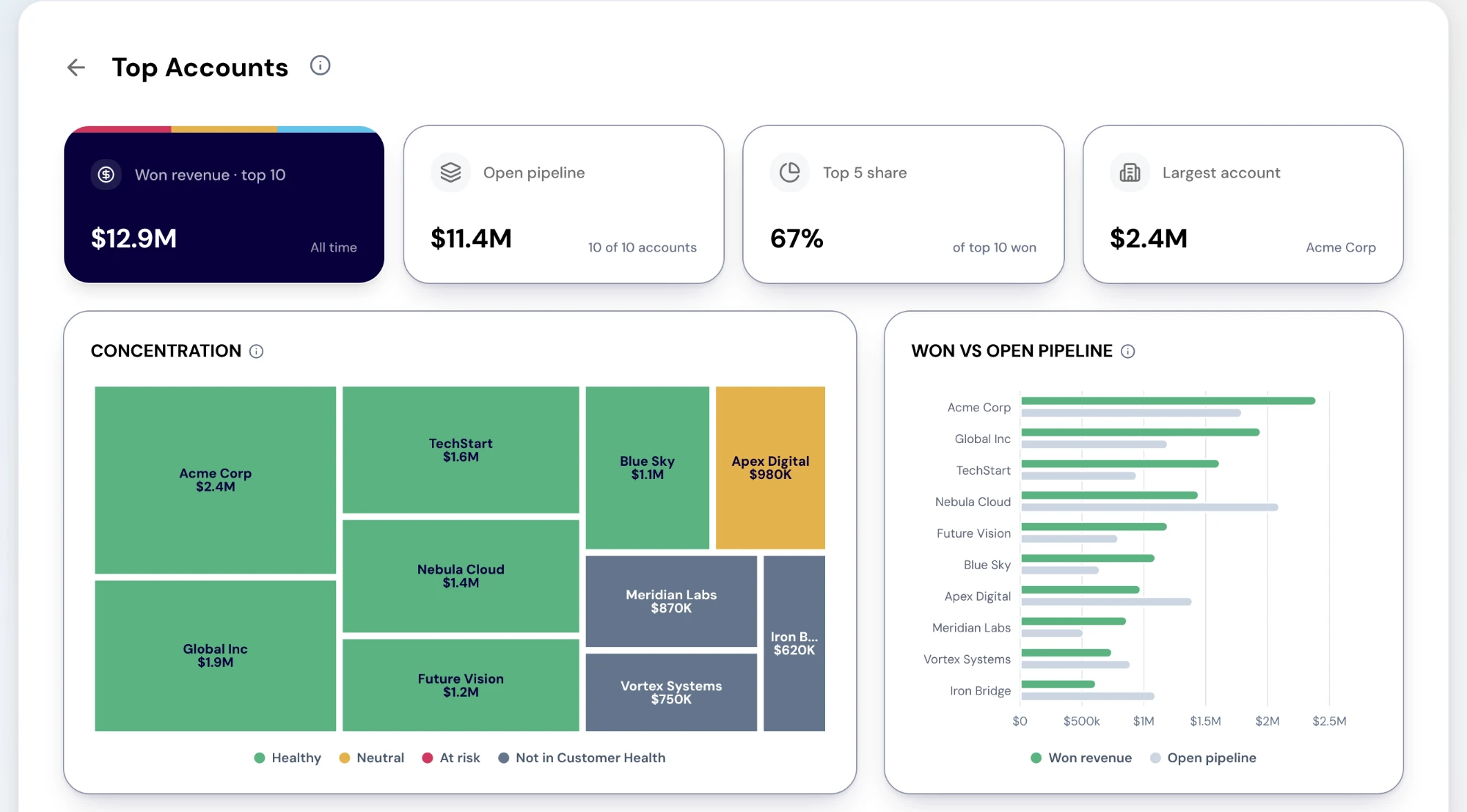
The Top Accounts report. Cards show the largest account and the share of revenue held by the top five. Charts show revenue concentration and each top account’s won revenue against its open pipeline. Sample data. Screenshot of the RevTech application; sample data. Top Accounts: the largest accounts by won revenue, their open pipeline, and the top-five share. Demo data.
Where this is today
The Expansion and CS Team reports show no net revenue retention in a production tenant — "No ARR source yet" — rather than a number nobody can defend. The Net Retention card on Recurring Revenue is derived from the same renewal-based bridge, so quote it with its basis. Top Accounts is all-time, with no period or team filter, and its shares are of the top 25 accounts rather than of the whole book.
What to take away
- Know the basis first. ARR is renewal-derived on twelve-month terms until contracts are read directly.
- The bridge is about movement. The total is the least useful figure on it.
- Read gross retention on its own. A net story can hide a deteriorating gross number for two quarters.
- Concentration is a plan, not a footnote: name the few accounts and give each one an account plan.
Go deeper
The material behind this
See how the work gets done.
Explore how agents prepare work across your revenue teams, and how people review it, guide it and decide what happens next. Fictional data. Real product.
Explore the demo