Pressure-test the plan before committing to it
Saved scenarios sit beside the live pipeline baseline, so a what-if is a comparison rather than a spreadsheet nobody else has.
The job
“I want to see what the plan looks like if the assumptions are wrong.”
- Finance
- Sales leaders
- RevOps
Planning conversations are usually conducted against one set of assumptions and one spreadsheet, owned by one person. The assumptions are rarely written down as assumptions, which means the disagreement in the room is about the output when it is really about an input nobody has named.
Saved scenarios make the assumption the object of discussion. Two people who disagree about the plan can look at the same two projections and find the input they actually disagree about, which is a much shorter conversation.
What it moves
- Forecast variance
- Plan confidence
The division of labour
What RevTech does, and where you decide
In the product
How to do it
- Step 1 of 4
Read the plan surfaces first
Bookings, Revenue, Revenue by Segment and Recurring Revenue are the four reports the plan is argued from. Bookings is the coverage problem, Revenue is what finance is asking, Recurring is the story you defend to a board, and the segment view is where the mix problem shows up.
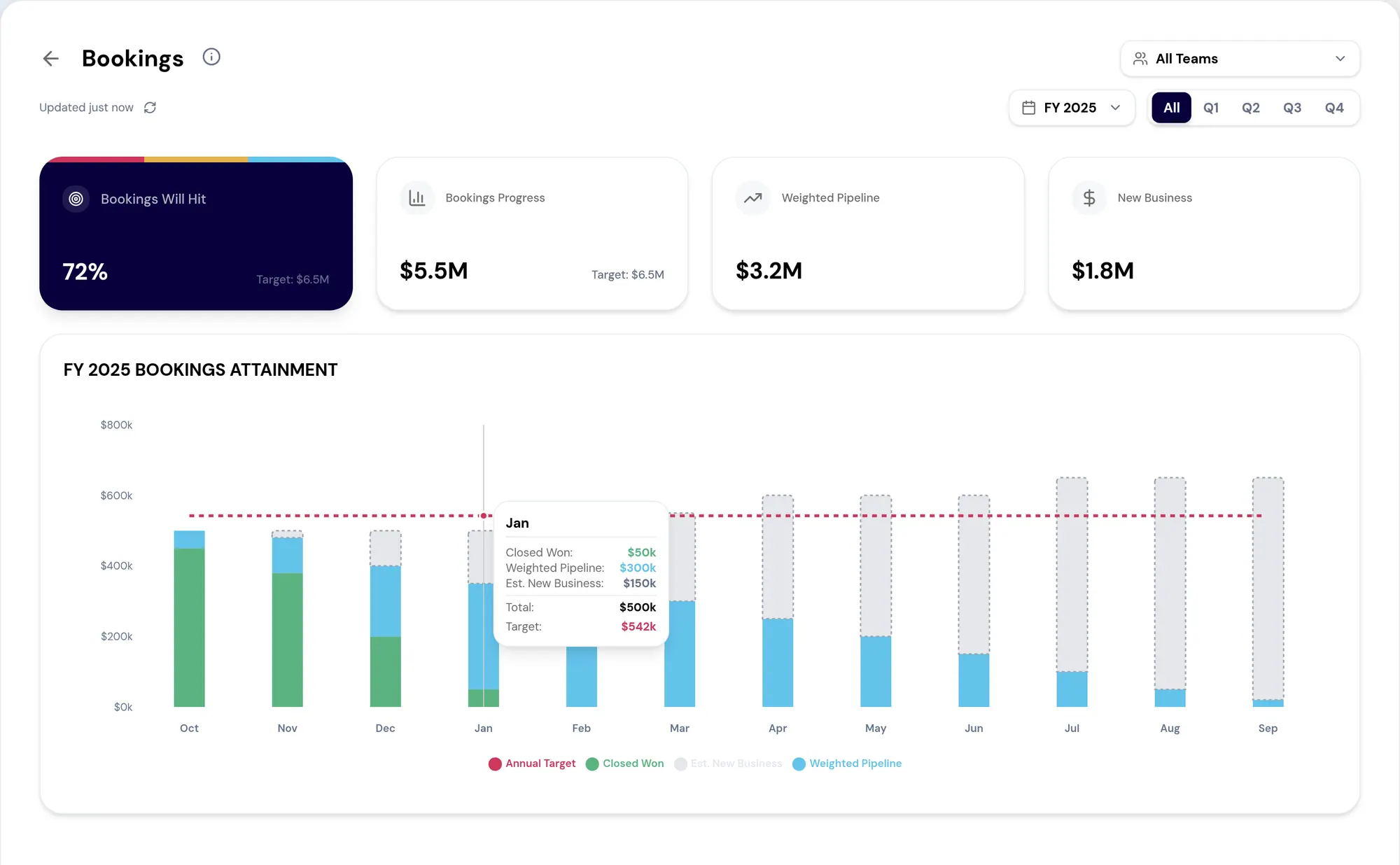
The Bookings plan view: attainment measured against plan for the period, with the movement and drivers behind the variance available in the same place. Screenshot of the RevTech application; sample data. The planning surfaces. Scenarios are argued against these, not instead of them. - Step 2 of 4
Save the assumptions, not the answer
A scenario is a named set of assumptions that everyone can open, rather than a number somebody arrived at. They are shared across the tenant, which is the point: a scenario only settles an argument if both sides can see it.
- Step 3 of 4
Compare against the live baseline
Each scenario’s projection is computed and shown against the baseline drawn from live pipeline. A scenario that looks fine until you put it next to the baseline is the normal outcome, and it is the one worth having before the commitment rather than after.
- Step 4 of 4
Name the input you are arguing about
When two scenarios disagree, the useful question is which single assumption accounts for most of the difference. That is the number to go and get evidence for, and usually there is a standing analyst question that speaks to it.
What to take away
- A scenario is a set of assumptions, saved so other people can open it.
- The comparison against the live baseline is the point, not the projection on its own.
- When two scenarios disagree, find the one input that accounts for the gap.
Go deeper
The material behind this
Try the demo.
See agents carry the repeatable work of GTM across sales, marketing, customer success, and RevOps. Every action prepared, reviewed, and recorded. Fictional data, real product.
Explore the demo