Judge a motion on evidence
Impact is KPI-first: expand a KPI to see the plays moving it. Which numbers answer whether a motion works, and which cannot.
The job
“I want to know whether a play is actually working, or just running.”
- RevOps
- Sales leaders
- Marketing leaders
A motion that is running produces a great deal of evidence that it is running: accounts enrolled, actions completed, steps fired. None of that is evidence that it works, and the gap between the two is where programmes live for a year before anybody asks.
Reading impact from the KPI rather than from the play is what closes it, because it forces the question in the right direction: not "what did this play do" but "what moved this number, and was this play part of it".
What it moves
- Play contribution to KPI
- Action completion rate
- Pipeline created
The division of labour
What RevTech does, and where you decide
In the product
How to do it
- Step 1 of 4
Start from the KPI, not the play
The impact report is KPI-first: each KPI expands to the plays contributing to it. That ordering is the discipline — a play list sorted by activity will always put the busiest motion at the top, whether or not it is the one moving anything.
- Step 2 of 4
Read enrolment as two different numbers
Eligible accounts and enrolled accounts answer different questions. A play with many eligible and few enrolled has an adoption problem; one with many enrolled and no completions has an execution problem. They look similar in a summary and need opposite responses.
- Step 3 of 4
Read completed against pending
Actions completed and actions pending, by lifecycle, is the honest read of whether the motion is being worked. A growing pending count is the earliest sign that a play is generating more work than the team it routes to can absorb.
- Step 4 of 4
Know what these numbers cannot tell you
Throughput is not outcome. A play whose actions are all completed and whose KPI has not moved is a well-executed motion that does not work, and that is a finding worth acting on rather than explaining away. The counterfactual is genuinely unavailable here, so hold the judgement loosely and look at direction over quarters.
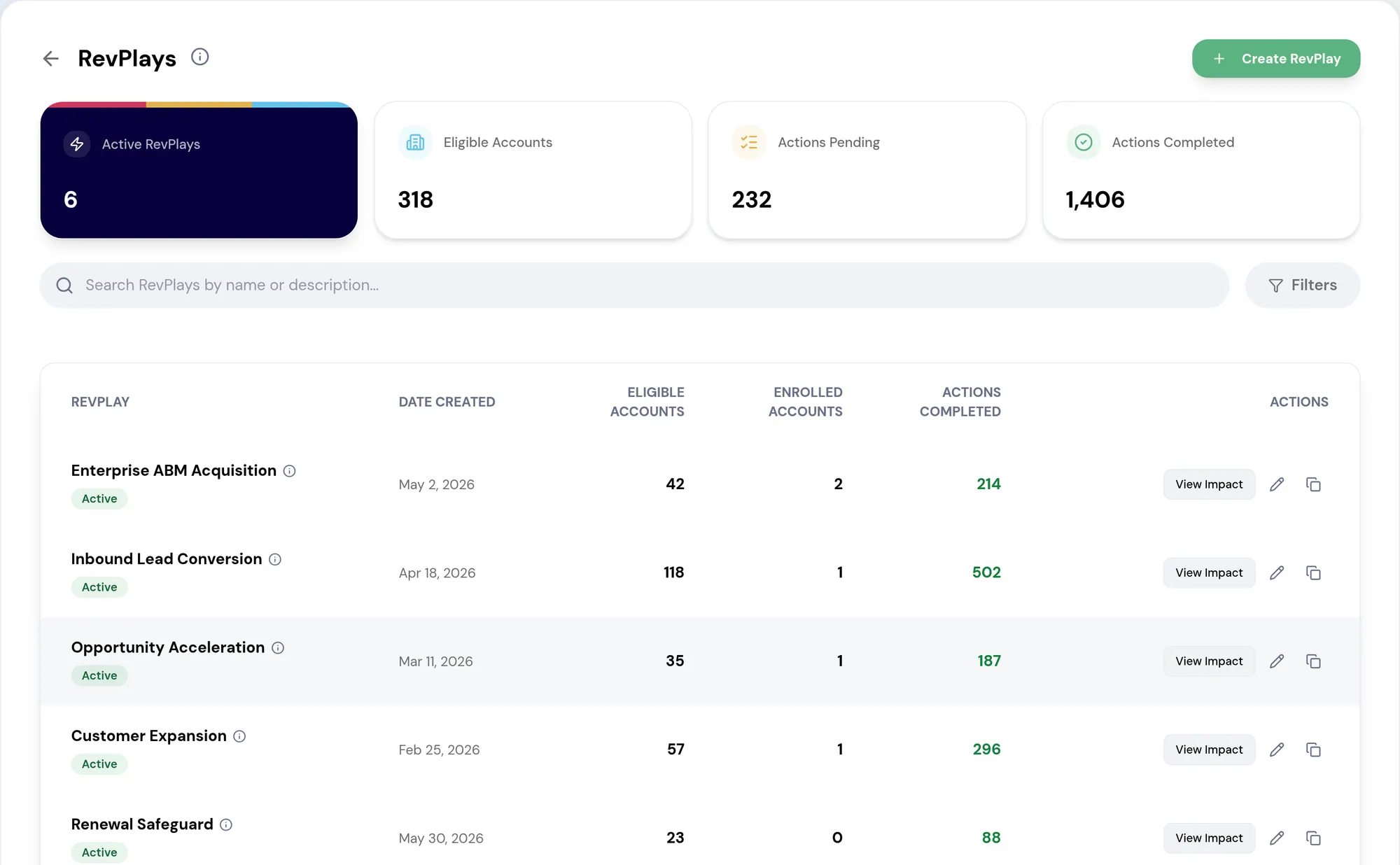
The RevPlays library: repeatable GTM plays, the accounts enrolled in each, and the actions they generate. Screenshot of the RevTech application; sample data. The play library. Activity is easy to read here; contribution is what the impact report is for.
What arrives
What this puts in your Action Center
| Item | What is prepared | How it resolves |
|---|---|---|
| EnrollmentOutcome | The outcome summary when an enrolment completes or exits | Acknowledge |
| EnrollmentAttention | The signals and the elapsed wait behind a stalled enrolment | The account, on its Signals tab; the owner can also complete the current step |
Where this is today
Completing an action refreshes the surfaces it should, but the recalculation of a play’s impact is not backed by the platform yet — so the Action Center can be correct while the impact report lags. Read impact as a trend over weeks rather than as a live figure.
What to take away
- Start from the KPI. A play list sorted by activity flatters the busiest motion.
- Eligible versus enrolled is adoption. Enrolled versus completed is execution.
- A rising pending count means the play is outproducing the team it routes to.
- Throughput is not outcome. A well-run play that moves nothing is a finding.
Go deeper
The material behind this
Try the demo.
See agents carry the repeatable work of GTM across sales, marketing, customer success, and RevOps. Every action prepared, reviewed, and recorded. Fictional data, real product.
Explore the demo