Slide 1 of 4
Impact is KPI-first
RevPlay Impact, under Reporting, shows every KPI your plays are aimed at, the plays contributing to each, and how each is performing over time.
Use RevPlay Impact and the library rollups to judge whether the play is working, and know which numbers cannot answer that question.
RevPlay Impact sits under Reporting and is KPI-first: every KPI your plays are aimed at, the plays contributing to each, and how each performs over time. Open it from the Reporting hub, or for one play use View Impact on its library row; Back returns you to the table. It is KPI-first by design. An earlier version of this surface carried cost, adoption, efficiency and quality cards, and they were removed because they measured the machinery rather than the motion.
The library row itself carries three numbers per play, and their definitions matter more than they look. Eligible Accounts is how many accounts currently match the conditions. Enrolled Accounts counts accounts with an active enrollment, not everything that ever entered, so it falls as accounts complete the timeline. Actions Completed is cumulative.
Misreading the middle one as a running total is the single most common way a healthy play gets reported as a dying one. A falling enrollment number on a working play is normal, and it means accounts are finishing the motion.
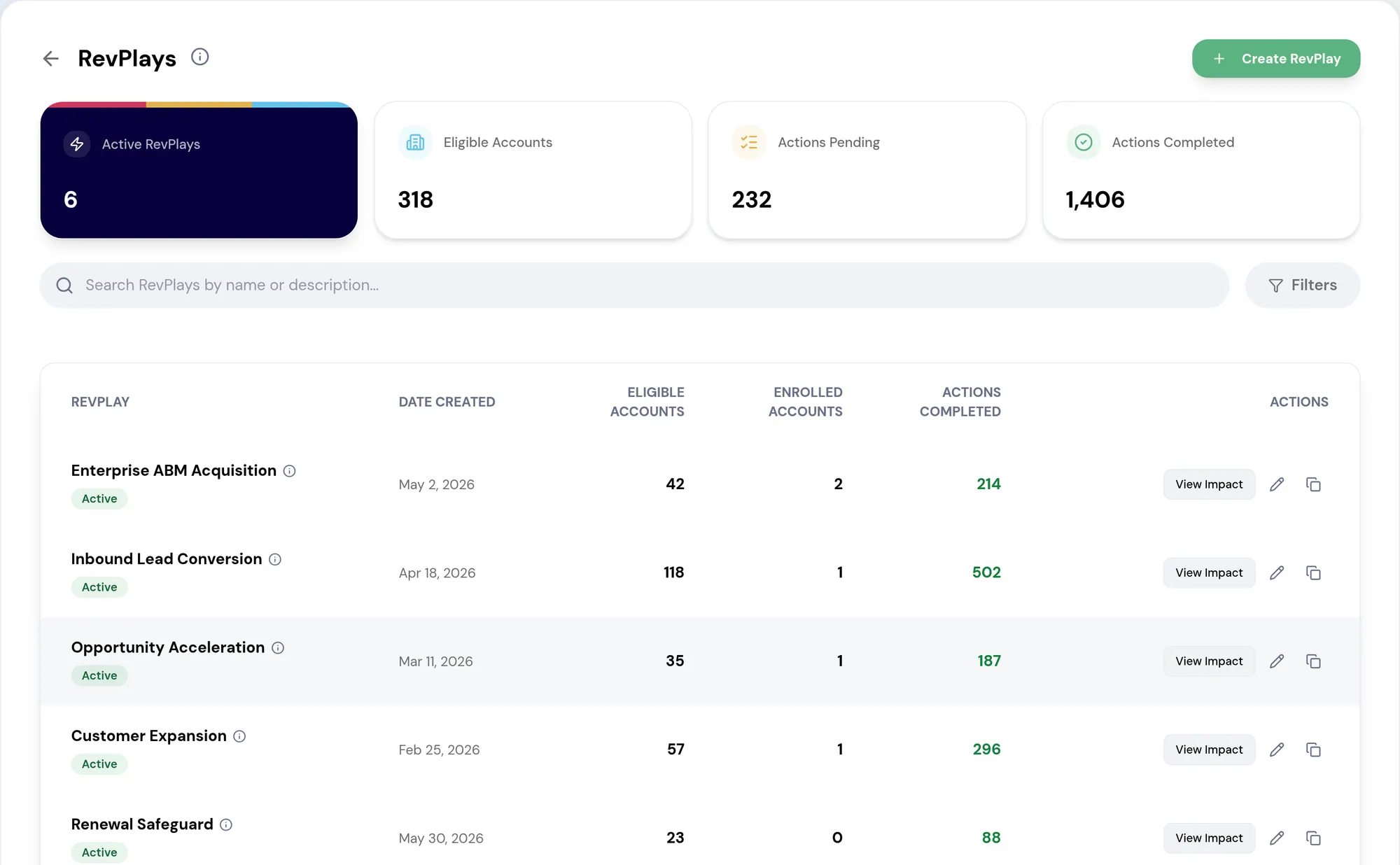
No single figure tells you whether a play is working. Three of them together do, because each fails in a different direction and the combination is diagnostic.
Enrolled says whether the motion is reaching anyone. Completed says whether the prepared work is getting done. Actions Pending says whether the team is absorbing it. Read on their own each can mislead; read together they point at one of three specific problems.
Be honest about the timescale. Two weeks after activation is enough to judge execution: whether accounts are enrolling, whether prepared work is usable, whether the team is working the queue, whether the rejection rate is falling as you fix the instructions. Those are real signals and they are actionable now.
Two weeks is not enough to judge the KPI in most motions. If the play is aimed at something with a sales cycle behind it, a fortnight of data cannot show movement, and reading it as though it could produces exactly the wrong decision, killing a working play because the number it targets has not moved yet, or declaring victory on noise. Judge execution on the fortnight; judge the KPI on the timescale the motion actually operates on, and write down in advance which one you are looking at.
At two weeks the post-pilot play shows forty accounts enrolled, sixty actions completed, and eleven pending. The KPI it targets, pipeline reopened from dormant accounts, has not moved at all.
Read on its own, that last fact looks like failure, and this is the point at which plays get switched off. Read alongside the others it is close to meaningless: the play's timeline runs twenty-one days, so at fourteen days no account has finished the motion and the outcome the KPI measures has not had the opportunity to occur. What the fortnight actually tells you is that enrollment is working, that the prepared work is being done, and that eleven pending decisions against a team of four is a queue people are keeping up with.
At eight weeks the same play reads very differently. Enrollment has fallen to twenty-two, which is health rather than decay, because accounts complete the timeline and leave. Completions are up. Actions Pending is still around ten, so the team has found a steady state. And the KPI has now had three full cycles to respond, which makes a flat line genuinely informative rather than premature.
The three-number reading gives you a diagnosis. Each one has a different next move, and picking the wrong move is how teams spend a quarter fixing the thing that was not broken.
Enrollment near zero is not an adoption problem and no amount of encouraging the team will change it. Go back to the eligibility conditions and check the properties they read, because the usual cause is a filter on a field that is not maintained or a condition that encodes a moment rather than a state.
A climbing Actions Pending is a sizing problem, and the fix is upstream in the builder rather than downstream in the team. Either narrow eligibility so fewer accounts are in motion, or reduce the number of approval-gated steps so fewer items need a human. Asking people to work harder against a queue that structurally outpaces them produces resentment and no improvement.
Healthy completions with a flat KPI after a full cycle is the diagnosis people least want and most need. The motion runs, the work gets done, and it does not move that number.
That is not a reason to kill the play if the work itself is valuable. It is a reason to stop reporting it against that KPI, and to be honest in the next review about which number it does move. A play quietly credited to a KPI it does not affect costs you more than a play you retired, because it keeps the real explanation for that KPI hidden.
You should be able to answer each of these from memory before opening it. Recalling the answer is what makes it stick; recognizing it when you read it does not.
No. The figure counts actively enrolled accounts, not every account that ever entered, so it falls as accounts complete the timeline. A falling number on a working play is normal.
The motion runs, and it is not the motion that moves that number. That is a different problem from a sizing or adoption failure, and the fix is to change what the play targets or the play itself, not to push harder.
Execution: whether accounts enroll, whether prepared work is usable, whether the queue is being worked, whether rejections are falling. Not the KPI, if the motion has a sales cycle behind it.
RevPlay Impact, under Reporting, shows every KPI your plays are aimed at, the plays contributing to each, and how each is performing over time.
The enrolled figure counts accounts currently active in the play — not everything that ever entered it. Read it as a snapshot, not a total.
A motion with a sales cycle behind it cannot show KPI movement in a fortnight. Judge the execution now; judge the KPI on the cycle's own timescale.
See agents carry the repeatable work of GTM across sales, marketing, customer success, and RevOps. Every action prepared, reviewed, and recorded. Fictional data, real product.
Explore the demo