Walk into the exec review with the read done
Company KPIs, the people carrying them, and the two standing questions worth having open. The order that makes it a decision meeting.
The job
“I want to prepare an executive review without spending a day assembling it.”
- Sales leaders
- RevOps
- Executives
Executive reviews degrade in a predictable direction. They start as decision meetings and become status meetings, because assembling the picture takes so long that presenting it consumes the hour. Everybody leaves informed and nothing was decided.
The fix is not a better deck. It is that the read exists before the meeting, so the hour can be spent on the two or three things that are actually in question.
What it moves
- Review preparation time
- Executive intervention speed
- GTM operating latency
The division of labour
What RevTech does, and where you decide
In the product
How to do it
- Step 1 of 4
Read the two performance questions in order
KPIs tell you how the company is doing. Team performance tells you who is carrying it. Reading them in that order matters: starting with people produces a meeting about individuals, and starting with the company produces a meeting about the business that then narrows to individuals.
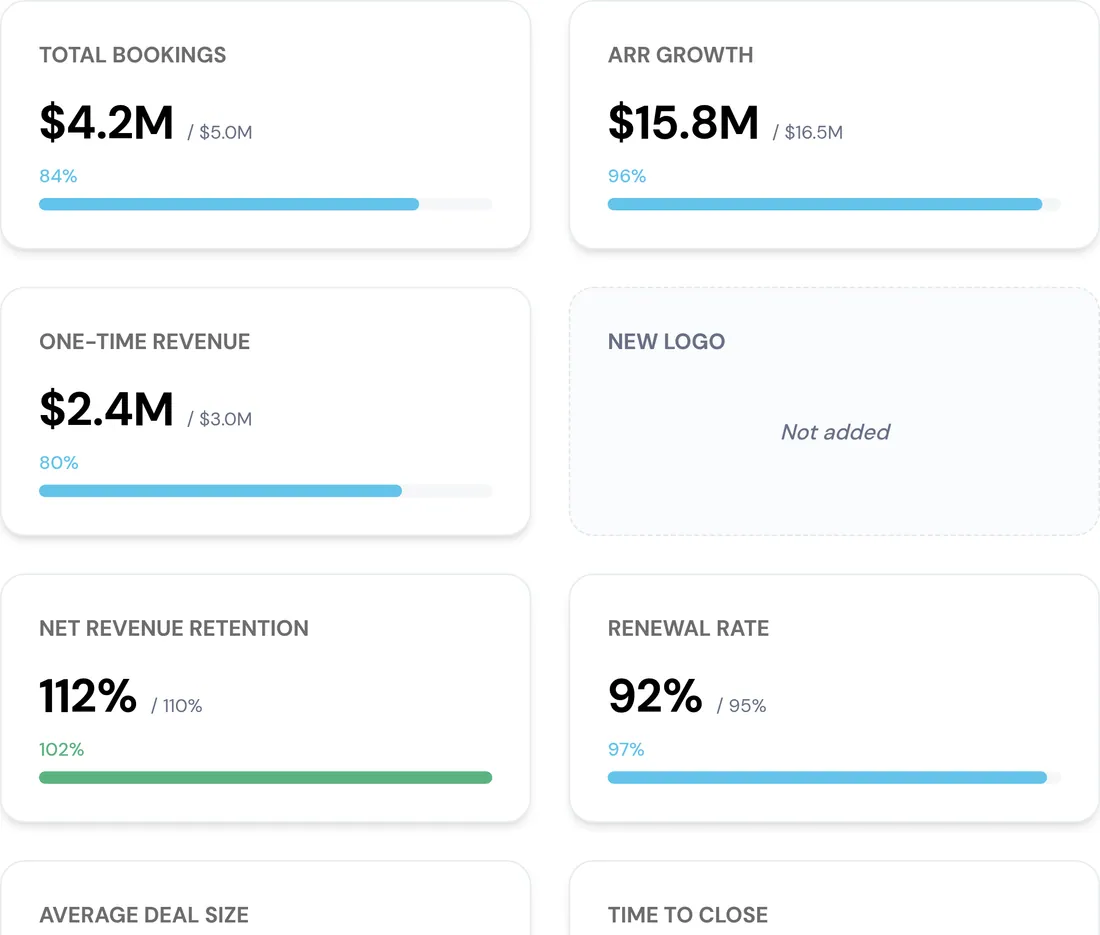
The executive KPI read: the headline measures of GTM performance in one governed view. Screenshot of the RevTech application; sample data. Company KPIs above, the people carrying them underneath. The order is the agenda. - Step 2 of 4
Bring the movement, not the level
An executive audience can read a number. What they cannot do from the report is see which three deals moved the rollup or which lever moved net retention, and that is what the cards carrying rollup changes are for. Bring the movement and its cause.
- Step 3 of 4
Open two standing questions rather than building slides
Whether the quarter will be hit, and what is driving revenue, both exist as governed questions with evidence attached. Opening them live is a stronger position than a screenshot, because the follow-up question can be answered in the room.
- Step 4 of 4
Finish somewhere that is not the report
Neither KPIs nor team performance moves a number. The read has to end in an action — a deal list, a coaching decision, a play — or the meeting was a status meeting that felt analytical.
What arrives
What this puts in your Action Center
| Item | What is prepared | How it resolves |
|---|---|---|
| ReportUpdate | The regenerated report | That specific report |
| TargetAtRisk | A ranking of the deals that would close the gap | Performance |
| AnalystQuestionUpdate | The re-run analysis with the delta highlighted | That question’s refreshed answer |
What to take away
- Company first, people second. The other order produces a meeting about individuals.
- Bring the movement and its cause. The level is already in the report.
- Open the standing question live so the follow-up can be answered in the room.
- End somewhere that is not a report, or it was a status meeting.
Go deeper
The material behind this
Try the demo.
See agents carry the repeatable work of GTM across sales, marketing, customer success, and RevOps. Every action prepared, reviewed, and recorded. Fictional data, real product.
Explore the demo