Learn something real from a closed deal
Loss reasons arrive pre-filled and wins arrive with a handoff drafted. Both are only worth anything if the reason is captured while it is true.
The job
“I want to know why we win and why we lose, from evidence rather than from anecdote.”
- Sales managers
- Sales leaders
- RevOps
- Marketing
Loss reasons are the least reliable field in most CRMs, for a structural reason: they are filled in at the moment a seller least wants to think about the deal, by the person with the strongest incentive to choose "price". The resulting data is then used to argue for discounting, which is how a reporting artefact becomes a pricing strategy.
Capturing the reason at the moment of closing, pre-filled from what actually happened in the deal, does not make it perfect. It makes it good enough to argue with, which is a considerable improvement on good enough to ignore.
What it moves
- Win rate
- Sales cycle length
- Forecast variance
The division of labour
What RevTech does, and where you decide
In the product
How to do it
- Step 1 of 3
Take the pre-filled reason seriously
A closed-lost deal arrives with a loss reason already proposed from the deal’s history. The value of it is not that it is right; it is that disagreeing with it is faster than composing one, so the field gets a considered answer instead of a default.
- Step 2 of 3
Read Won and Lost as reports, not as a list
The Won Deals report carries won revenue, win rate and sales cycle; Lost Deals carries lost revenue and loss reasons. Read together, over a period, they answer the question anecdote cannot: whether the thing everybody says is costing deals is actually costing deals.
- Step 3 of 3
Ask the questions that already exist
Two of the standing analyst questions are exactly this — why deals are lost, and how deals are won — with the evidence attached to the answer. It is a better starting point for the argument than a pivot table somebody built for one meeting.
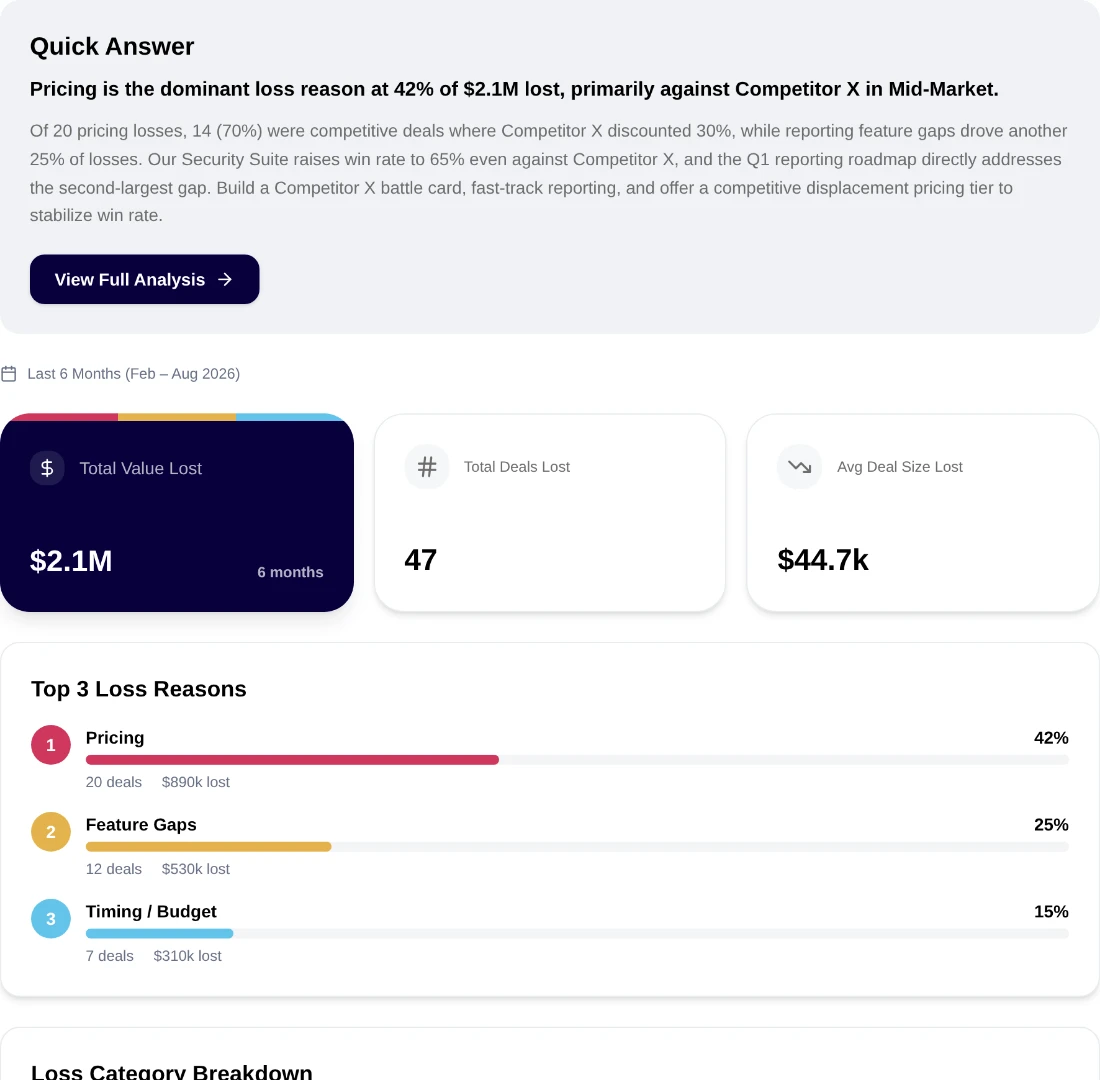
The evidence behind an answer: the underlying records and sources, so the conclusion can be checked rather than trusted. Screenshot of the RevTech application; sample data. An answer with its evidence. The point is to be able to interrogate the conclusion.
What arrives
What this puts in your Action Center
| Item | What is prepared | How it resolves |
|---|---|---|
| LostDeal | A pre-filled loss reason, drawn from the deal’s own history | The deal |
| WonDeal | A drafted customer success handoff | The deal |
What to take away
- A pre-filled reason is worth having because disagreeing is faster than composing.
- Won and Lost read together answer what anecdote cannot.
- The standing analyst questions on winning and losing come with their evidence attached.
Go deeper
The material behind this
Try the demo.
See agents carry the repeatable work of GTM across sales, marketing, customer success, and RevOps. Every action prepared, reviewed, and recorded. Fictional data, real product.
Explore the demo