See who will miss before they miss
Attainment is a lagging number. Pacing, coverage and concentration are the three that tell you early, and two cards do the watching.
The job
“I want to know which of my people are going to miss while the quarter can still be changed.”
- Sales managers
- Customer success leaders
- Sales leaders
Attainment tells you where somebody has got to. It does not tell you where they are going, and in the first half of a quarter those are very different questions — a rep at thirty per cent in week four is either fine or in serious trouble depending on coverage, and the attainment number cannot distinguish them.
Managers who only read attainment therefore intervene late, in week ten, when the only remaining lever is heroics. The earlier read is pacing against coverage, and the conversation it produces is about pipeline generation rather than about closing.
What it moves
- Quota attainment
- Coaching action completion
- Pipeline coverage quality
The division of labour
What RevTech does, and where you decide
In the product
How to do it
- Step 1 of 4
Read the team view as three questions, not one
One row per person, with attainment, commit, upside and pipeline. Attainment is where they are. Commit and upside is what they believe. Pipeline against the remaining gap is whether the belief is supported. A row where the third disagrees with the second is the row to open.
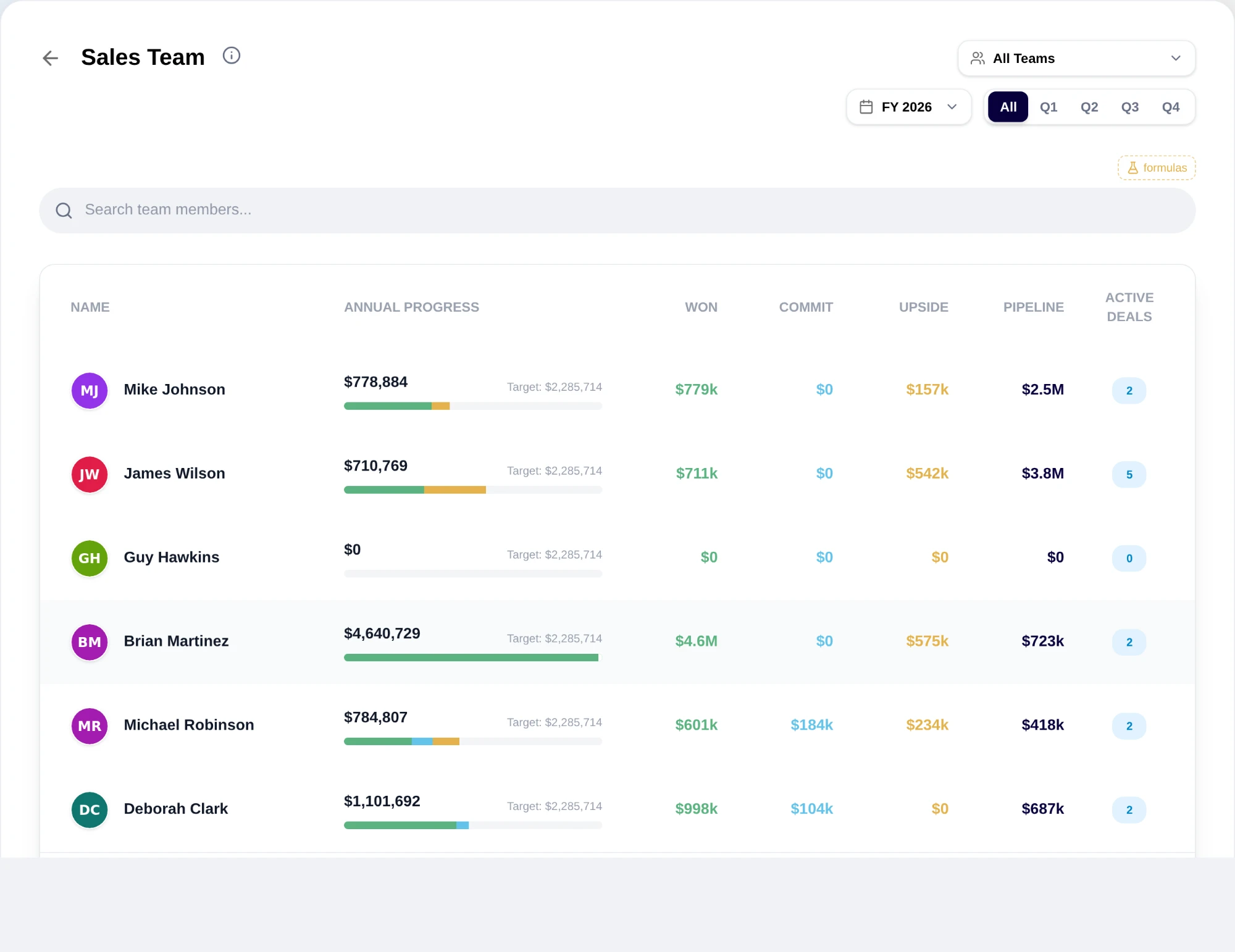
The Sales Team roster: attainment, commit, upside and active pipeline for each rep, so a manager starts a review with the same numbers everyone else sees. Screenshot of the RevTech application; sample data. One row per rep. The useful read is the disagreement between what is committed and what is covered. - Step 2 of 4
Look for concentration
A rep on track because of one large deal is not on track; they are exposed. Concentration is invisible in an attainment percentage and obvious in the drilldown, and it is the single most useful thing to find in week five.
- Step 3 of 4
Take the pacing cards seriously in both directions
A target at risk arrives with a ranking of the deals that would close the gap, which turns a warning into an agenda. A target achieved arrives with the attainment breakdown — worth reading rather than dismissing, because knowing which motion produced an over-performance is how it gets repeated.
- Step 4 of 4
Let people see their own number
Every user has their own KPIs page with their individual targets and attainment. A team where each person can see their own pacing has a different kind of one-to-one from one where the manager is the only source of that information.
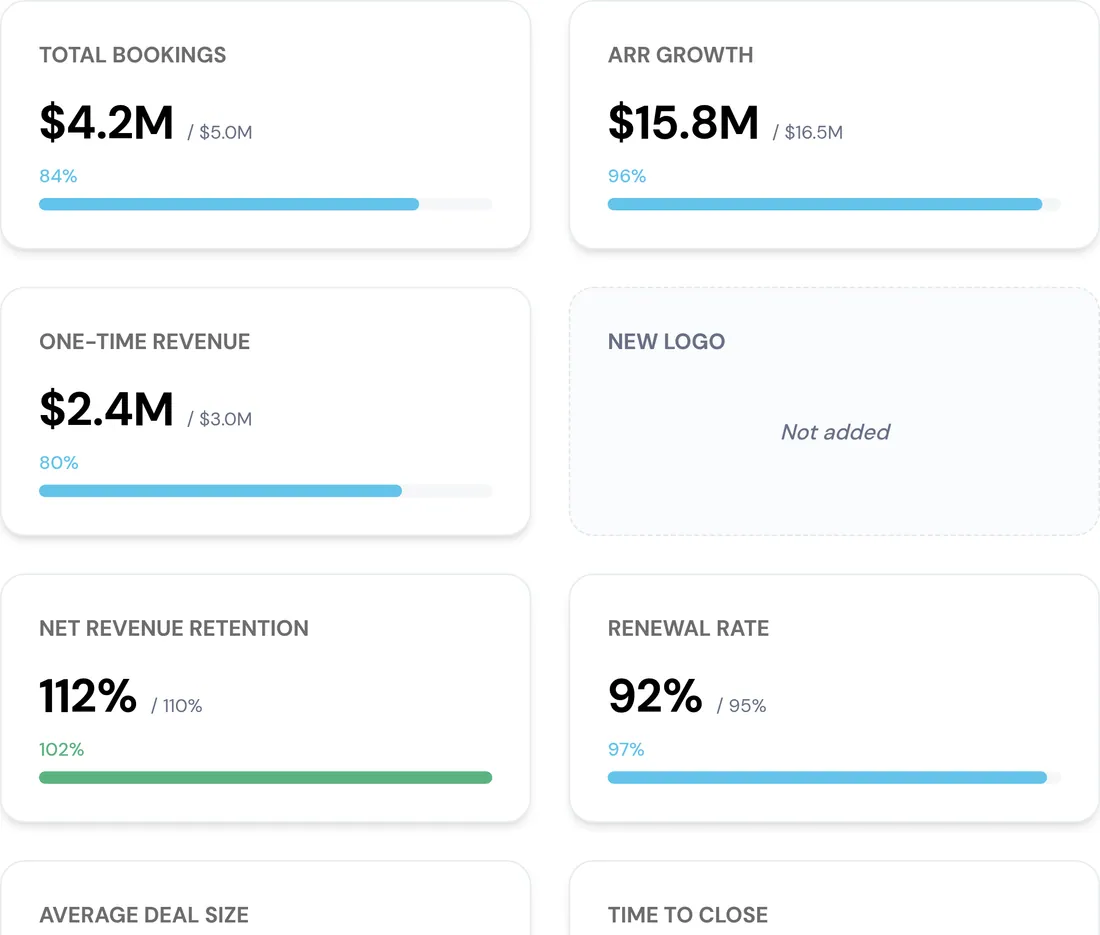
The executive KPI read: the headline measures of GTM performance in one governed view. Screenshot of the RevTech application; sample data. The performance surfaces. Company KPIs above, the people carrying them underneath.
What arrives
What this puts in your Action Center
| Item | What is prepared | How it resolves |
|---|---|---|
| TargetAtRisk | A ranking of the deals that would close the gap | Performance |
| TargetAchieved | The attainment breakdown behind crossing the line | Performance |
| ManagerFollowUp | The activity timeline and coaching prompts behind a repeated follow-up gap | The contact, on its Journey tab |
What to take away
- Attainment is where they got to. Pacing against coverage is where they are going.
- A rep carried by one deal is exposed, not on track. Concentration only shows in the drilldown.
- Read the achieved card too — an over-performance you cannot explain cannot be repeated.
Go deeper
The material behind this
Try the demo.
See agents carry the repeatable work of GTM across sales, marketing, customer success, and RevOps. Every action prepared, reviewed, and recorded. Fictional data, real product.
Explore the demo