Decide what agents may do without asking
Autonomy is set per capability, and review is a budget you are spending. Where to put the gates, and what is recorded when somebody passes one.
The job
“I want to put review where the risk is instead of everywhere.”
- RevOps
- Sales leaders
- Compliance
The instinct on day one is to gate everything, and it is the wrong instinct for a specific and counter-intuitive reason. A queue where every item needs a decision is a queue people clear rather than read, so the items that genuinely needed scrutiny get the same three seconds as the ones that did not. Blanket caution produces less scrutiny, not more.
Review capacity is finite and every gate spends some of it. The question is therefore not how careful to be but where to be careful, which is a design decision somebody has to make on purpose.
What it moves
- Human approval rate
- Agent action auditability
- Workflow exception volume
The division of labour
What RevTech does, and where you decide
In the product
How to do it
- Step 1 of 5
Set autonomy per capability, not per agent
On a play, autonomy is chosen per capability rather than as one global dial: suggest, draft, or act. That granularity is what makes deliberate placement possible — the same motion can draft an internal summary automatically and only ever suggest a customer-facing message.
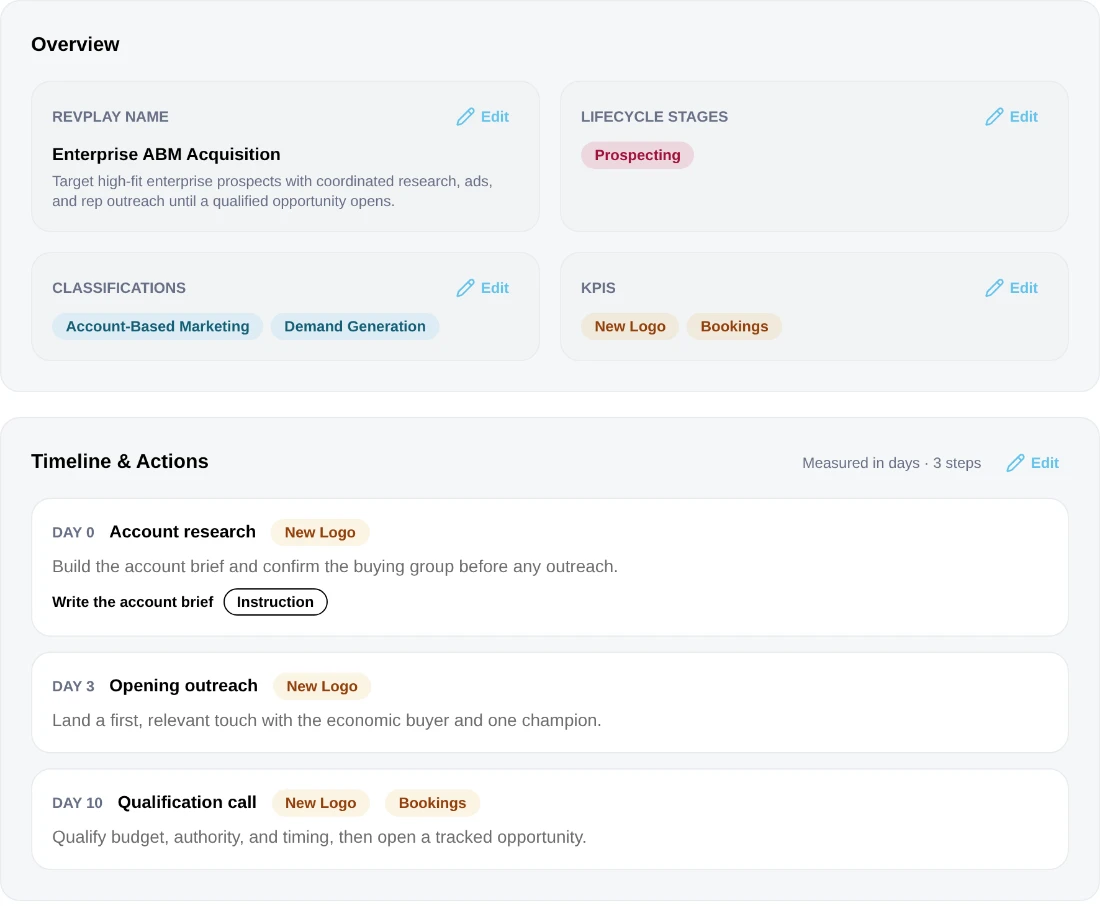
The Review and Activate step of a RevPlay. Before the play runs against a single account, the whole definition is laid out for a person to check: what it is called, which lifecycle stages it targets, how it is classified, the KPIs it is measured on, and every timed action in order. Nothing is enrolled until someone activates it here. Screenshot of the RevTech application; sample data. A play reviewed before activation, with its autonomy and governance settings visible together. - Step 2 of 5
Gate on consequence and reversibility
Two questions decide whether something needs a gate. What happens if it is wrong, and how hard is it to undo. Anything customer-facing gets a person regardless of severity; anything internal and easily corrected usually does not need one.
- Step 3 of 5
Name approver roles, not people
Approval routes to roles rather than individuals, which is what makes it survive somebody changing job. A routing map built on names is a map that is wrong within a year.
- Step 4 of 5
Know what the platform records
Completing work, ignoring it with a stated reason and escalating it to a named person are all durable decisions and form the audit trail. Sign-off on a drafted campaign, a new play version or a new analyst question is not recorded yet and arrives as a Review only item, deliberately without a completion control so that reading one cannot be logged as approving it.
- Step 5 of 5
Measure the backlog, not the gate count
The number of gates is a design choice, not a health measure. What tells you whether the governance is working is whether the queue of things awaiting a decision is shrinking, and whether the items that sat longest were the ones that mattered.
What arrives
What this puts in your Action Center
| Item | What is prepared | How it resolves |
|---|---|---|
| PlayPublishApproval | The version diff and a governance summary | Review only in a production tenant |
| CampaignApproval | The drafted brief, the generated variants and the audience | Review only in a production tenant |
| AnalystQuestionApproval | A sample answer to judge the new question by | Review only in a production tenant |
Where this is today
The three sign-off items above are staged: a production tenant renders them as Review only, with no durable approve or reject. Design your gates around the decisions the platform does record — complete, ignore with a reason, escalate — and treat sign-off as a review step whose outcome you record where the motion is owned. Demo and staging builds simulate the decision.
What to take away
- Gating everything produces less scrutiny, not more.
- Consequence and reversibility are the two questions. Customer-facing always gets a person.
- Route approval to roles. A map built on names is wrong within a year.
- Complete, ignore-with-reason and escalate are recorded. Sign-off is not, yet.
Go deeper
The material behind this
Try the demo.
See agents carry the repeatable work of GTM across sales, marketing, customer success, and RevOps. Every action prepared, reviewed, and recorded. Fictional data, real product.
Explore the demo