Slide 1 of 4
A signal noticed twice should be encoded
The first time is an observation. The second time is a pattern, and a pattern worked by hand is a pattern worked inconsistently.
Convert a repeating expansion signal into a RevPlay with a named owner, so the motion runs on evidence rather than on individual initiative.
Noticing an expansion signal on one account and acting on it is good work. Noticing the same signal on a second account is the moment the calculus changes, because you now have a pattern, and a pattern worked by hand is worked by whoever happens to notice it, at whatever moment they happen to look, with whatever framing they happen to choose.
That is precisely the profile of a motion that belongs in a RevPlay: an observable trigger, a sequence of steps that holds across accounts, and a finish you can describe without naming an account. If you took the RevPlay course, this is the same three tests arriving from the direction of a real signal rather than an abstract one.
The translation into a play is more direct than people expect. The evidence that made you notice the account (usage at the edge of the footprint, a new function appearing, a new stakeholder with an overlapping mandate) is the eligibility condition. Add the segment and lifecycle-stage filters that say who this motion is structurally for, and the exclusions that keep accounts in an active renewal negotiation or an open escalation out of it.
That last exclusion matters more here than almost anywhere. An expansion approach landing in the middle of a difficult renewal or a live support escalation is the kind of error that damages the relationship you were trying to grow, and it is entirely avoidable at the point of writing the conditions.
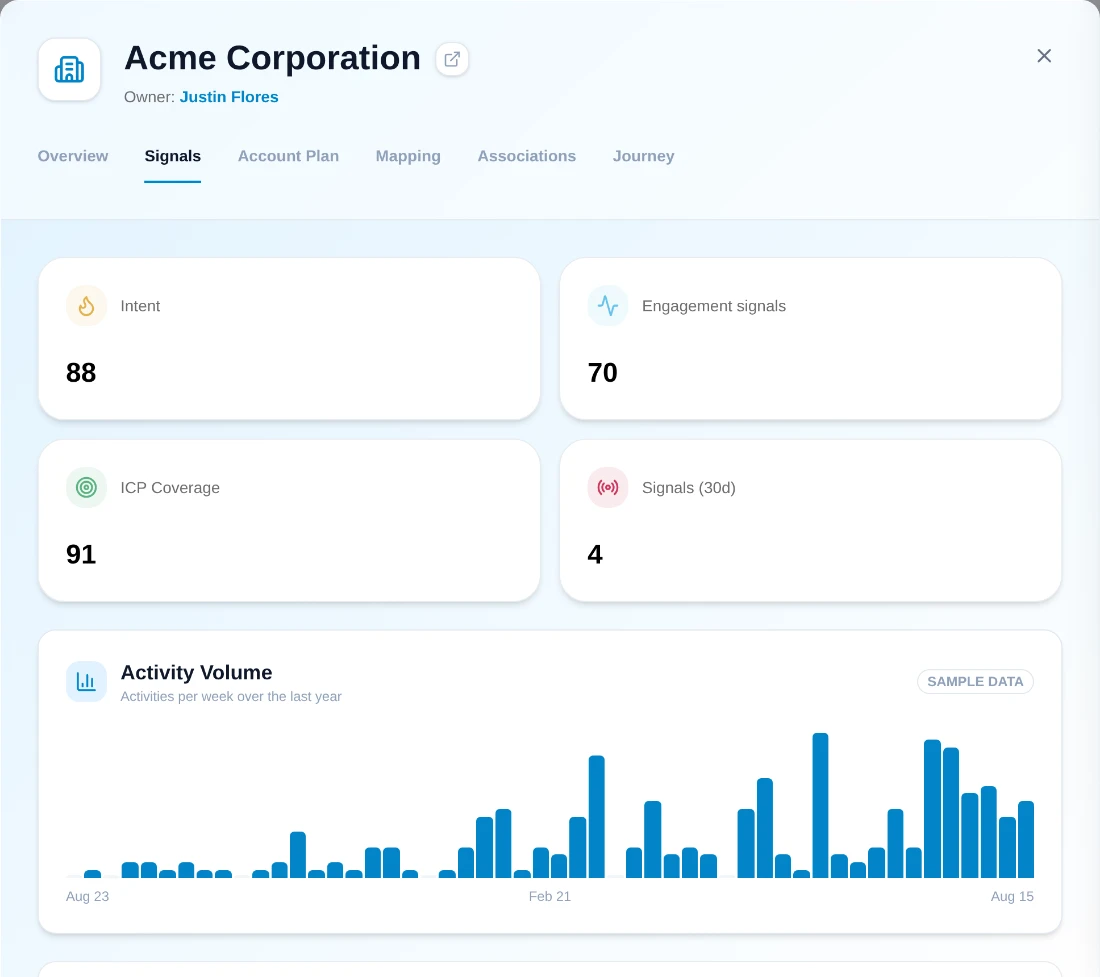
The account map determines where the play should start, and this is what separates a considered expansion play from a blunt one. Where a sponsor is already in place, the first step is the expansion conversation itself. Where there is a coverage gap, the first step is relationship work, an introduction, a broader conversation, getting to the level where the decision could be made.
Same signal, different opening, because the constraint is different. A play that ignores this asks people with no sponsor to have a commercial conversation with nobody, which produces exactly the rejections you would expect.
Finally, give every action a named role. Expansion work is the first thing to lose to whatever is urgent, and an unowned expansion action loses that competition every week without anyone deciding it should.
What the finished object looks like for the usage-at-the-edge signal, in the builder's own terms. Overview: name "Expansion: usage ceiling, mid-market"; purpose "Open a capacity conversation at accounts pressing the limits of their current plan, before the limit becomes a frustration"; KPIs: expansion pipeline created. Eligibility: mid-market, active customer, usage above threshold for two consecutive months, excluding accounts in renewal negotiation or escalation. Timeline: day 0, assemble the usage evidence and check the account map; day 3, branch by coverage, so sponsored accounts get the prepared conversation opener routed to the CSM for approval, gapped accounts get a relationship step instead; day 21, resolve: opportunity opened, or closed out with a reason.
Every piece of that came from a lesson in this course or the RevPlay one. The signal became the eligibility condition, the map decided the branch, the arithmetic sized it, and the CSM approval sits exactly where the external touch is.
Do this in the product
You should be able to answer each of these from memory before opening it. Recalling the answer is what makes it stick; recognizing it when you read it does not.
The second time you act on it. One is an observation; two is a pattern, and a pattern worked by hand is worked by whoever notices, whenever they look, with whatever framing they choose.
Where a sponsor exists, the first step is the expansion conversation. Where the map shows a gap, it is relationship work. A play that ignores this asks people with no sponsor to have a commercial conversation with nobody.
The first time is an observation. The second time is a pattern, and a pattern worked by hand is a pattern worked inconsistently.
The evidence that made you notice the account is exactly the condition that decides which accounts enter the play.
Expansion actions without a named owner are the ones that lose to whatever is on fire this week.
See agents carry the repeatable work of GTM across sales, marketing, customer success, and RevOps. Every action prepared, reviewed, and recorded. Fictional data, real product.
Explore the demo