Walk into a renewal with the brief done
The brief arrives assembled: usage trend, value recap, risk flags. What is prepared for you, and what stays entirely yours.
The job
“I want to start every renewal from a prepared position rather than from a spreadsheet.”
- Customer success managers
- Account managers
- CS leaders
Renewal preparation is expensive in exactly the way that guarantees it gets skipped for the accounts that look safe. Pulling a year of usage, remembering what was promised, checking who has left and assembling a value story takes an afternoon, and there are forty renewals in the quarter.
So preparation concentrates on the accounts that already look risky, and the surprises come from the ones that did not. A brief that is assembled for every renewal regardless is the only way the safe-looking ones get read at all.
What it moves
- Account review preparation time
- Gross revenue retention
- Renewal cycle time
The division of labour
What RevTech does, and where you decide
In the product
How to do it
- Step 1 of 4
Work the book by period, not by proximity
The Renewals report tracks the book by period and drills into the deals up for renewal. Working by period rather than by whatever is closest is what creates room to start the difficult ones early, which is the only lever that reliably changes a renewal outcome.
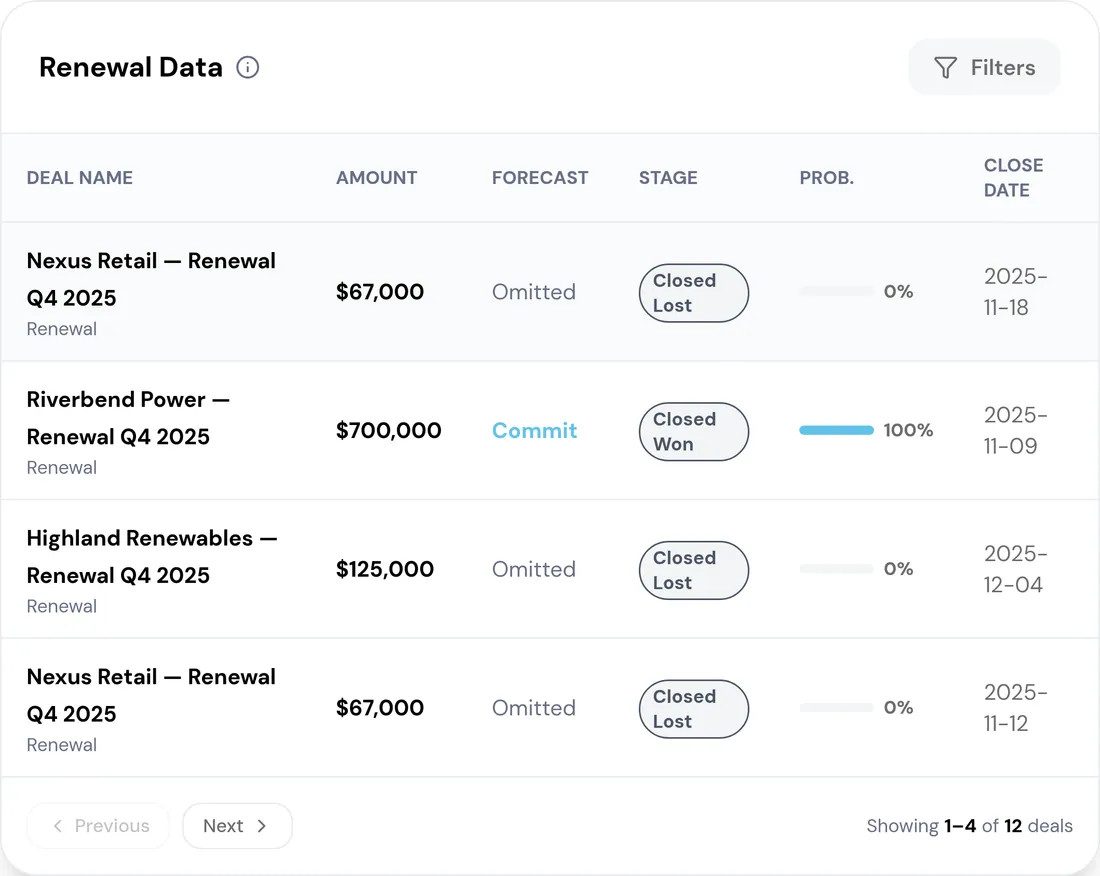
The renewal book laid out by period, with the value and risk attached to each upcoming renewal. Screenshot of the RevTech application; sample data. The renewal book by period. Starting early is the lever; this is the surface that makes it possible. - Step 2 of 4
Read the brief, then check the two things it cannot know
The brief carries the usage trend, the value recap and the risk flags. What it cannot carry is what was promised in the room and what the customer’s own year looks like. Those two are the ones to add.
- Step 3 of 4
Set the start date by risk, not by the renewal date
A high-risk renewal started ninety days out is a different conversation from the same renewal started thirty days out. Use the health read to decide the runway, and treat the renewal date as the deadline rather than the trigger.
- Step 4 of 4
Review a prepared response against its trigger
When a drafted customer response arrives, read it against the thing that produced it before reading it as prose. A well-written reply to a misread signal is worse than an awkward reply to the right one.
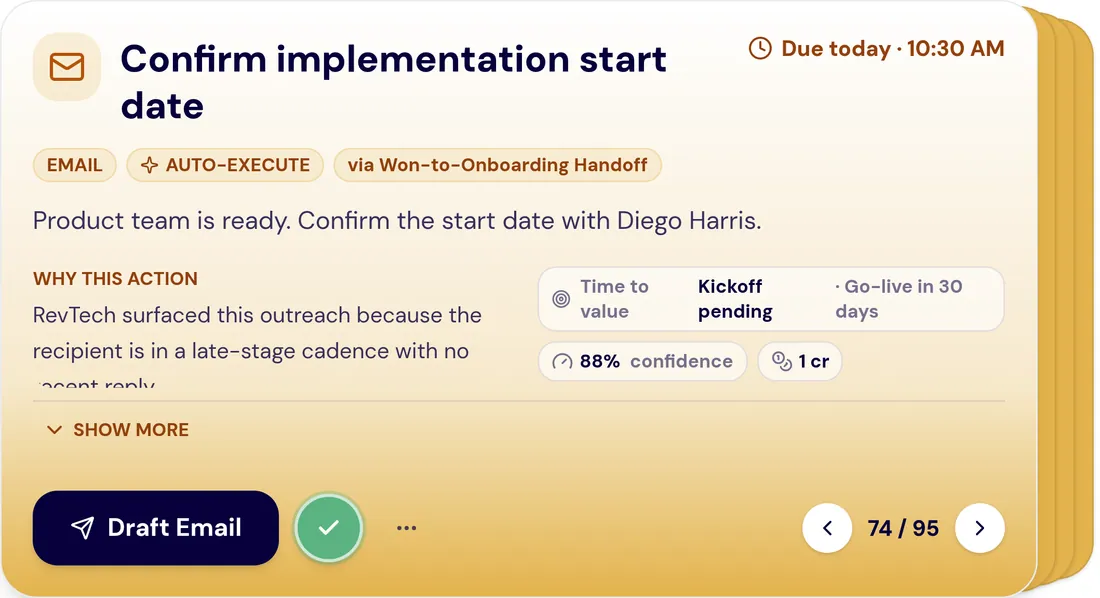
A customer response drafted by the agent, presented with the trigger that prompted it and the outcome it is expected to produce. Screenshot of the RevTech application; sample data. A prepared customer response, with the trigger that produced it alongside.
What arrives
What this puts in your Action Center
| Item | What is prepared | How it resolves |
|---|---|---|
| RenewalDue | The brief: usage trend, value recap, risk flags | The account |
| HealthRisk | The intervention plan behind a health drop | The account |
What to take away
- By period, not by proximity. Room to start early is the only reliable lever.
- Add the two things no brief can hold: what was promised, and what their year looks like.
- Risk sets the runway; the renewal date is the deadline, not the trigger.
- Read a drafted response against its trigger before you read it as prose.
Go deeper
The material behind this
Try the demo.
See agents carry the repeatable work of GTM across sales, marketing, customer success, and RevOps. Every action prepared, reviewed, and recorded. Fictional data, real product.
Explore the demo