Get an answer you can defend in the room
A governed library of standing questions, each with a current answer and the evidence behind it. What to check before you repeat one.
The job
“I want to answer a standing revenue question without commissioning an analysis.”
- Sales leaders
- RevOps
- Finance
- Marketing leaders
The questions leadership asks are remarkably stable. Will we hit the number, why are we losing, what does a good customer look like, which campaigns are working. They get asked every quarter, answered from scratch every quarter, and answered slightly differently each time because whoever built it made different choices about the denominator.
A governed set of questions asked the same way every time is worth more than a better one-off analysis, for a reason that has nothing to do with accuracy: answers you can compare across quarters are the only ones that show a trend.
What it moves
- Time to answer
- Decision latency
- Forecast variance
The division of labour
What RevTech does, and where you decide
In the product
How to do it
- Step 1 of 4
Find the question rather than writing one
The library is a defined set of business questions, each resolving to a prepared answer. It is not a query box, and that constraint is what makes the answers comparable over time. Global search covers question wording too, so the fastest route is usually to search the phrasing you have in your head.
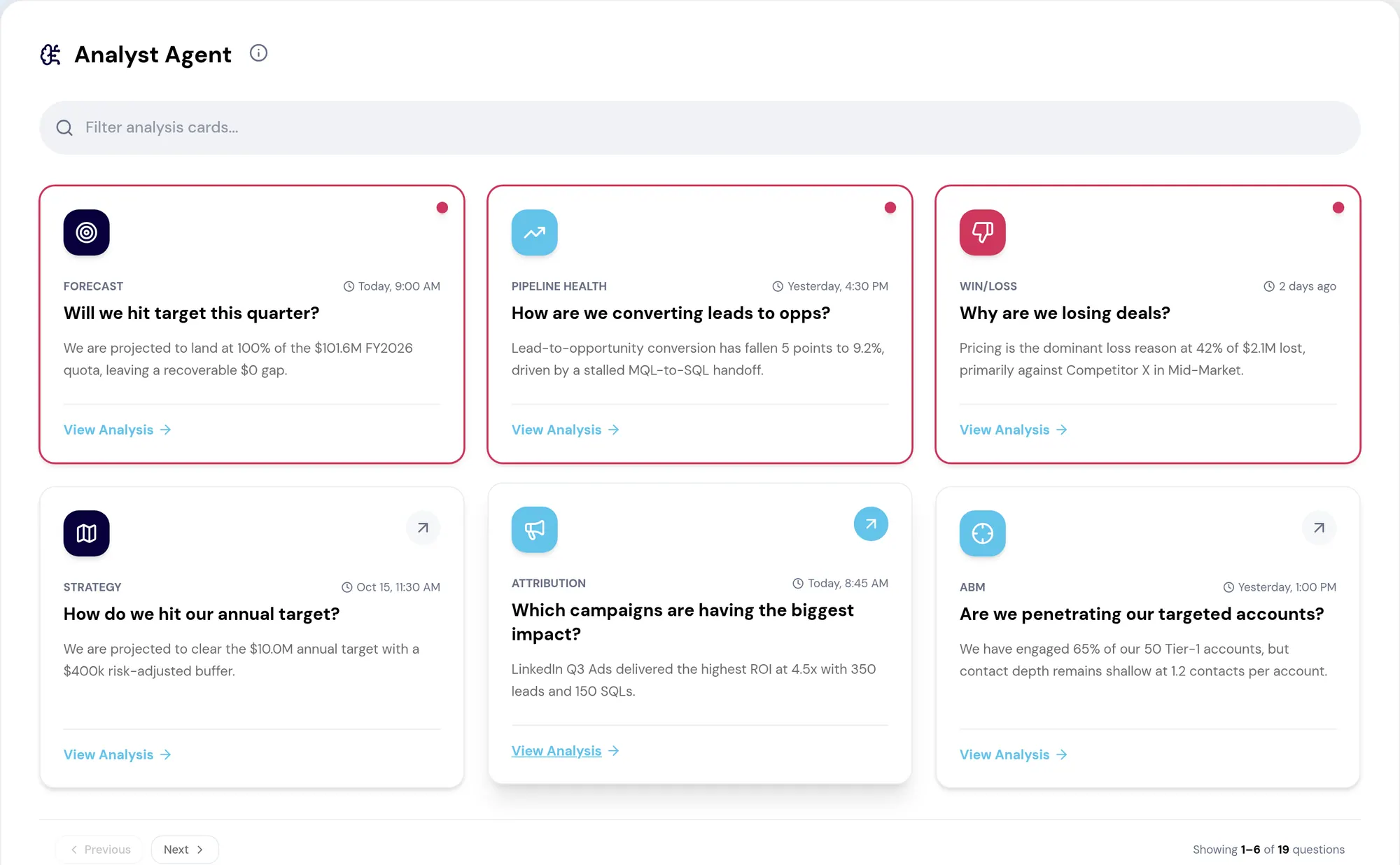
The Analyst workspace, presenting a governed library of GTM questions — pipeline health, win/loss patterns, churn drivers and more — each of which resolves to a prepared answer with its underlying evidence. Screenshot of the RevTech application; sample data. The governed question library. A defined set, asked the same way every time. - Step 2 of 4
Read the quick answer as a claim
Every analysis opens with a concise answer and a short analysis under it. Treat that as the claim rather than the conclusion: it is written to be quotable, which is exactly why it should not be the only thing read before it gets quoted.
- Step 3 of 4
Check three things before it travels
That the question is the one you think it is. That the evidence supports the conclusion rather than merely accompanying it. And that the source snapshot was collected recently enough for the decision you are about to make. The third is the one people skip, and the snapshot time is not a statement about how fresh your CRM is.
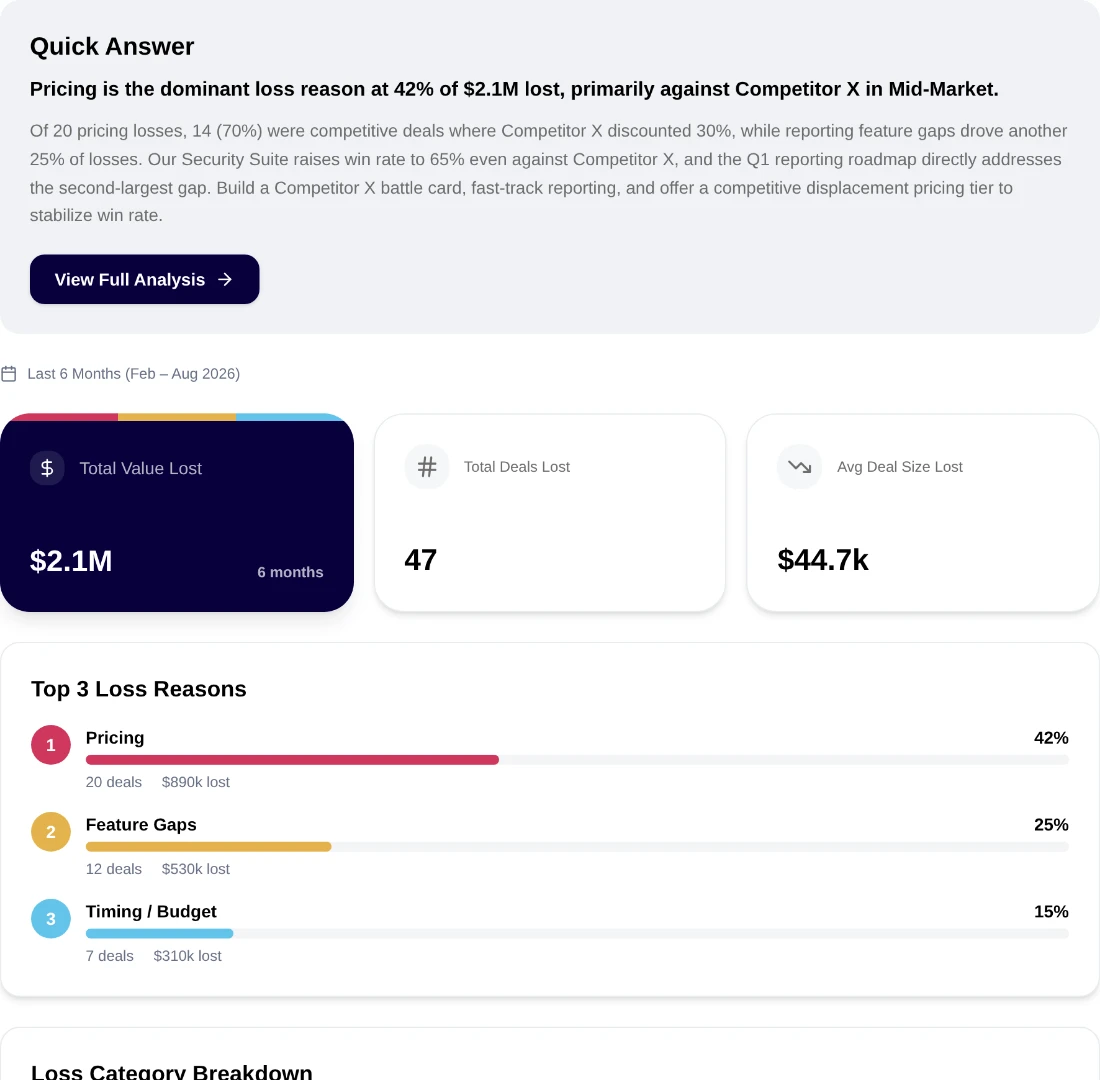
The evidence behind an answer: the underlying records and sources, so the conclusion can be checked rather than trusted. Screenshot of the RevTech application; sample data. The evidence behind an answer, and when its source was collected. - Step 4 of 4
Know why you cannot see everything
Which questions you can open is granted per role. A question a colleague can see and you cannot is a permission, not a fault, and the person to ask is whoever administers roles.
What arrives
What this puts in your Action Center
| Item | What is prepared | How it resolves |
|---|---|---|
| AnalystQuestionUpdate | The re-run analysis, with the change from the previous answer highlighted | That question’s refreshed answer |
Where this is today
The Analyst is read-only. You cannot trigger a run, change a cadence, or compare two versions of an answer — the platform decides when each question re-runs and the surface states the recurrence rather than a next-run date.
What to take away
- A defined set asked the same way beats a better one-off, because only the first shows a trend.
- The quick answer is a claim. The evidence is the conclusion.
- The source snapshot time is about that run, not about your CRM’s freshness.
- Question access is granted per role. A missing question is a permission.
Go deeper
The material behind this
Try the demo.
See agents carry the repeatable work of GTM across sales, marketing, customer success, and RevOps. Every action prepared, reviewed, and recorded. Fictional data, real product.
Explore the demo