Run a named-account motion end to end
A segment defines the list, a campaign type decides the specificity, and a play carries the follow-through to named owners.
The job
“I want to run a real account-based motion rather than a list and good intentions.”
- Marketing
- Sales leaders
- RevOps
Account-based motions fail in the handoff far more often than in the targeting. The list is usually fine and the content is usually fine; what is missing is that the follow-through belongs to nobody in particular, so the marketing half executes and the sales half is a request in a channel.
The other failure is specificity that nobody can sustain. One-to-one content for two hundred accounts is a promise that gets quietly downgraded to one-to-many with the account name merged in, which performs like one-to-many because it is.
What it moves
- Account penetration
- Pipeline created
- Account engagement to pipeline
The division of labour
What RevTech does, and where you decide
In the product
How to do it
- Step 1 of 5
Define the list as a segment, not as an export
A segment is a reusable audience with an ICP profile behind it — industries, size, revenue band, geography, titles, technologies. Campaigns, plays and reporting all draw on the same definition, which is what stops three teams working three slightly different lists.
- Step 2 of 5
Pick the campaign type honestly
One-to-one is hyper-personalised, one-to-few is segment-based, one-to-many is broad reach. The choice should follow from how many accounts you can actually review content for, not from ambition.
- Step 3 of 5
Give every account an owner before anything ships
The campaign’s account list shows known owners. An account-based motion where a third of the list has no owner is a marketing campaign with an account-based description, and that is worth knowing before launch rather than after.
- Step 4 of 5
Carry the follow-through on a play
Enrol the segment into a play so the touches arrive as owned, timed steps in the right queues. This is the step that distinguishes the motion from the list, and it is the one most often skipped.
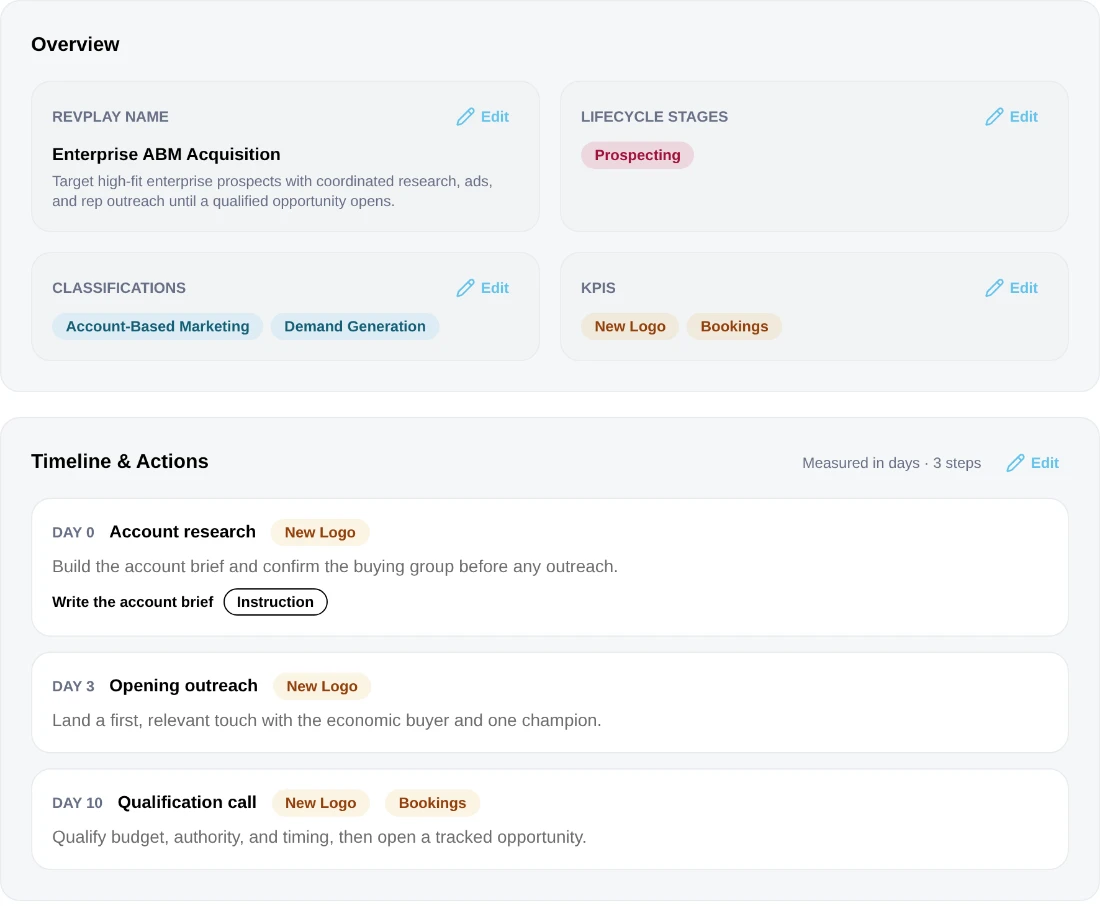
The Review and Activate step of a RevPlay. Before the play runs against a single account, the whole definition is laid out for a person to check: what it is called, which lifecycle stages it targets, how it is classified, the KPIs it is measured on, and every timed action in order. Nothing is enrolled until someone activates it here. Screenshot of the RevTech application; sample data. A play reviewed before activation. The follow-through is where an account-based motion is won or lost. - Step 5 of 5
Measure penetration, not sends
The standing question on whether you are penetrating targeted accounts is the right measure here, alongside the account engagement on the campaign. Volume of outreach into named accounts is an input and reporting it as a result is how these programmes lose their funding.
What arrives
What this puts in your Action Center
| Item | What is prepared | How it resolves |
|---|---|---|
| AccountAssetReview | An asset written against one account’s own context, for its owner | The artifact itself |
| AccountSignal | The correlated signals for a target account | The account, on its Signals tab |
| RevPlayActionInstance | The instruction, the objective, the KPI and the account context for one step | Opens the account; completion goes through the play |
What to take away
- A segment is reusable and shared. An export is neither.
- Specificity should follow review capacity, not ambition.
- Owners before launch. An unowned third of the list is not an account-based motion.
- Penetration is the measure. Outreach volume is an input.
Go deeper
The material behind this
Try the demo.
See agents carry the repeatable work of GTM across sales, marketing, customer success, and RevOps. Every action prepared, reviewed, and recorded. Fictional data, real product.
Explore the demo