See renewal risk while it is still fixable
Health is a way to rank attention, not a verdict. How to turn the distribution into the specific list you work this week.
The job
“I want to know which customers need attention before the renewal is thirty days out.”
- Customer success managers
- CS leaders
- RevOps
Customer success work fails quietly. Nobody notices the account that stopped engaging until the renewal is close, and by then the conversation is a negotiation rather than a relationship. The signals were all present — usage drifting, the champion gone, tickets rising — and all in different places.
A health score does not predict anything. What it does is rank attention across a book too large to hold in your head, which is a smaller claim and a much more useful one.
What it moves
- Renewal risk surfaced
- Time to risk action
- Gross revenue retention
The division of labour
What RevTech does, and where you decide
In the product
How to do it
- Step 1 of 4
Read the distribution, not the average
Customer Health shows the health-score distribution and the at-risk save list, drillable by segment. The average is the least informative number on the page — a book with everybody at neutral and a book split between very healthy and very unhealthy have the same mean and nothing else in common.
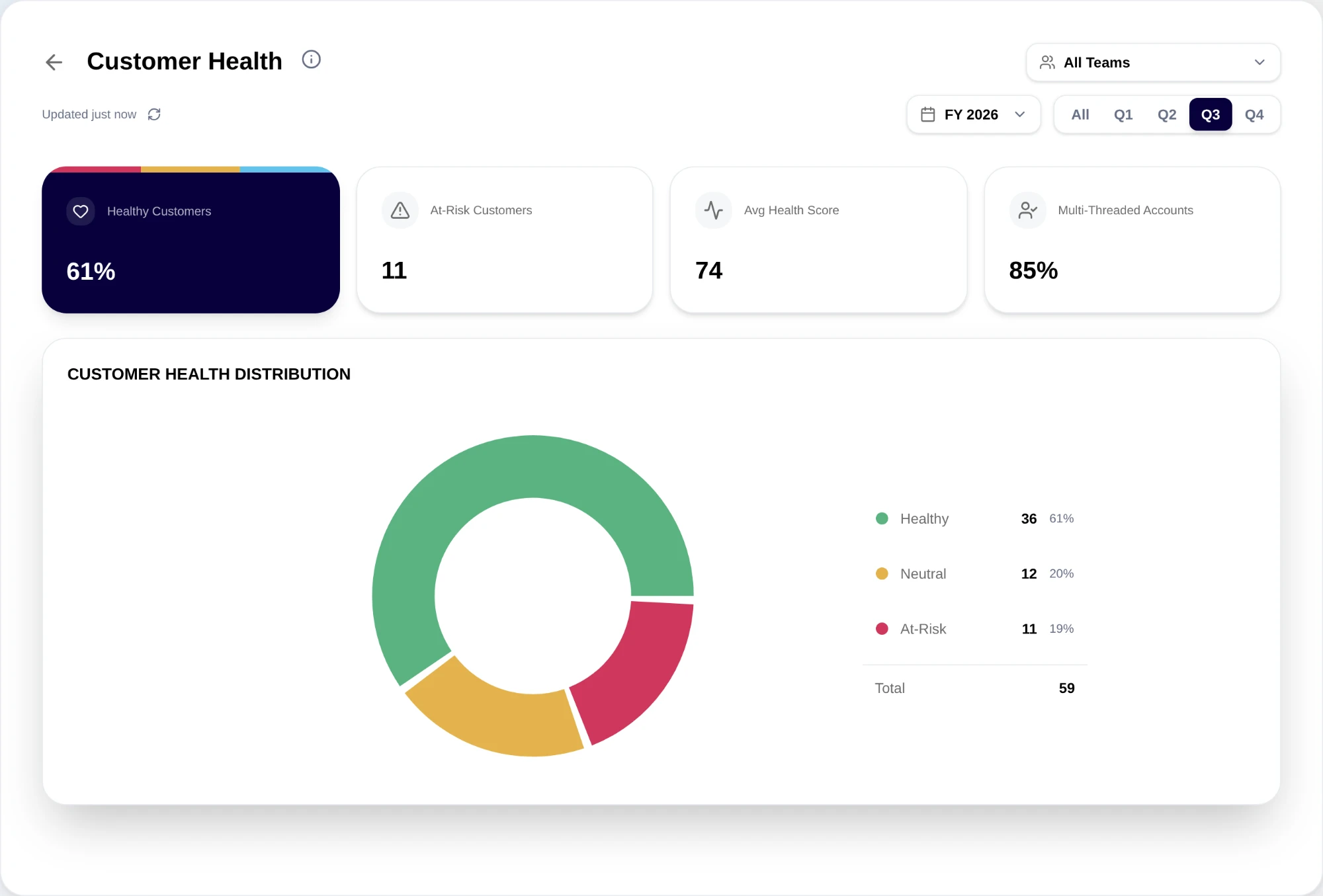
The Customer Health view: health scores distributed across the customer book, with at-risk accounts surfaced so retention work starts before a renewal is in danger. Screenshot of the RevTech application; sample data. Health across the book. The distribution is the read; the mean is not. - Step 2 of 4
Drill from a segment into the accounts
Each health band drills into the accounts underneath it. That is how a distribution becomes a list of names, which is the only form in which any of this gets worked.
- Step 3 of 4
Produce an owned list every week
The output of this read is not a feeling about the book. It is a specific list of accounts, each with a named owner and a date, or an explicit reason it is fine. An account that appears on the at-risk list three weeks running with no owner is the finding, not the account.
- Step 4 of 4
Act on the health cards as they arrive
A health drop arrives with the reason — champion change, usage dip, ticket spike — and an intervention plan rather than just a number that moved. A stakeholder change in particular is worth treating as urgent: it is the signal with the longest lead time and the most predictable consequence.
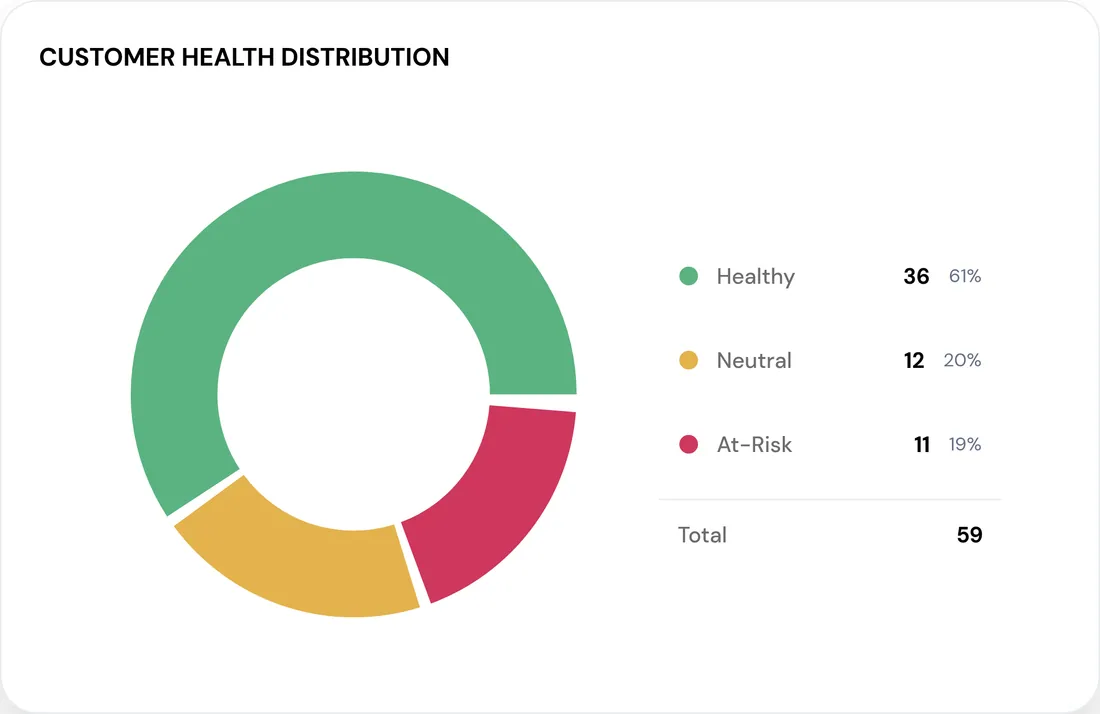
Customer health shown as a distribution, so concentrations of risk are visible rather than hidden behind an average. Screenshot of the RevTech application; sample data. A health change with the reason attached, which is what makes it actionable.
What arrives
What this puts in your Action Center
| Item | What is prepared | How it resolves |
|---|---|---|
| HealthRisk | An intervention plan: the new-champion map and an executive agenda | The account |
| RenewalDue | A brief carrying the usage trend, the value recap and the risk flags | The account |
What to take away
- Health ranks attention. It does not predict an outcome, and using it as a prediction is how it loses credibility.
- Read the distribution. The mean hides the only two things worth knowing.
- The output is an owned list with dates, not an impression of the book.
- A champion change has the longest lead time of any signal here. Treat it as urgent.
Go deeper
The material behind this
Try the demo.
See agents carry the repeatable work of GTM across sales, marketing, customer success, and RevOps. Every action prepared, reviewed, and recorded. Fictional data, real product.
Explore the demo