Enablement
What is customer success operations?
Customer success operations (CS Ops) is the function that runs the systems, data, and process behind retention and growth: renewal management, churn-risk detection, expansion, and clean handoffs from sales. It keeps CS teams focused on the right accounts at the right time. In the agentic model, agents monitor health continuously and surface risk early, so intervention beats the save.
Definition
The operations behind retention and growth
Winning a customer is the beginning; keeping and growing them is where durable revenue comes from. Customer success operations is the function that makes that repeatable: the systems, data, and process that tell CS teams which accounts are healthy, which are at risk, and where expansion is possible.
CS Ops sits on the same operating-model pillars as RevOps — systems, data, process, governance — applied to the post-sale motion. It turns customer signals into timely, coordinated action.
The core CS operations motions
Four connected motions carry most of the retention and expansion workload.
- Renewal management — tracking, forecasting, and executing renewals
- Risk detection — spotting churn signals early enough to act
- Expansion — surfacing upsell and cross-sell opportunities
- Handoffs — clean transitions from sales to onboarding to CS
- Health scoring — a trusted signal of account state
The traditional model: reacting too late
In the manual model, CS teams learn about risk from lagging indicators — a support escalation, a missed QBR, a renewal that suddenly goes quiet. By then the account is already a save, not a steady relationship. Health scores are stale, renewals are managed in spreadsheets, and handoffs lose context between teams.
The problem is signal timing. Risk and expansion signals exist in the data long before a human notices them, but no one is watching continuously.
How the agentic model changes CS operations
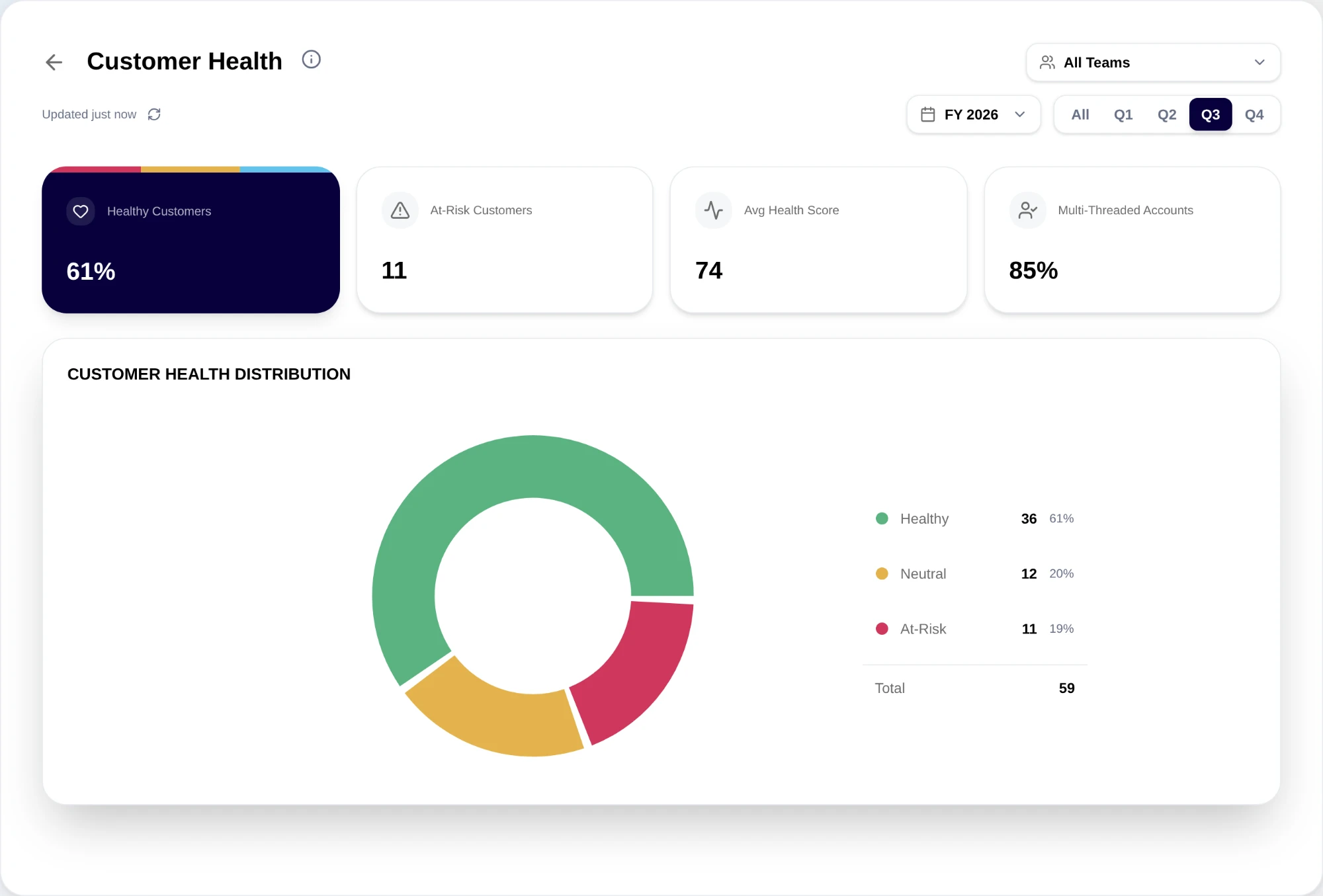
Agents monitor every account continuously. A customer-risk agent watches usage, engagement, and sentiment signals to flag churn risk early; a renewal-risk agent tracks upcoming renewals and surfaces the ones in jeopardy; a customer-expansion agent identifies where growth is possible. All of it is grounded in your context layer.
CS managers then do the human work: the conversations, the saves, the expansion plays. Agents do the repeatable monitoring and preparation; humans manage the last mile of the relationship.
Metrics of customer success operations
CS operations is measured on the durability and growth of the customer base.
- Gross and net revenue retention
- Churn rate and at-risk revenue identified early
- Renewal rate and on-time renewal execution
- Expansion pipeline and upsell conversion
- Time from risk signal to intervention
Frequently asked questions
Catch risk before it becomes a save
Put risk, renewal, and expansion agents on every account so CS acts early and grows the base.
Try the demo.
See agents carry the repeatable work of GTM across sales, marketing, customer success, and RevOps. Every action prepared, reviewed, and recorded. Fictional data, real product.
Explore the demoPut it to work
Jobs this page is behind
- SellingHand over a new customer without losing the context“I want to hand a new customer to the team who will keep them, with everything they need.”
- Forecast and planTrust the ARR bridge“I want to report ARR, retention and NRR from numbers I can defend.”
- CustomersSee renewal risk while it is still fixable“I want to know which customers need attention before the renewal is thirty days out.”
- CustomersStart every customer the same way“I want to give every new customer the same start, and know when one is drifting.”