Slide 1 of 4
Assembly, not judgment
The context arrives gathered: health, usage, stakeholders, support history, engagement, the value delivered since the last renewal.
Know what arrives already assembled for a renewal, and what remains entirely yours to decide.
The preparation for a renewal is the part that is the same every time: pulling the health picture together, checking product usage, listing who the stakeholders are and how engagement has moved, reviewing support history, and assembling the evidence of value delivered since the last renewal. It is genuinely necessary work and it is genuinely repetitive, which is exactly the profile of work that belongs with an agent.
What changes is where the conversation starts. Instead of an hour of gathering before you can think, the material is already in front of you and the first hour is spent on the decisions. That is the whole operating model in miniature: the work arrives prepared, not done.
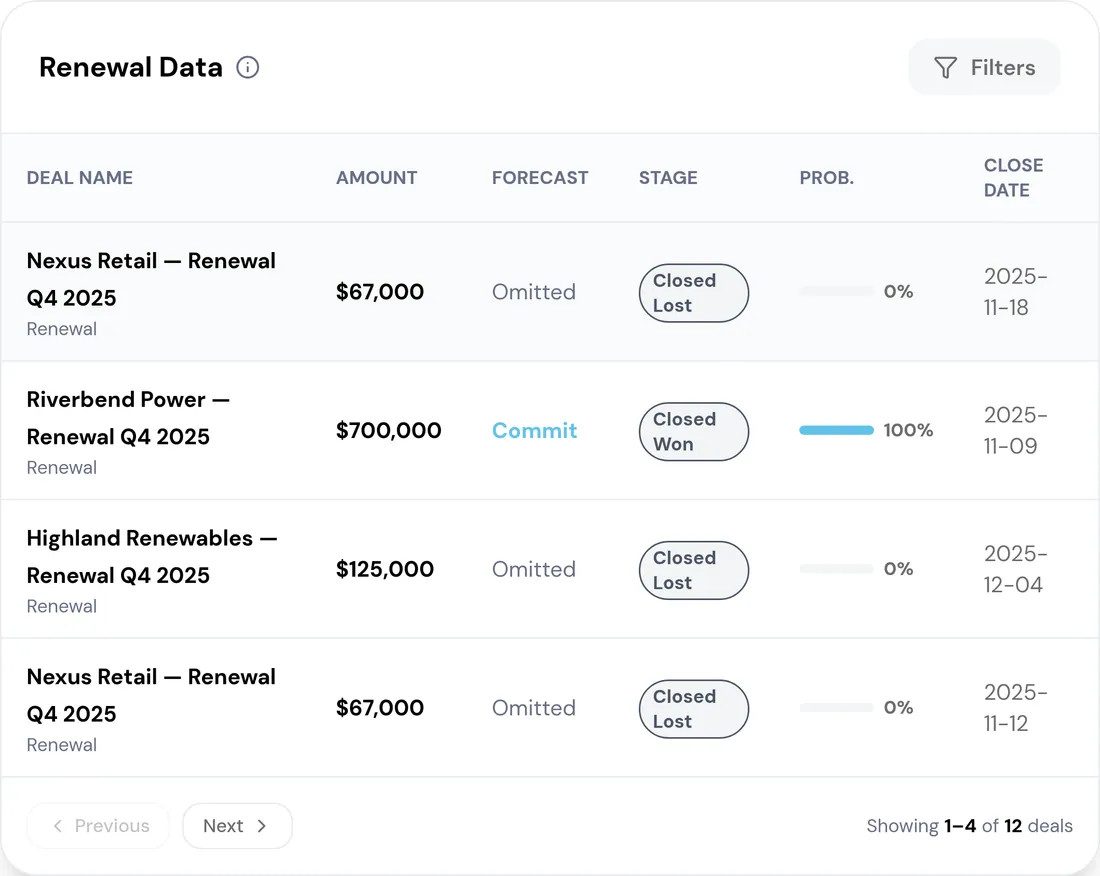
Every judgment in the renewal remains with you, and it is worth being explicit about which ones those are, because the presence of good preparation makes it easy to drift into treating the assembled view as a recommendation.
Whether to open on value delivered, on risk mitigation or on the partnership. What is worth conceding and what is not. Whether this account is a renewal conversation at all or an expansion one wearing a renewal date. Whether the relationship can carry a difficult ask right now. None of that is in the data, and an agent that decided any of it would be a liability rather than a help.
Preparation inherits the record, so it fails in the specific ways your data fails, and those failures arrive looking like confidence rather than uncertainty. A stakeholder who left three months ago still appears as the champion, because nothing marked their departure. Usage reads as a cliff because a team migrated to a second workspace recorded separately. A support escalation that dominated the relationship for a fortnight is missing entirely, because it was handled on calls nobody logged.
In each case the assembled view is coherent, internally consistent, and describing a customer that does not exist.
What makes this manageable is that the failures are predictable. They cluster around events that happen off-system: people leaving, work moving, conversations held on the phone. So the audit is not a general suspicion of the preparation. It is a short list of specific things to check, on the renewals where being wrong is expensive.
For a routine renewal, taking the preparation at face value is a fair trade. For your largest and most at-risk ones it is not. Open the account and check the prepared context against four questions.
When one of those four turns up something, fix your own preparation — and then hand the underlying problem to whoever owns hygiene. A departed champion still listed on the record is not wrong only in your renewal brief. It is wrong on every surface that reads that account, and you are the one who noticed.
You should be able to answer each of these from memory before opening it. Recalling the answer is what makes it stick; recognizing it when you read it does not.
Assembled: the health picture, product usage, stakeholders and engagement, support history, value delivered since last renewal. Yours: the framing (value, risk or partnership), what to concede, and whether this is really an expansion conversation.
On your largest and most at-risk renewals. Preparation inherits whatever the record gets wrong, and a departed stakeholder or an unlogged escalation is invisible from the summary alone.
The context arrives gathered: health, usage, stakeholders, support history, engagement, the value delivered since the last renewal.
Prepared context is drawn from the record. Where the record is wrong or thin, the preparation inherits it, and the account is where you find that out.
You get the hour back that went on gathering. The hour that went on deciding is still the job.
See agents carry the repeatable work of GTM across sales, marketing, customer success, and RevOps. Every action prepared, reviewed, and recorded. Fictional data, real product.
Explore the demo