Slide 1 of 4
Read the trigger before the draft
A response arrives with the reason it was prepared. Reading the draft first anchors you to its wording instead of to whether it should exist.
Review a drafted customer response against the trigger that produced it, and know what to change versus what to send back.
A prepared response reaches you as an item carrying three things: the drafted message itself, the trigger that prompted it (the condition the agent observed), and the outcome it is expected to produce. Your controls are the standard three: approve it, edit then approve, or reject it, ideally with a reason.
Nothing sends until you decide. That is worth restating because it defines what kind of task this is: not quality control on something already in flight, but the actual decision about whether this message exists. The order you read those three parts in is the entire skill of this lesson.
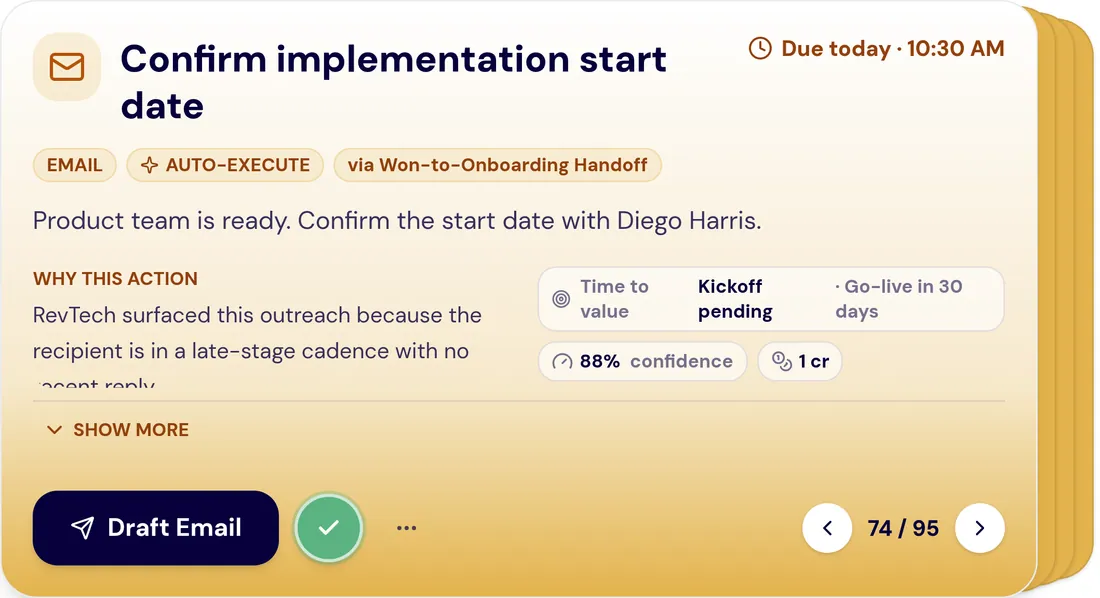
A prepared response comes with the trigger that prompted it and the outcome it is expected to produce. Read those first. It is a small discipline with a real effect: opening the draft first anchors you on the wording, and you end up editing sentences in a message that should not have been drafted at all.
The trigger also tells you whether the system's reading of the situation matches yours. When it does not (the response is pitched at a concern the account resolved last month, or it treats a routine question as an escalation) the wording is irrelevant and the useful feedback is about the trigger.
Reviewing well is mostly a matter of asking things in the right sequence, because each question makes the next one cheaper. Should we be responding to this at all? Then: is this the right thing to say? Only then: is this the right way to say it?
Most reviewers start at the third question, since wording is what is in front of them and it is the easiest thing to have an opinion about. That is how a well-written response to the wrong situation gets approved, polished, on-brand, and answering something nobody asked.
Once you know what is wrong, the choice between editing and rejecting is a question of what recurs. Tone, phrasing and a detail specific to this customer are faster to fix than to explain, so fix them and move on. A wrong argument, a wrong trigger, or a claim that should not have been made is a defect that will show up again on the next account, and returning it is what gets it fixed.
Reject properly when you do. A rejection with a reason is a correction to the system; a rejection without one is a message that says only that something was wrong, which cannot be acted on. This is the same discipline as the campaign course's pattern-versus-instance distinction, arriving in a different queue.
A response arrives for an account that has gone quiet. The draft is good: warm, specific, references the last QBR, asks a clear question. Reviewed on wording alone it sails through.
The trigger says it was prepared because engagement dropped below a threshold. Reading that first changes the question. Engagement dropped because the champion has been on parental leave for six weeks, which is recorded on the contact and was not part of what the threshold looks at. The account has not gone quiet; one person has.
The right outcome here is not an edit. Editing the wording ships a well-phrased message to a covering stakeholder implying their team has gone silent, which is both wrong and slightly insulting. The right outcome is to reject it with the reason, because the same threshold will fire again on the next account whose main contact is on leave, and the reason is the only thing that can prevent that.
This is the case that makes the trigger-first habit worth the two seconds. Read in the other order, nothing about the draft invites suspicion, and a fluent message papers over a wrong premise.
You should be able to answer each of these from memory before opening it. Recalling the answer is what makes it stick; recognizing it when you read it does not.
Should this response exist, is the substance right, is the wording right. Most reviewers start at the third because wording is what is in front of them, which is how a well-written response to the wrong situation gets approved.
Edit what is local: tone, phrasing, a detail specific to this customer. Send back what will recur: a wrong argument, a wrong trigger, a claim that should not have been made. Always with a reason.
A response arrives with the reason it was prepared. Reading the draft first anchors you to its wording instead of to whether it should exist.
A wording change is faster to make than to explain. A wrong argument is a defect worth returning, because it will recur.
The draft waits. Approval is a decision you make, which is the whole point of the queue.
See agents carry the repeatable work of GTM across sales, marketing, customer success, and RevOps. Every action prepared, reviewed, and recorded. Fictional data, real product.
Explore the demo