Slide 1 of 4
The book is laid out by period
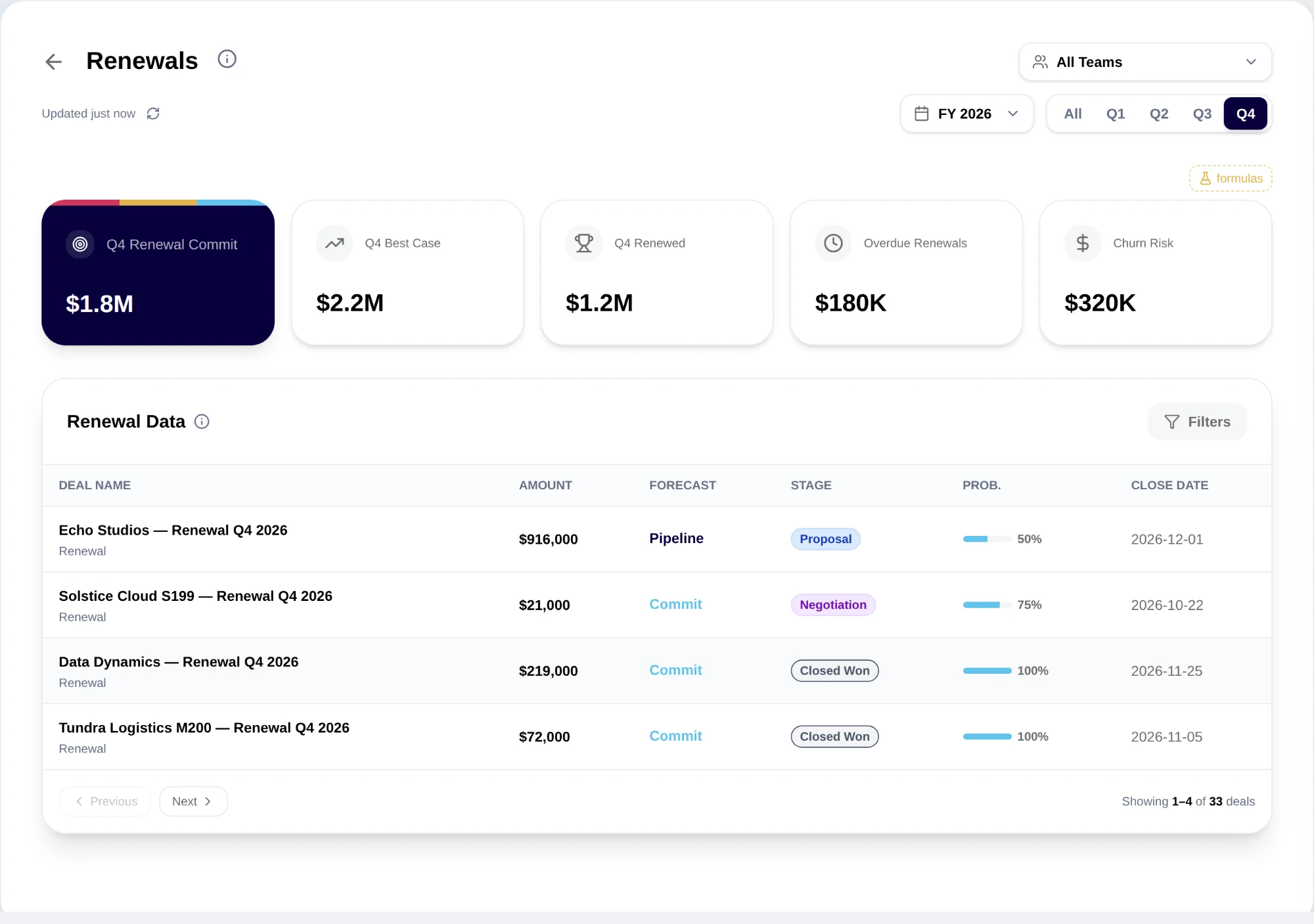
Commit and best-case totals sit above the individual renewals, each with its value, date and current risk.
Work the renewal book by period rather than by whatever is closest, and start each renewal on a timeline set by its risk.
The renewal book is organized by period, with commit and best-case totals above the individual renewals, each carrying its value, its date and its current risk. The intent is that a CS team walks into a renewal quarter already knowing which accounts need attention and which are safe, rather than discovering it as the dates arrive.
The two halves answer different questions and both matter. The totals tell you the shape of the quarter: whether commit covers what you need, and how much of the gap sits in best case. The individual rows tell you where to spend the week. Reading only the totals produces a forecast nobody is acting on; reading only the rows produces activity with no sense of whether it adds up.
The intuitive way to work a dated book is in date order, and it is subtly wrong. The lead time a renewal needs is a function of its risk and its size, not of how soon it happens to fall. A large enterprise renewal with real risk on it needs a quarter of work, stakeholder mapping, value evidence, an executive conversation, a negotiation. A healthy small renewal needs a fraction of that.
Working strictly by date gives both the same runway, which means the difficult one starts too late and the easy one absorbs attention it did not need. Sort by risk and value instead, and let the date decide urgency within that ordering rather than across it.
Comparing commit against what the period needs is the single most useful early reading available, because it is the one that still leaves time to respond. A coverage gap identified in the first weeks of a quarter can be worked, saves accelerated, expansion pulled forward, an at-risk account escalated. The same gap identified in the final weeks can only be reported.
For the same reason, spend part of every renewal review looking one period ahead rather than only at the current one. The renewals you ought to be starting now largely sit in the next period, and a review that only examines the current one guarantees you are always beginning the hardest conversations later than you should.
Next quarter's book, sorted by risk and value instead of date: at the top, Harborview Systems at 480k, high risk, renewing in eleven weeks. It gets a start date of this Monday, an executive sponsor named in the plan, and the quarter of runway the risk demands. Second, Delta Freight at 60k, high risk, nine weeks out. Early start but a deliberately cheap motion: the save effort is capped at what a 60k renewal is worth. Third, Pinewood Health at 350k, low risk, six weeks out: a light touch scheduled at four weeks, with the value evidence refreshed, and no more.
Then the tail of small, healthy renewals: processed on their dates, no special handling. Notice what the sort did. The account renewing soonest (Pinewood) is third in effort, and the account getting the most runway renews latest. Date order would have inverted exactly the two decisions that matter.
Do this in the product
You should be able to answer each of these from memory before opening it. Recalling the answer is what makes it stick; recognizing it when you read it does not.
Runway is a function of risk and size, not of proximity. Working strictly by date gives a difficult enterprise renewal and an easy small one the same lead time, so the hard one starts too late.
The renewals you should be starting now mostly sit in the next period. A review that only looks at the current period guarantees the hardest conversations always begin later than they should.
Commit and best-case totals sit above the individual renewals, each with its value, date and current risk.
Commit against the total tells you the shape of the quarter early, while there is still time to change it.
The renewals you should be starting now mostly sit in the next period, not this one.
See agents carry the repeatable work of GTM across sales, marketing, customer success, and RevOps. Every action prepared, reviewed, and recorded. Fictional data, real product.
Explore the demo