Slide 1 of 4
The map shows the buying group
Stakeholders with their roles and relationships — where the relationship is deep, where it rests on one person, and which parts of the group nobody has met.
Use the account map to find where the relationship is thin, and treat coverage gaps as the precondition for expansion rather than an afterthought.
The account map is the mapping tab of the account record. It lays out every stakeholder with their role and their relationships, both to each other and to your team, so the depth of coverage is visible as structure rather than as a number: where the relationship is deep, where it rests on a single contact, and which parts of the buying group nobody has met.
That makes it the evidence expansion conversations depend on, and the framing is precise. Expansion is a conversation with a person who can sponsor it, so the map is a picture of whether such a person exists.
It is also the concrete form of the multi-threading metric from the first module. Multi-threading gives you a number for the account; the map tells you who the contacts are and where the holes sit. The metric flags the problem; the map is where you plan the fix.
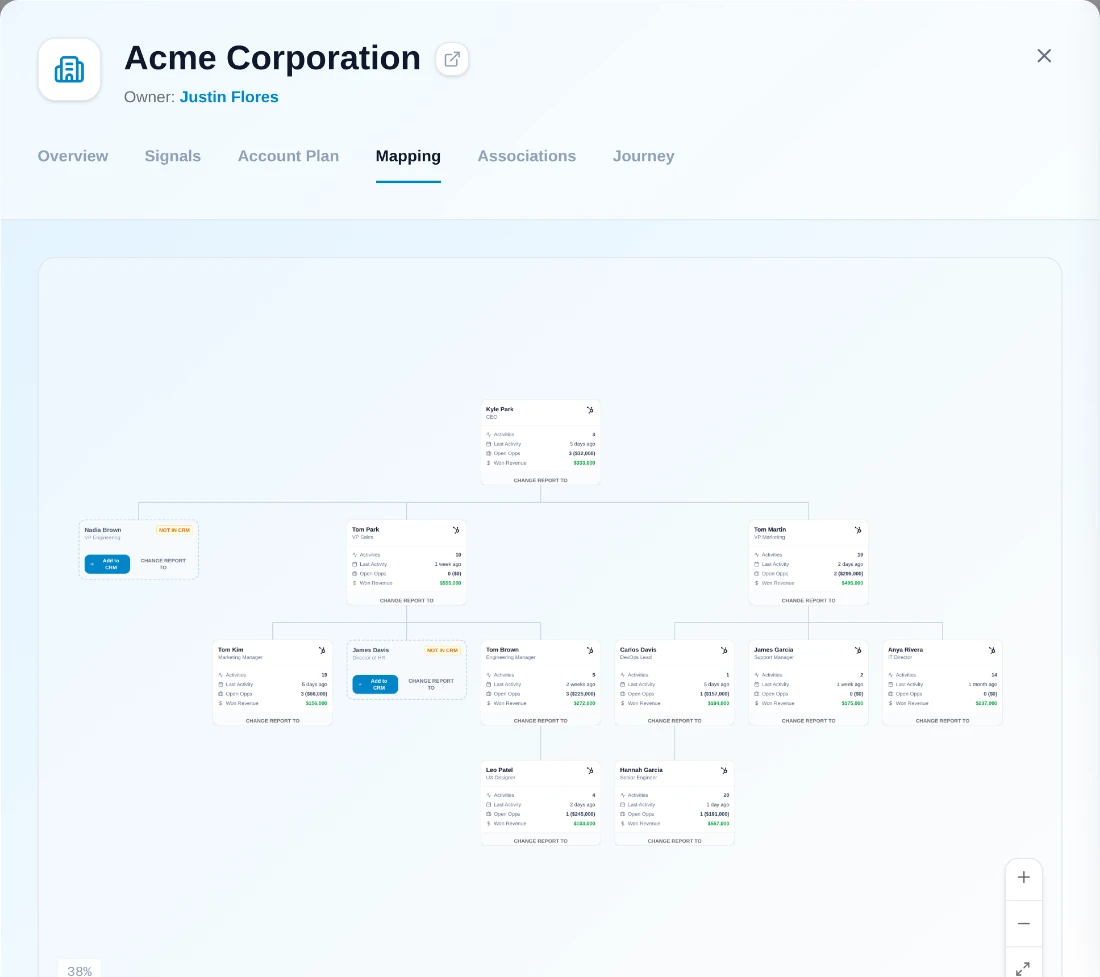
Coverage gaps are not interchangeable, and naming which one you have determines the work.
A single-threaded account holds its entire relationship in one person, and everything else is downstream of that. A wrong-level gap has healthy coverage among users and practitioners and nothing where budget is decided: the accounts that love the product and cannot buy more of it. An unmet-function gap means part of the buying group, security or finance or the neighbouring team who would be the natural next users, has never been in a conversation.
Only the third is really an expansion motion. The other two are relationship work that has to happen before an expansion conversation is possible at all.
Stakeholders and relationships are visible on the account record specifically so that a change in the buying group reaches whoever owns the account. Those changes are among the most actionable signals available, and they cut both ways.
A departure on a single-threaded account is urgent regardless of what the health score currently says, because the score is a lagging summary and the loss of your only relationship is a present fact. A new arrival in a relevant function is the opposite: a moment when introductions are easy and a new stakeholder is actively forming views. Both are worth acting on within days rather than at the next review.
Three accounts in the same segment all show as expansion candidates on usage. The map gives each a different first move.
The first has eight mapped stakeholders across three functions, including a named economic buyer your team has met. There is no coverage problem, so the first move is the expansion conversation itself, and it can be booked this week.
The second has six stakeholders, all of them practitioners in one team. This is the wrong-level gap: the people who love the product cannot buy more of it, and pitching them harder produces enthusiastic internal advocates with no budget. The first move is a route to the economic buyer, usually via the strongest practitioner relationship, and the expansion conversation happens after that.
The third has one contact. Whatever the usage says, this is a renewal risk before it is an expansion opportunity, because a single departure ends the relationship entirely. The first move is breadth, and an expansion approach made before that breadth exists is a conversation with a single point of failure.
Same signal, same segment, three different weeks of work, and the only thing that distinguishes them is the map.
You should be able to answer each of these from memory before opening it. Recalling the answer is what makes it stick; recognizing it when you read it does not.
Single-threaded (the whole relationship is one person), wrong-level (good coverage below the economic buyer, none at it), and unmet function (part of the buying group nobody has met). Only the third is an expansion motion; the first two are relationship work that has to happen first.
Urgent now. The score is a lagging summary and the loss of your only relationship is a present fact, so waiting for the score to catch up wastes the window where re-entry is easiest.
Stakeholders with their roles and relationships — where the relationship is deep, where it rests on one person, and which parts of the group nobody has met.
An expansion conversation needs someone who can sponsor it. A gap where the sponsor should be is the first thing to fix, not a detail to work around.
Stakeholder movement is visible on the account. A departure on a single-threaded account is urgent regardless of what the health score says.
See agents carry the repeatable work of GTM across sales, marketing, customer success, and RevOps. Every action prepared, reviewed, and recorded. Fictional data, real product.
Explore the demo