Slide 1 of 4
Review is a reading, not a checkbox
The whole motion is laid out in order: the timeline, each step's objective and execution instructions, the actions attached, and who they route to.
Read a finished play back on the Review & Activate step and catch the errors that only become visible when the whole motion is laid out in order.
Step 4 is Review & Activate. It lays the whole motion out for a person to check before it runs against a single account: the name, lifecycle stages, classifications and KPIs from Overview; every timeline step in order with its objective and execution instructions; the actions attached to each step and who they route to; and the eligibility conditions.
Anything required and still missing is listed beside the Activate button, and each blocker links straight to the step that needs it: click the blocker, fix the field, come back. There is deliberately no readiness score: an earlier version of this step carried one and it was removed in favour of plain required-field validation, because a score invites you to interpret a number when the only real question is binary. Two buttons leave the step. Save Draft keeps everything without starting anything. Activate sets it live.
Every field in your play was correct when you wrote it. The errors that survive to this step are relational: they live between steps rather than inside one, which is exactly why building the play step by step cannot surface them and reading it end to end can.
Three recur often enough to look for by name. Each of them comes from the same cause: the steps were written in separate sittings, and nobody has read them together since.
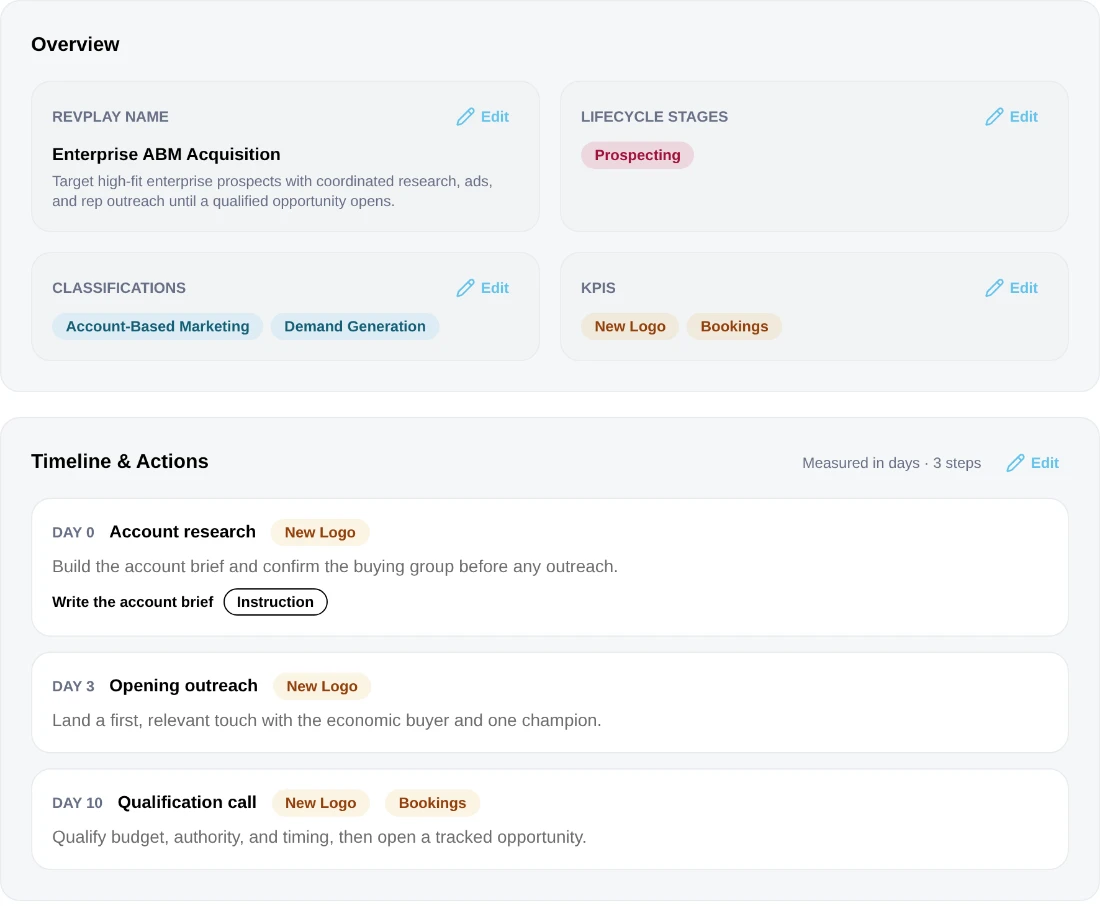
Read the play twice, and change who you are between readings. The first pass is as the account: this sequence of touches arrives at your company over these weeks, is it coherent, is it attentive, would it feel like one conversation or several unrelated approaches?
The second pass is as the owner the actions route to: these items arrive in your queue on these days, carrying these instructions, can you act on each one without going to find something the play did not give you? The first pass catches an incoherent customer experience. The second catches an unworkable queue. Neither finds the other's errors.
You should be able to answer each of these from memory before opening it. Recalling the answer is what makes it stick; recognizing it when you read it does not.
Relational ones, which exist between steps rather than inside one: duplicate asks landing on the same owner days apart, instructions assuming preparation an earlier step never does, and gaps long enough to break the conversation.
Once as the account, which catches an incoherent customer experience, and once as the action owner, which catches an unworkable queue. Neither pass finds the other's errors.
The whole motion is laid out in order: the timeline, each step's objective and execution instructions, the actions attached, and who they route to.
Anything still missing appears here with a link straight to the step that needs it. There is no readiness score to interpret, either a required field is filled or it is not.
Two passes catch different errors: the first finds an incoherent experience, the second finds an unworkable queue.
See agents carry the repeatable work of GTM across sales, marketing, customer success, and RevOps. Every action prepared, reviewed, and recorded. Fictional data, real product.
Explore the demo