Slide 1 of 4
AI prepares, humans decide
Autonomy is set per action. The question is never whether people are involved. It is how much is ready before they are.
Set the autonomy level for each action deliberately, so review lands where the risk is rather than everywhere.
Autonomy is set on each action, where the action is defined inside its timeline step. It is not a switch on the play, and that granularity is what makes the model workable: within one play, assembling a briefing pack can run unattended while the outreach that follows it waits for a person. Set one level for the whole play and you have thrown that away.
One rule holds regardless of what you configure — external touches never fire on their own. A message to a customer always waits for a person. So the decision here is narrower and more interesting than "should humans be involved": for each internal or preparatory action, does a review gate buy scrutiny where it matters, or does it just add a keystroke to someone's morning?
The answer that holds up in practice: gate where the consequence is external, commercial, or hard to reverse. Assembling a brief, preparing context, updating an internal field that writes to history: all recoverable, none needing a gate. A message to a customer, a change to a commercial term, anything a person could not undo in a minute: those do.
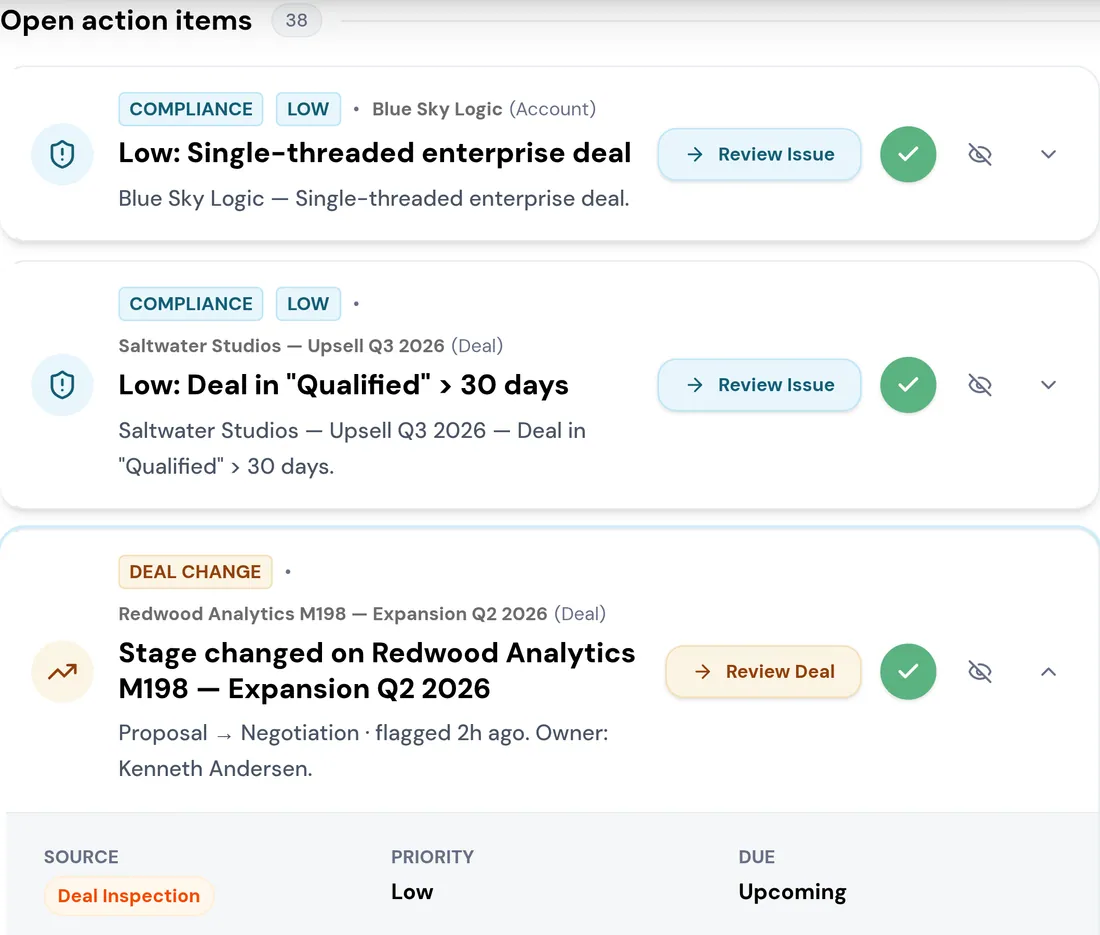
The instinct on a first play is to gate everything, on the reasoning that more approval is more control. It is not. A queue in which every single item requires a decision is a queue people learn to clear rather than read, and the approval becomes a keystroke. You end up with less scrutiny on the items that mattered, because they arrived in a stream of items that did not.
Targeted approval concentrates attention where it changes outcomes. It also tells your team something useful about the play: the items that stop for a human are the ones the organization considers consequential. Stop everything and that signal is gone.
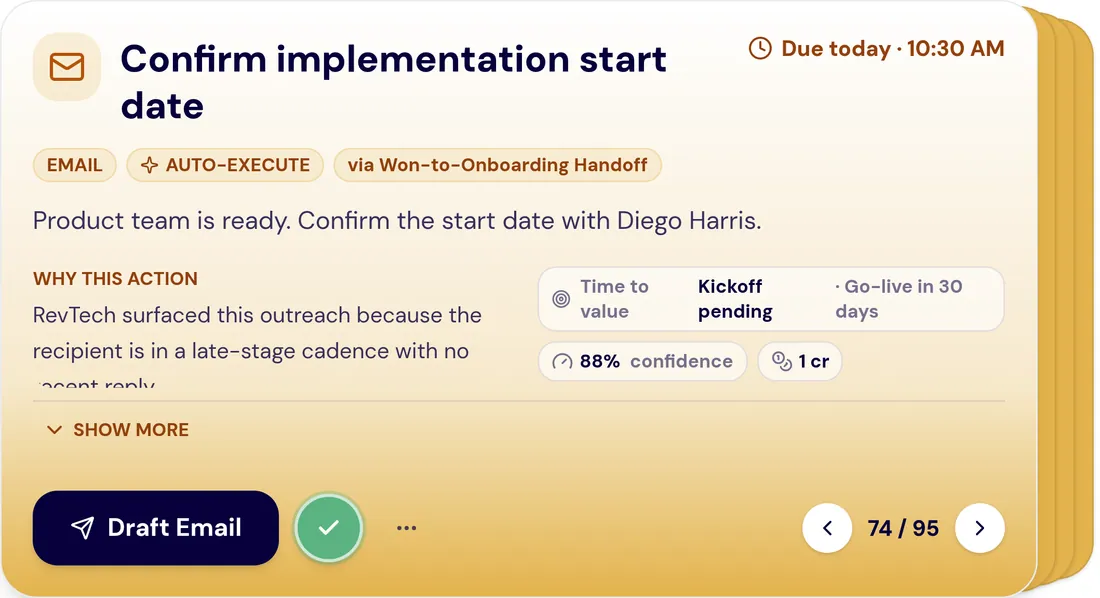
Once the play is running, what gets rejected is the most honest feedback you will get about it. A one-off rejection is an account-specific judgment, exactly what the human is there for. The same step rejected repeatedly, by different people, is not judgment; it is a defect in the step, and the fix belongs in the play rather than in each person's queue.
Build the habit early, because it is what turns a play from something you launched into something you operate. The measure of a healthy play is not how few items it sends for review; it is whether the ones it sends are the ones people actually change.
Inside one re-engagement play, three actions sit at three different autonomy levels, and the reasoning for each is short.
Assembling the briefing pack runs unattended. It reads records the owner could have read themselves, produces an internal document, and if it gets something wrong the owner notices while reading it. There is no external consequence and no commercial commitment, so a gate here buys nothing and costs a decision.
The outreach to the economic buyer stops for approval. It leaves the building, it carries a claim about the pilot outcome, and it cannot be recalled. That is all three risk criteria at once, and it is exactly the item a person should spend their attention on.
The third action is the one worth sitting with. Updating the opportunity stage after a reply runs unattended, but writes to the change history.
It changes a record a forecast depends on, which feels consequential enough to gate. But it is fully reversible and fully attributed: you can see what changed, when, and what triggered it. The audit trail is doing the work an approval gate would otherwise do, and it does it without spending anyone's morning.
That is the pattern to look for when you are tempted to gate something. Ask whether the thing you want from the gate is control, or simply a record, because a record is much cheaper.
You should be able to answer each of these from memory before opening it. Recalling the answer is what makes it stick; recognizing it when you read it does not.
Anything external, commercial, or hard to reverse. Recoverable preparation such as assembling a brief or updating an internal field with an audit trail does not need one.
A queue where every item needs a decision is one people learn to clear rather than read, so approval becomes a keystroke. The consequential items then get the same three seconds as everything else.
Defect. A one-off rejection is account-specific judgment, which is what the human is there for. A repeated one across different reviewers is a fault in the step, and it belongs fixed in the play.
Autonomy is set per action. The question is never whether people are involved. It is how much is ready before they are.
A queue where every item needs a decision trains people to clear it without reading. Blanket approval produces less scrutiny than targeted approval, not more.
A step rejected repeatedly is telling you the step is wrong. Track what gets sent back; it is the most honest feedback the play will ever give you.
See agents carry the repeatable work of GTM across sales, marketing, customer success, and RevOps. Every action prepared, reviewed, and recorded. Fictional data, real product.
Explore the demo