Slide 1 of 4
A score is a summary, not a verdict
It compresses several signals into one number so a book of hundreds can be ordered. Compression is the point, and it is also the limitation.
Understand what a health score summarizes, and treat it as a way to rank attention rather than as a prediction about an account.
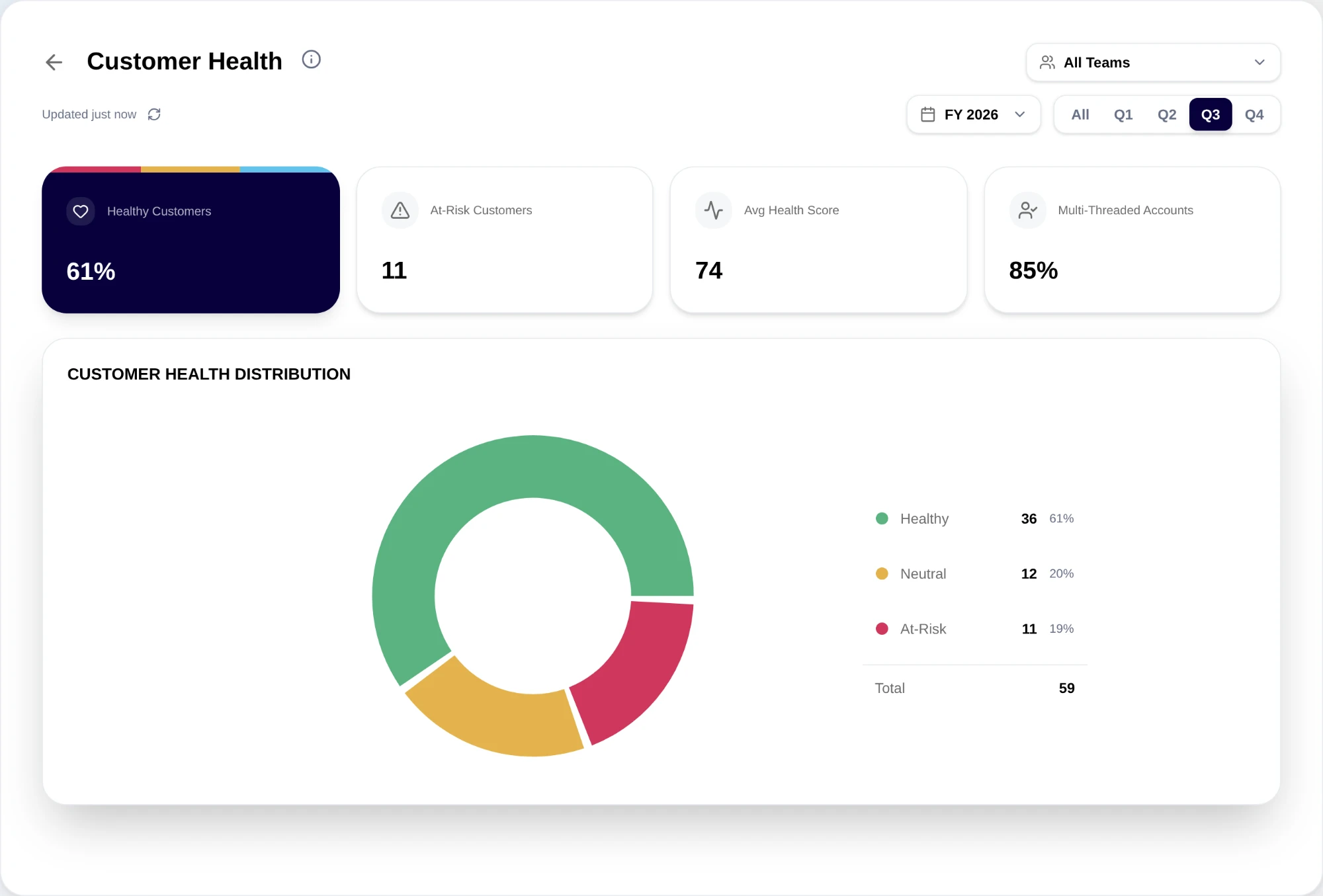
Customers is the retention command center, and it is three reports on three tabs: Retention (are we keeping the revenue we already won), Expansion (are we growing from the base), and Customer Health (the working list of accounts to act on). Two filters govern everything below them: fiscal year and quarter, defaulting to the current ones, and a team filter that narrows to Enterprise, Mid-Market, SMB or Strategic.
This module works the Health tab, where every customer is binned into Healthy, Neutral or At-Risk. Before trusting any of it, this lesson is about what the underlying score actually is and, just as importantly, what it is not.
A health score compresses several signals about an account (engagement, relationship breadth, product usage, support history) into one figure so that a book of hundreds of customers can be ordered by where attention is most likely to pay off. Ordering a large book is genuinely hard without something like it, and that is the job it does well.
It follows that the score is a ranking instrument rather than a prediction about any particular account. The Health surface reflects this by binning customers into Healthy, Neutral and At-Risk rather than presenting the score as a precise quantity: the bin is what changes your behavior this week, and arguing about whether an account is a 61 or a 64 is arguing about a rounding decision inside a summary.
One input deserves separate attention because it behaves differently from the others: multi-threading, the number of active contacts on an account. Accounts with three or more renew more reliably, and the reason is structural rather than sentimental: a relationship resting on one person is one job change away from being no relationship at all.
That makes it the most useful cross-check on the surface. When at-risk counts rise and multi-threading falls at the same time, the honest diagnosis is that the company has lost contact breadth, and a save motion built on demonstrating product value will underperform one built on rebuilding relationships. The two responses are different work, and the metrics tell you which you are in.
Two things reliably escape it. The first is anything the system cannot see: a change of sponsor discussed in a meeting nobody logged, a budget cycle nobody recorded, a competitor conversation happening entirely off your instrumentation. The second is causation. A score falls because inputs moved, and the inputs never say why.
So the working posture is to let the score choose where to look and never to let it conclude. It ranks the book; you open the accounts at the top of that ranking and find out what is actually happening. Teams that treat the number as the finding end up managing the metric, which is a well-documented way to make a metric stop being informative.
Two accounts both land at the bottom of the Neutral band, close enough that the score cannot separate them. Opening them takes five minutes and finds two unrelated situations.
The first has strong usage, a champion who replies quickly, and a single support escalation eight weeks ago that dragged. Its score is depressed by one input that has already resolved, and the honest read is that this account is fine and the number is lagging. Nothing to do beyond noting why it looks worse than it is.
The second has flat usage, one contact, and no meaningful engagement for a quarter. Its score is depressed because everything that feeds the score is genuinely weak, and the single contact means there is nobody to ask about it. That account needs work this week, and it needs relationship work before anything else.
Same band, same approximate number, entirely different weeks of work. This is what people mean when they say a score ranks rather than diagnoses, and it is why the discipline is to let the score choose where to look and never to let it conclude.
You should be able to answer each of these from memory before opening it. Recalling the answer is what makes it stick; recognizing it when you read it does not.
Good at ordering a large book by where attention is likely to pay off. Bad at predicting any individual account, because it compresses several signals into one number and cannot see anything unrecorded.
The company has lost contact breadth, so the problem is relationship coverage rather than product value. A save motion built on demonstrating value will underperform one built on rebuilding relationships.
It compresses several signals into one number so a book of hundreds can be ordered. Compression is the point, and it is also the limitation.
Accounts with three or more active contacts renew more reliably. When multi-threading falls while at-risk rises, the problem is relationship breadth, not product value.
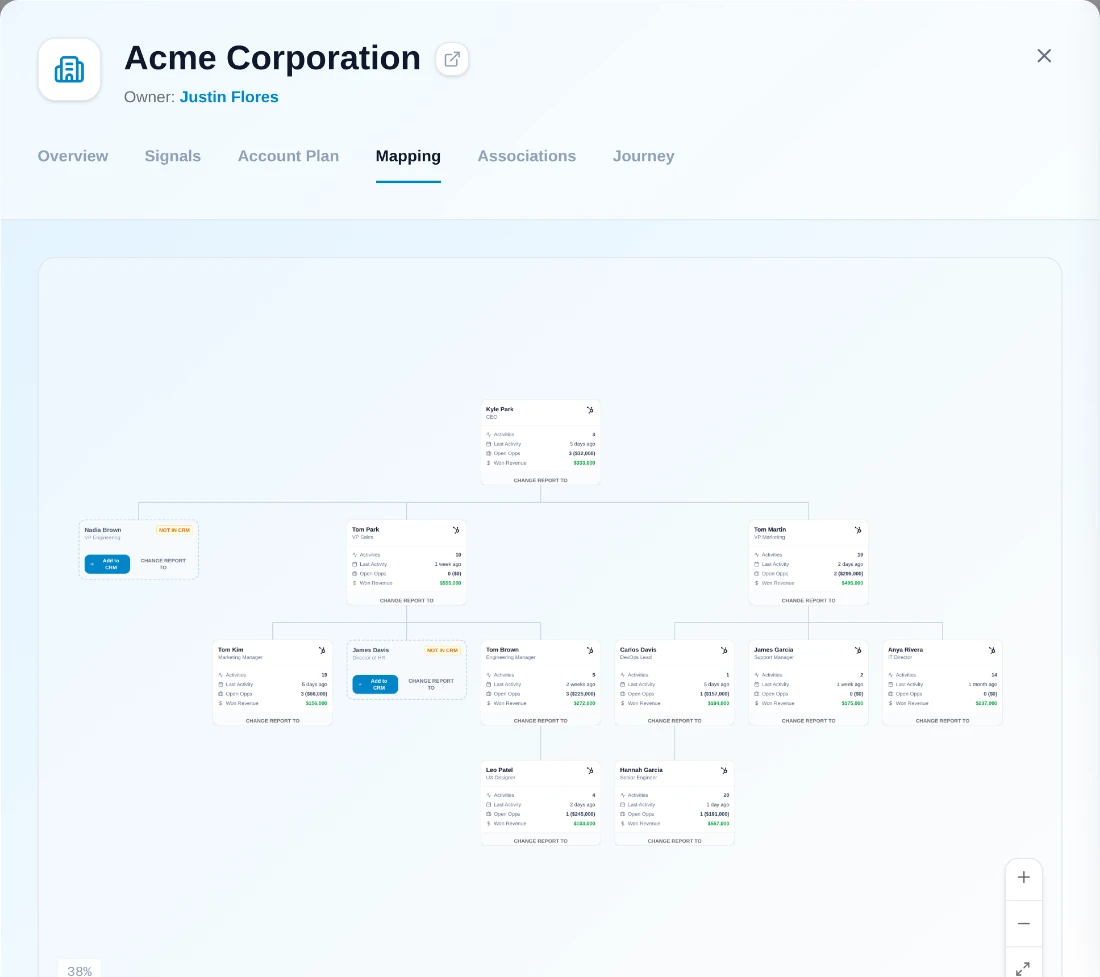
The score tells you which twelve accounts to open. What is actually wrong is in the account, not in the number.
See agents carry the repeatable work of GTM across sales, marketing, customer success, and RevOps. Every action prepared, reviewed, and recorded. Fictional data, real product.
Explore the demo