Enablement
What is pipeline management?
Pipeline management is the operating discipline of keeping the deals that drive revenue accurate, healthy, and moving. It combines inspection, testing whether deals are real, current, and progressing, with the actions that follow. Done well it makes the forecast trustworthy and the quarter predictable. In the agentic model, agents inspect the pipeline continuously so managers act on signal, not stale data.
Definition
Inspection plus action, run as a discipline
Pipeline management is not the same as pipeline reporting. Reporting tells you what the pipeline looks like; management is the discipline of interrogating it and driving the right next steps. It asks whether each deal is real, whether the stage reflects reality, whether coverage is enough to hit the number, and what has to happen next.
That discipline is what separates a pipeline you can forecast from a list of hopeful opportunities. It runs on a cadence and depends on data you can trust.
What good pipeline inspection tests
Inspection is the analytical core of pipeline management. It probes each deal and the pipeline as a whole for the signals that predict whether the number will land.
- Coverage — is there enough qualified pipeline to hit the target?
- Stage accuracy — does the recorded stage match real deal progress?
- Momentum — are deals advancing or quietly stalling?
- Risk — missing next steps, single-threading, slipping close dates
- Hygiene — are amounts, dates, and contacts current and complete?
The traditional model: the weekly scramble
In most teams, pipeline management happens in a manual weekly rhythm. Reps update deals the night before the call, managers eyeball a report, and the review becomes a status meeting rather than an inspection. By the time a risk surfaces, it is often too late to act on it.
The core problem is timing and data. Inspection is only as good as the data underneath it, and manual inspection can only happen periodically, so risk hides between reviews.
How the agentic model changes pipeline management
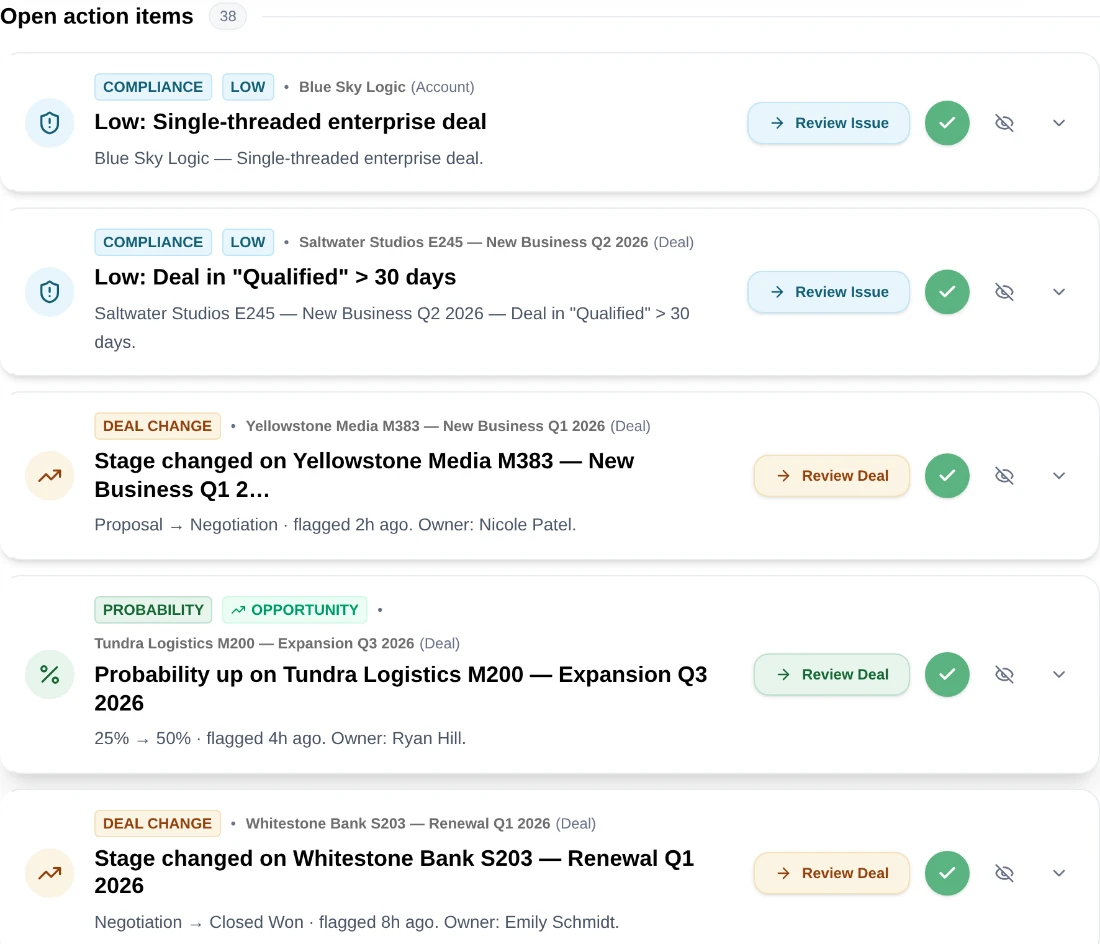
A pipeline inspection agent works continuously, not once a week. It reads every deal against your stages and exit criteria, flags stalled and at-risk opportunities, checks coverage, and surfaces the deals that need a manager's attention, with the reasoning attached.
This shifts the human role from hunting for problems to deciding what to do about them. Agents do the repeatable inspection; managers manage the last mile. Writes and nudges stay behind the review gates RevOps sets.
Metrics of pipeline discipline
A well-managed pipeline shows up in the numbers, not just the deal reviews.
- Pipeline coverage ratio against target
- Stage conversion rates and average time in stage
- Slippage rate — deals pushing close dates
- Percentage of deals with a defined next step
- Forecast accuracy against pipeline signals
Frequently asked questions
Inspect your pipeline continuously
Let an inspection agent surface risk with reasoning so managers act on signal, not stale data.
Try the demo.
See agents carry the repeatable work of GTM across sales, marketing, customer success, and RevOps. Every action prepared, reviewed, and recorded. Fictional data, real product.
Explore the demo