Slide 1 of 4
Three responses, three different meanings
- Send or complete it — the prepared work is right
- Edit the draft first — close, and correcting beats explaining
- Ignore with a reason — wrong in a way that will happen again
Understand what happens when you approve, edit or reject — and why your rejections are the most useful thing you produce in week one.
The next lesson asks you to work your own queue for a week. This one is what makes that exercise worth anything, because the difference between a useful week and a wasted one is whether you respond to items deliberately or clear them.
The three responses mean genuinely different things. Approve says the prepared work is right. Edit says it is close and the correction is quicker than an explanation. Reject says it is wrong in a way that is likely to recur, and that is the one that carries information back.
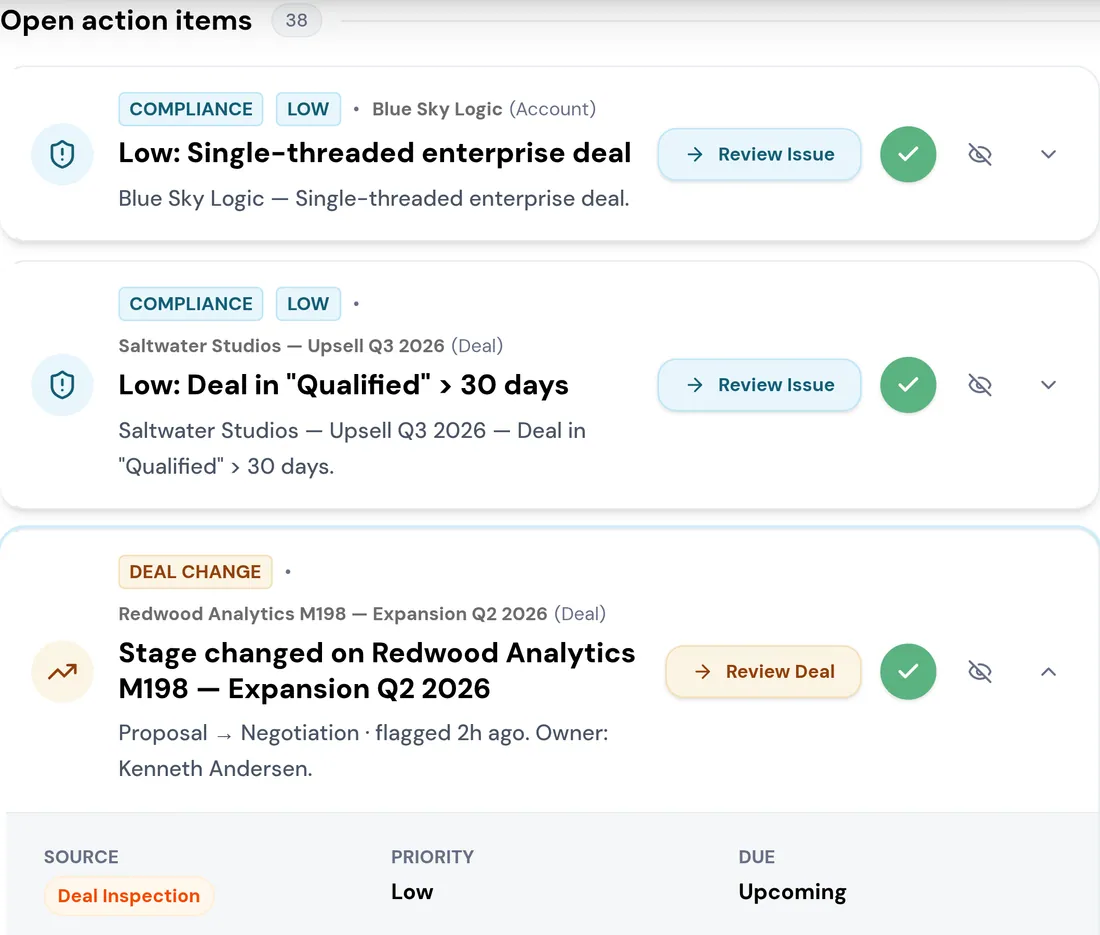
The three meanings are the useful way to think, but they are not three buttons. Each card carries one primary control that is the decision itself — send the drafted message, enrol the account, mark the work complete — and an overflow menu holding the ways out. Editing is not a separate verb: you edit the draft inside the flow, before the send that completes it. Rejecting is Ignore, and it asks you for a reason. Handing it to someone else is Escalate.
One class of item behaves differently and it is worth recognising on sight. Sign-off on a drafted campaign, on a new version of a play, or on a new analyst question arrives as a Review only item: everything is there to read, ignoring and escalating still work, and there is deliberately no completion control, so that having read one can never be recorded as having approved it. When you meet one, read it and raise it with whoever owns the motion.
The habit worth forming now, while everything is new and you are noticing things a month of familiarity will make invisible, is rejecting with a stated reason. A rejection with a reason is a correction the system and the people configuring it can act on. A rejection without one says only that something was wrong somewhere, which nobody can do anything with.
This is also the moment to internalise that external touches never fire on their own. That is not a detail; it is why reading the queue matters. If approval were a formality, skimming would be rational; because it is a gate, the reading is the job.
Now watch the video
This lesson is the orientation. The material itself lives on its own page, kept in one place so it stays current everywhere it is referenced.
You should be able to answer each of these from memory before opening it. Recalling the answer is what makes it stick; recognizing it when you read it does not.
Approve: the prepared work is right. Edit: it is close and correcting is faster than explaining. Reject: it is wrong in a way likely to recur, which is the response that carries information back.
It says only that something was wrong somewhere, which nobody can act on. A rejection with a reason is a correction the people configuring the agents can actually apply.
Approval is a real gate, not a confirmation dialog. That is what makes the queue worth reading rather than clearing.
In your first week you are not just doing your job — you are calibrating the system. A rejection without a reason cannot do that.
Every item carries why it was surfaced. Approving without reading it is how a queue becomes a formality.
See agents carry the repeatable work of GTM across sales, marketing, customer success, and RevOps. Every action prepared, reviewed, and recorded. Fictional data, real product.
Explore the demo