Slide 1 of 4
Severity is a routing instruction
It is not a label describing how annoying something is. It answers one question: who needs to see this, and how quickly.
Assign each severity level to the role that should hold it, and produce a routing map that survives people changing jobs.
Severity is routinely treated as a description of how bad something is, which makes it a matter of opinion and leads to long arguments that resolve nothing. It is more useful (and more accurate to what it does) to treat it as a routing instruction. Severity answers who needs to see this and how quickly, and nothing else.
That reframing makes the levels definable. Instead of arguing about whether a missing close date is "major" or "moderate", you ask who should act on it and within what window. If the answer for two levels is the same person within the same window, they are one level with two names, and collapsing them is a straightforward improvement.
Write each level as a test someone else could apply without asking you. A definition that requires your judgment to use is a definition that will be applied inconsistently the moment you are on holiday, and inconsistent severity is worse than no severity, because it makes the routing untrustworthy without making it obviously broken.
Prefer three well-defined levels to five aspirational ones. Every additional level needs a real distinction in owner or urgency to justify it, and in most organizations there are about three genuinely different responses: someone fixes it in the normal course of work, someone is told now, or something stops until it is resolved.
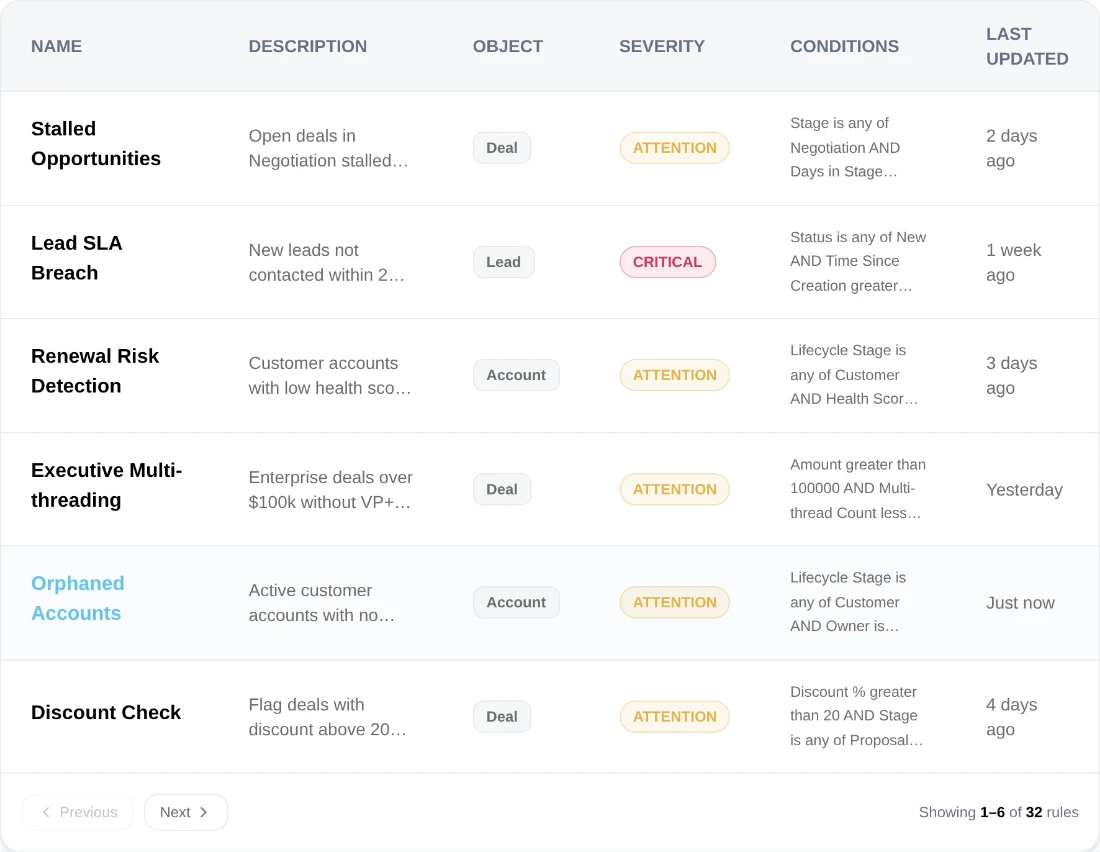
Route to roles rather than named individuals, for the same reason plays route to roles: people move, and a map built on names decays quietly. The failure is not visible (exceptions keep routing successfully to somebody who no longer owns the thing) which makes it worse than a loud failure.
Then check the load. For each level, estimate how many exceptions per week it will produce against the rules you authored, and divide by the people holding it. A level firing forty times a week at one person is not high severity in practice regardless of its name, and the fix is upstream: tighten the rule scope, or move the level. Doing this now costs twenty minutes; discovering it after enablement costs the credibility of the whole rule set.
Do this in the product
You should be able to answer each of these from memory before opening it. Recalling the answer is what makes it stick; recognizing it when you read it does not.
Who needs to see this, and how quickly. Treating it as a description of how bad something feels makes it a matter of opinion and produces arguments that resolve nothing.
Then apply the collapse test from the previous chunk to whatever you have written, and check what survives it.
Estimated weekly exception volume per level divided by the people holding it. A level firing forty times a week at one person is not high severity in practice, whatever it is called.
It is not a label describing how annoying something is. It answers one question: who needs to see this, and how quickly.
A map built on individuals is correct on the day it is written and wrong after the first reorganisation, silently.
A severity level that fires forty times a week at one person is not high severity in practice, whatever it is called.
See agents carry the repeatable work of GTM across sales, marketing, customer success, and RevOps. Every action prepared, reviewed, and recorded. Fictional data, real product.
Explore the demo