Slide 1 of 3
Claims come from artifacts
Customer names, results, differentiators and competitive positioning are drawn from what you have published, not generated to fill a gap.
Read vagueness in a draft as a map of where your library is thin, and fix it upstream where the fix applies to everything.
The checkable assertions in generated collateral, a named customer, a result, a competitive contrast, a differentiator, come from the artifacts you maintain. That is the design, and it is why the library is framed as your responsibility rather than a nice-to-have.
The practical consequence is that a proof point missing from the library is a proof point missing from the campaign. It is not replaced with an approximation or filled in from general knowledge of your category. It is simply absent, with the copy working around the space where it should have been.
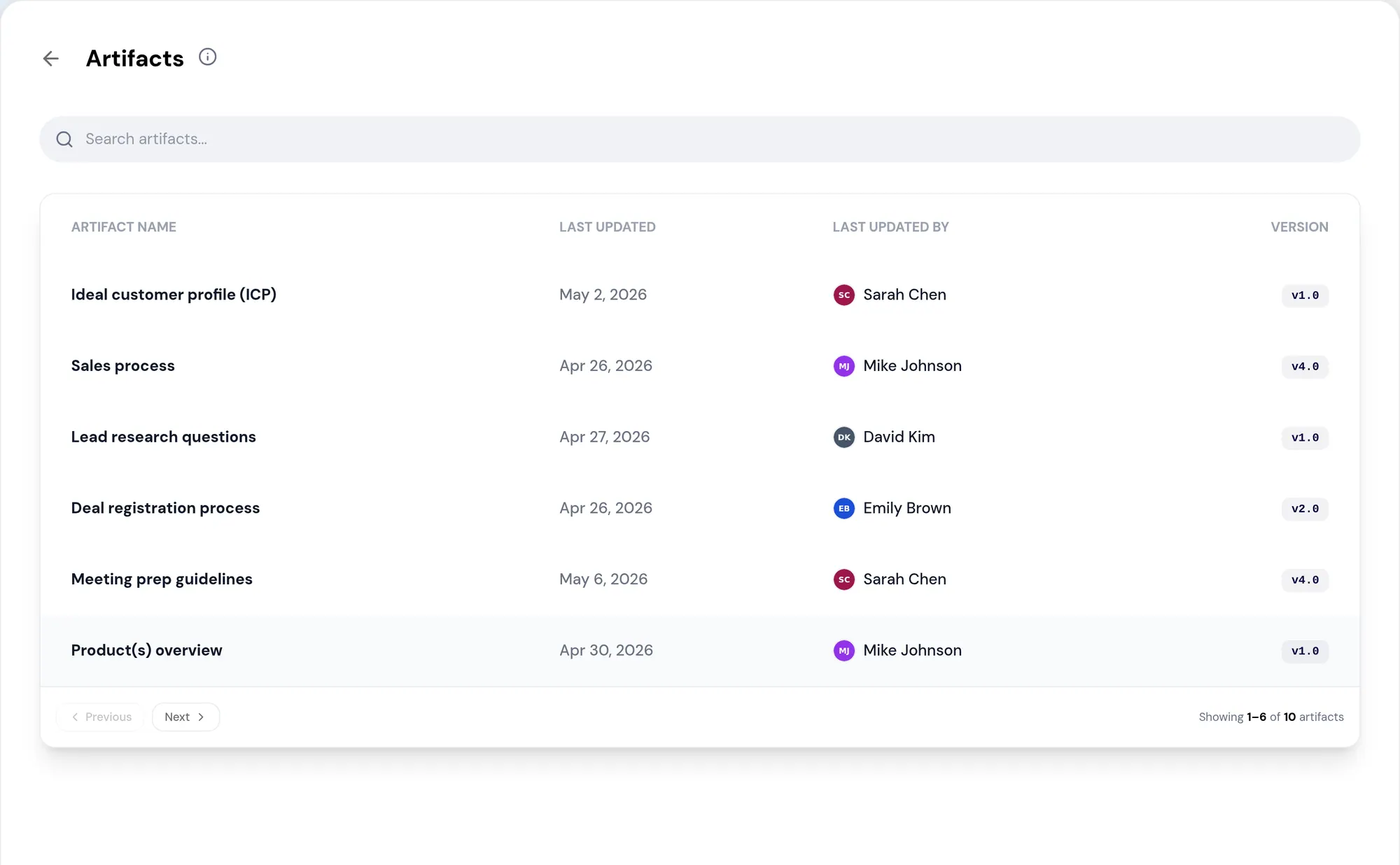
This gives you a useful diagnostic once drafts arrive. Vagueness in generated copy is not evenly distributed. It clusters exactly where the library is thin. A page that argues well and then goes abstract at the moment it should name a comparable customer is telling you, precisely, that there is no comparable customer in your artifacts.
The temptation is to fix that in the draft: write the sentence you wanted and move on. That fixes one asset. Adding the case study to the library fixes every asset in this campaign that needed it, and every campaign afterward. It is roughly the same amount of writing, done once instead of repeatedly, and it is the difference between a library that improves with use and one that stays exactly as thin as it was on day one.
Sourcing claims from a governed library substantially reduces invented specifics, and it is a real advantage over generating from a model with no grounding. It is not a guarantee, and it is not a substitute for review, which is why nothing external ships without a person approving it.
The working posture: the library governs what can be claimed, and the reviewer governs what is claimed, on this campaign, to this audience. The next module is about doing that second job across a hundred assets without reading every one.
A generated brief for the example campaign argues the migration-risk position well, then closes with: "Many teams have made this transition successfully." That sentence is the hedge: the exact spot where a named customer with a named result belongs, going abstract instead.
The check takes one search: the library's case studies cover enterprise logos only; there is no mid-market migration story. The fix is not to write a better closing sentence into this brief. It is to get the mid-market case study written and into the library, then regenerate. Every brief in the campaign picks up the proof point, and so does every future campaign, sequence and account plan that needs it. One hedge, read correctly, just upgraded the whole library.
You should be able to answer each of these from memory before opening it. Recalling the answer is what makes it stick; recognizing it when you read it does not.
That there is no comparable customer in the artifact library. Vagueness clusters where the library is thin, so the hedge is a map of what is missing rather than a writing problem.
Editing the draft fixes one asset. Adding the artifact fixes every asset in this campaign that needed it and every campaign afterward, for roughly the same amount of writing.
Customer names, results, differentiators and competitive positioning are drawn from what you have published, not generated to fill a gap.
When a page argues confidently and goes abstract exactly where a proof point belongs, the proof point is missing from the library.
See agents carry the repeatable work of GTM across sales, marketing, customer success, and RevOps. Every action prepared, reviewed, and recorded. Fictional data, real product.
Explore the demo