Skip to content
Running a campaign with drafted content
ReadLesson 4 of 12Choose what gets generated

Campaign-level or per-account

Choose between campaign-level and per-account assets understanding that the choice multiplies your review load, your cost and your specificity all at once.

6 minIntermediate
Part 1 of 6

The four options and what separates them

Step three of the builder is Content Creation, and its subtitle is refreshingly plain: select the AI content we will create for you. It offers two asset types at two scopes, plus a Number of Variations control for ad copy.

  • Campaign Landing Page — one master page for all traffic
  • Per-Account Landing Page — a personalized page for each target account
  • Campaign Solution Brief — one general asset for download
  • Per-Account Solution Brief — a customized PDF for each account
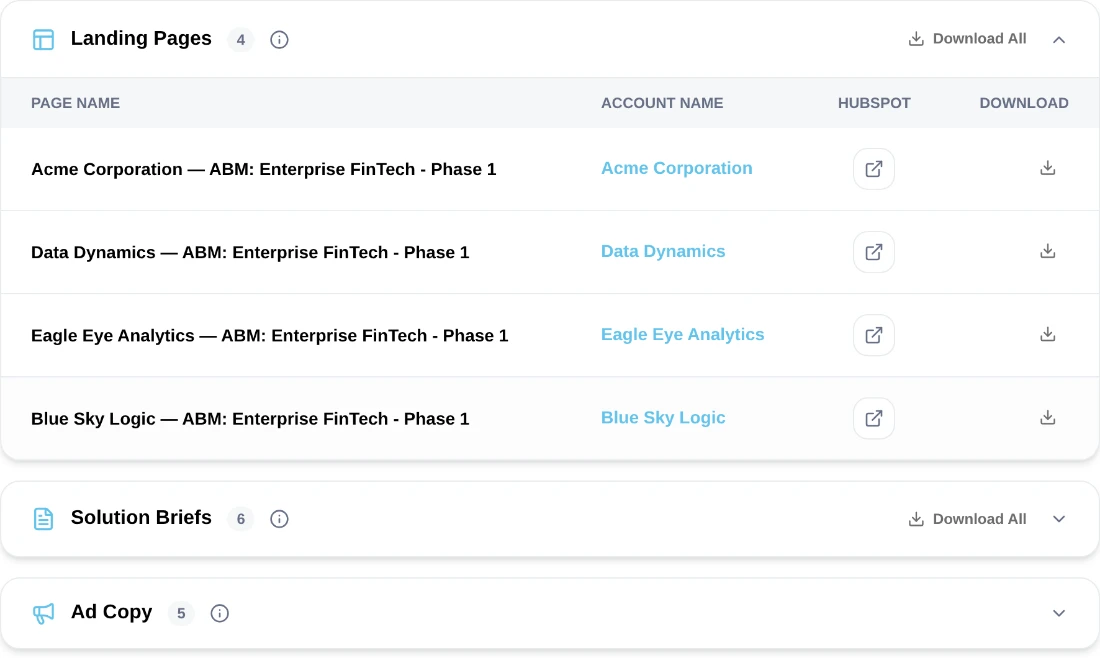
Campaign content drafted by RevTech: per-account landing pages, solution briefs and ad copy, each ready to review, push to HubSpot or download.
The assets tab of a campaign. RevTech drafts the collateral the campaign needs, from a landing page per target account to solution briefs and ad copy, and lists each one with the account it was written for, a link to push it into HubSpot and a download for any other system. The agent produces the first draft; a marketer decides what ships. Screenshot of the RevTech application; sample data.
The result of this step: a landing page per target account, plus briefs and ad copy, each listed with the account it was written for. Every row here is a choice you made on the Content step.
Part 2 of 6

The real decision is scope, not asset type

Read down that list and it becomes visible. Campaign-level means one artifact exists at the end. Per-account means one exists for every account in the audience you selected on the previous step. That is the same choice made twice, once for pages and once for briefs, and it drives everything that happens for the rest of the campaign.

Part 3 of 6

What per-account buys and what it costs

Per-account generation is the reason to run a campaign this way at all. A page that references the account's own situation is a materially different thing from a page about your product, and it is the capability the whole course is built around. So the question is never whether per-account is better. It obviously is.

The question is what it multiplies — three things at once, and only the first is the one you wanted.

The trap is choosing per-account for everything on the reasoning that more personalization is always better, and then discovering that the review capacity to do it justice does not exist. Personalized assets that nobody read before shipping are worse than a single master page that somebody did, because the errors are per-account too and they land on the account they name.

  • Specificity per account — the reason to do it at all
  • Review load, in exact proportion to the audience: a hundred accounts means a hundred assets
  • Credit consumption, enough that the product interrupts you about it at launch
Part 4 of 6

Mixing scopes is usually the right answer

Because the choice is offered separately for pages and for briefs, you are not obliged to pick one philosophy for the whole campaign. Some of the most sensible configurations are mixed.

A campaign landing page for paid traffic, where the visitor is anonymous until they convert and per-account personalization has nothing to attach to, plus per-account solution briefs for the accounts your sales team is actively working, where a named person will send a specific document to a specific stakeholder. That configuration puts the specificity exactly where it can be used and does not manufacture ninety pages nobody will send.

The general principle: generate per-account where a human will actually deliver the asset to that account, and campaign-level where the asset is being broadcast. Anonymous traffic cannot benefit from personalization it never sees.

Part 5 of 6

Variations are a quieter multiplier

Number of Variations governs how many versions of ad copy get written. It looks harmless because ad copy is short, and it is the setting most likely to produce a review backlog nobody planned for, because the count multiplies against everything else you have selected.

Set it to the number you will genuinely test. Variations exist to support a test, and a test needs enough traffic per variant to distinguish them. Generating eight variants for a campaign that will only ever have the volume to compare two produces six assets that consumed credits, occupy review time, and answer no question.

Part 6 of 6

A worked configuration

The example campaign has 60 accounts in its audience: 40 well-evidenced, 20 thin. The configuration that fits: one Campaign Landing Page as the destination for all paid traffic (anonymous visitors, personalization has nothing to attach to); Per-Account Solution Briefs for the 40 well-evidenced accounts, because sales will hand a specific PDF to a specific stakeholder; no per-account landing pages at all, because nobody in this motion sends account-specific page links; and ad variations set to 3, because the paid budget supports distinguishing three variants and no more.

Count the output before confirming: 1 page + 40 briefs + 3 ad variants = 44 assets, of which 40 scale with the audience. The named reviewer estimated they can properly review a stratified sample plus the high-stakes accounts in a morning. That is what a deliberately configured Content step looks like: every choice traceable to who consumes the asset, and the total checked against review capacity before anything generates.

Key questions

You should be able to answer each of these from memory before opening it. Recalling the answer is what makes it stick; recognizing it when you read it does not.

What are the four content options, and what really separates them?

Campaign and Per-Account Landing Pages, and Campaign and Per-Account Solution Briefs. The asset type matters less than the scope: campaign-level produces one artifact, per-account produces one for every account in the selected audience.

When is a campaign-level asset the better choice despite being less specific?

When the asset is broadcast to anonymous traffic. A visitor who is unidentified until they convert cannot benefit from personalization, so per-account generation there costs credits and review time and buys nothing.

Why is Number of Variations riskier than it looks?

It multiplies against everything else selected, and variants only earn their keep if you have the traffic to distinguish them. Extra variants consume credits and review time while answering no question.

What to take away

  • The real choice is scope, not asset type: campaign-level makes one artifact, per-account makes one per account.
  • Per-account multiplies specificity, review load and credits together. Only the first is what you wanted.
  • Generate per-account where a person will deliver the asset; campaign-level where it is broadcast.
  • Set variations to the number you will actually test.

Teach this lesson

The argument in 5 slides, for presenting it to your team
Slide 1 of 5

The Content step offers four things

  • Campaign Landing Page — one master page for all traffic
  • Per-Account Landing Page — a personalized page for each target account
  • Campaign Solution Brief — a general asset for download
  • Per-Account Solution Brief — a customized PDF for each account
Slide 2 of 5

One decision, made twice

Campaign-level produces one asset. Per-account produces one per account in your audience. Everything downstream follows from which you pick.

Slide 3 of 5

Per-account multiplies three things

  • Specificity, which is why you want it
  • Review load, one asset per account
  • Credits, which the app will warn you about
Slide 4 of 5

You can mix

A campaign landing page for paid traffic plus per-account briefs for the accounts your team is actively working is often better than committing to either extreme.

Slide 5 of 5

Ads carry their own multiplier

Number of Variations decides how many versions get written. Variations are cheap to generate and still have to be read.

Demo

Try the demo.

See agents carry the repeatable work of GTM across sales, marketing, customer success, and RevOps. Every action prepared, reviewed, and recorded. Fictional data, real product.

Explore the demo