Slide 1 of 3
Five line items, not one number
- Program, Production, Third Party, Internal, Misc
- Each is a currency field on the Strategy step
- The Review step totals them as Total Estimated Budget
Record the campaign budget across its five line items so the campaign can later be judged on efficiency rather than on volume.
Campaign Budget on the Strategy step is not a single figure. It is five currency inputs: Program, Production, Third Party, Internal and Misc. The Review step adds them up and shows the result as Total Estimated Budget, alongside the audience counts and the asset count.
Use the split rather than dropping everything into Program, because the lines behave differently over time.
A campaign whose cost is mostly production is expensive once and cheap to repeat. One whose cost is mostly program is the opposite. Recorded as a single lump those two look identical, and the decision about which to run again gets made against a number that hides the thing you needed to know.
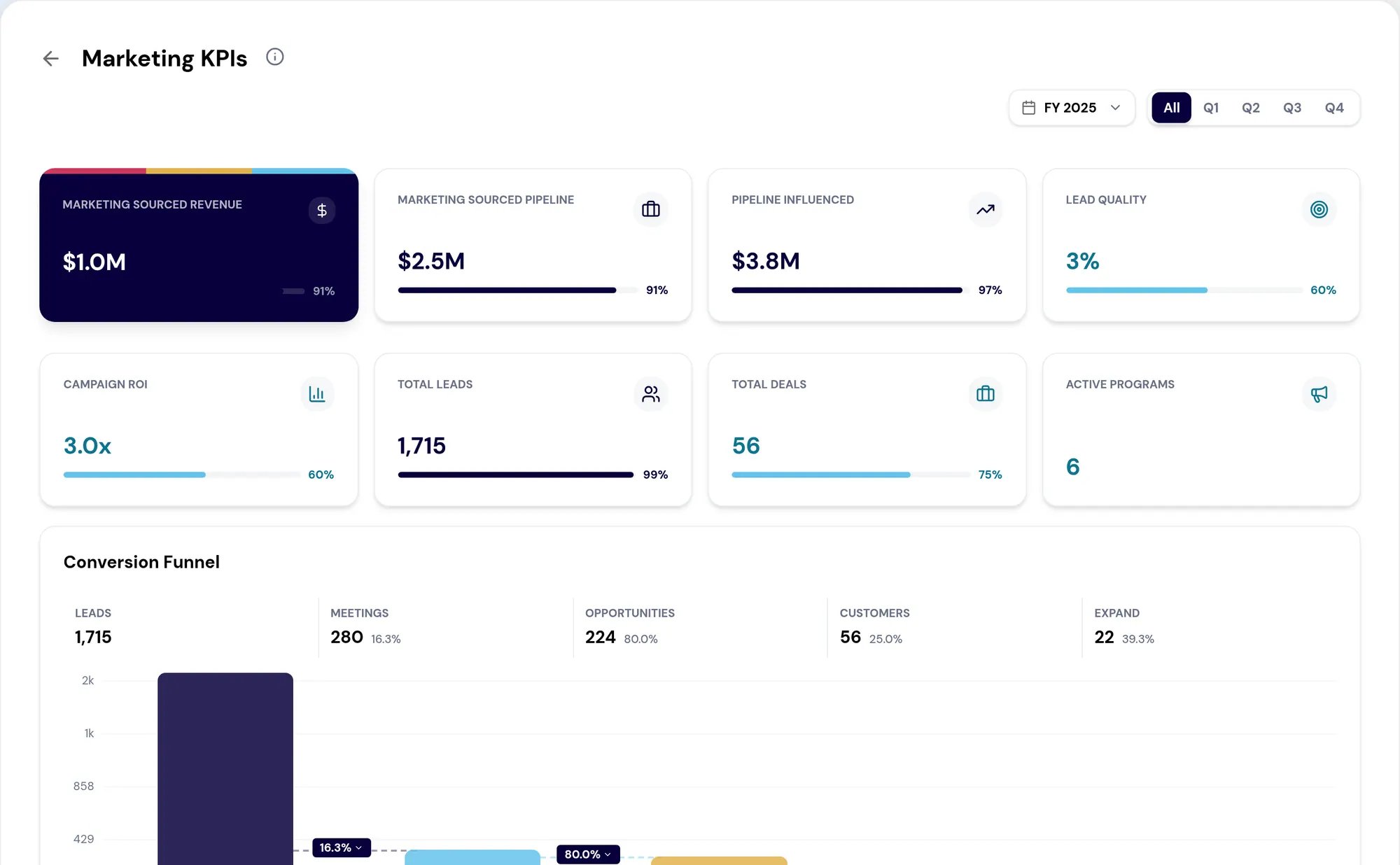
Every campaign is reported on the same terms: leads, meetings, deals, pipeline and revenue. Those columns answer what a campaign produced. They only answer whether it was worth doing when there is a budget to divide them by.
A campaign with no recorded budget can only be compared to others on volume, and volume always favors the largest campaign. That is a poor habit to build into a surface the whole team reads, and it punishes exactly the disciplined, tightly-targeted campaigns you want more of. Record the number even when it is approximate, and note what it includes. An approximate figure with a stated basis is far more useful than a blank.
The example campaign, split across the five lines: Program 18,000 (the paid distribution), Production 6,000 (design passes on the generated assets and one commissioned diagram), Third Party 4,500 (the intent-data enrichment for the audience), Internal 7,500 (a realistic costing of the marketing and RevOps hours at loaded rates), Misc 1,000. Total Estimated Budget on the review step: 37,000.
Now the split earns its keep. If the campaign is judged worth repeating, the second run does not cost 37,000. The production is largely done and the enrichment is annual, so the marginal cost is closer to 20,000, which changes the efficiency math substantially. Recorded as one lump under Program, that repeat decision would have been made against the wrong number. And the Internal line, the one most teams skip, is what keeps a "cheap" campaign that consumed three weeks of RevOps time from being scored as free.
Do this in the product
You should be able to answer each of these from memory before opening it. Recalling the answer is what makes it stick; recognizing it when you read it does not.
Program, Production, Third Party, Internal, Misc. Split, they distinguish a campaign that is expensive once (production-heavy, cheap to repeat) from one that is expensive every time (program-heavy). As a lump sum those look identical.
The efficiency comparison. The campaign can then only be judged on volume, which systematically favors the biggest campaign and penalizes tightly-targeted ones.
The report tells you what a campaign produced. Only a recorded budget turns that into whether it was worth doing.
Production is mostly one-off. Program scales with reach. A campaign that looks expensive in total may be cheap to run again.
See agents carry the repeatable work of GTM across sales, marketing, customer success, and RevOps. Every action prepared, reviewed, and recorded. Fictional data, real product.
Explore the demo