Definition and template
What is a RevPlay?
A RevPlay is a governed, account-centric GTM motion with a defined trigger, shared context, bounded actions, named owners, human approval points and measurable outcomes. Fully managed AI agents can prepare and coordinate the repeatable work, while people retain judgment, customer decisions and final approval.
Published
Definition
A play becomes a RevPlay when execution is explicit
A campaign, task list or prompt is not yet a RevPlay. A RevPlay connects a commercial situation to the coordinated work required across marketing, sales, customer success, partners and RevOps.
The design must make the operating contract visible: why the play starts, what context is required, what agents may prepare or update, which person owns each decision, what evidence travels with the work and how the outcome will be reviewed.
- 01
Trigger
A defined account, opportunity, customer or operating condition starts the play.
- 02
Context
Approved CRM, activity, product and business rules establish what is true.
- 03
Prepare
Agents research, inspect, summarize and assemble the next bounded action.
- 04
Approve
The accountable person reviews judgment, risk and customer-facing work.
- 05
Execute
The approved action moves through the system of record and named owners.
- 06
Learn
Completion, edits, exceptions and outcomes improve the play deliberately.
Anatomy
Design eight parts before choosing an agent
Starting with the agent encourages capability-first design. Starting with the motion makes the business rule, human responsibility and evidence standard testable before technology enters the conversation.
| Use case | Design question | Required evidence | Named owner |
|---|---|---|---|
| Objective | What commercial or operating condition should change? | Baseline and review cadence | Business owner |
| Trigger | What exact condition starts or excludes the play? | Queryable rule and reason code | RevOps |
| Context | Which records, definitions and sources are approved? | Source inventory and freshness rule | Data owner |
| Agent work | What may be researched, prepared, recommended or updated? | Permission boundary and test cases | Workflow owner |
| Human decision | Where is judgment or customer risk present? | Approval matrix and escalation path | Accountable GTM role |
| Completion | What is trustworthy completion? | Evidence packet and system-of-record update | Process owner |
| Recovery | What happens when context is missing or a step fails? | Exception and rollback path | Operating owner |
| Outcome | Which workflow and business indicators are reviewed? | Definitions without unsupported causal claims | Business and analytics owners |
Worked example
RevPlay: qualified account signal to owned action
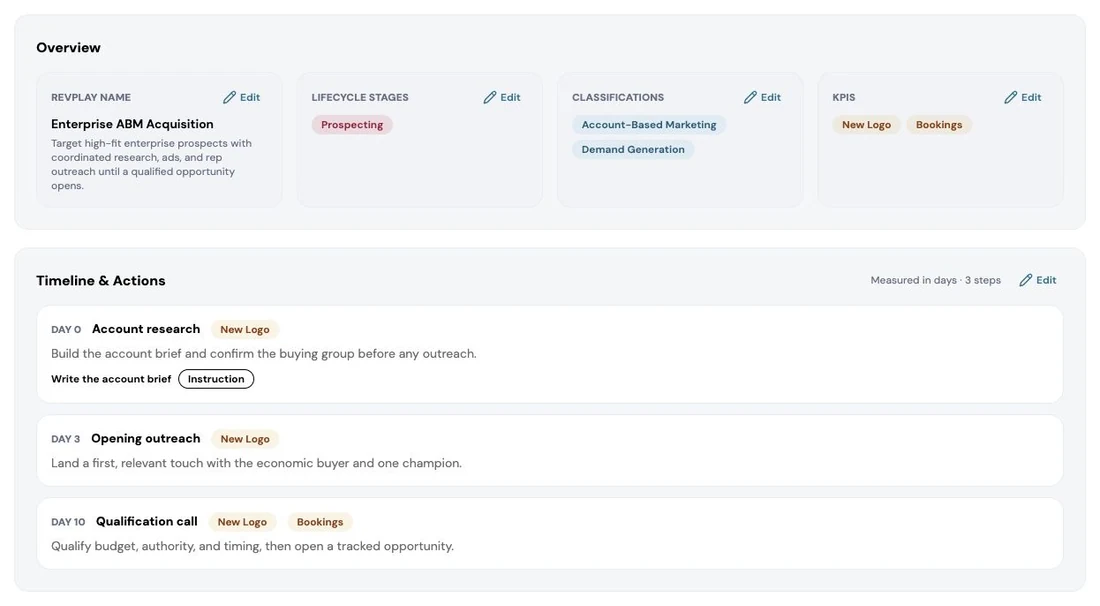
A target account reaches an agreed engagement threshold. The play confirms identity and ownership, assembles recent account and opportunity context, recommends the permitted next motion and routes the prepared work to the responsible seller or marketer.
The person reviews the recommendation and any customer-facing draft. Approved changes return to the CRM, exceptions route to RevOps, and the team reviews acceptance, completion, SLA, pipeline movement and edits without claiming the play caused revenue on its own.
Design
Make the contract explicit
Write the trigger, context, permissions, approvals, completion evidence and outcome definitions.
Pilot
Run on a bounded cohort
Use representative accounts, inspect every output and preserve a manual fallback.
Scale
Widen only with evidence
Expand scope after quality, adoption, exceptions and operating ownership are stable.
Failure modes
Why repeatable plays still fail
A named play can still be a loose collection of tasks. The failure appears when teams cannot explain why it started, which facts were used, who owns the next decision or what trustworthy completion looks like.
- The trigger is descriptive rather than queryable.
- Account and opportunity identity are unresolved before work starts.
- The play assumes context that is stale, missing or outside the approved boundary.
- Customer-facing work has no explicit human decision owner.
- Exceptions disappear into a queue with no recovery SLA.
- Activity is counted, but completion and commercial outcomes are never reviewed separately.
Downloadable template
Design the motion before configuring the agents.
A fillable Markdown canvas for the objective, trigger, context, actions, owners, approvals, evidence, recovery and outcome review.
Frequently asked questions
Turn one recurring motion into a governed RevPlay.
Start with the business objective and decision boundary. The agents come after the operating contract is clear.
See how the work gets done.
Explore how agents prepare work across your revenue teams, and how people review it, guide it and decide what happens next. Fictional data. Real product.
Explore the demo