Slide 1 of 4
Start here, and read it as an operating model
Not as a category description. The rest of this track is the practical consequence of one idea: agents do the repeatable work, humans manage the last mile.
Get the operating model clear enough that the rest of the track has something to attach to, particularly the division between what agents carry and what people keep.
Everything else in Launchpad is downstream of one idea, and reading the practical lessons without it produces a person who can work a queue without knowing why the queue is shaped that way. That person copes for a fortnight and then hits the first case the instructions do not cover.
The concept page is the argument in full. What this lesson adds is the reason it sits at position one and what to carry out of it, because you are not reading it as background. You are reading it to answer one specific question by the end.
The section to slow down on is the one describing what agents carry versus what people keep. It is the load-bearing distinction in the whole model: agents do the repeatable work and humans manage the last mile, which means work reaches you assembled rather than finished.
Hold that against your own week as you read. The question to answer by the end is which parts of your work are repeatable assembly (research, gathering context, drafting from known material) and which are judgment you would not want handed to anything. That answer is the input to the next lesson, and it is also the honest personal version of the ROI argument the leaders track makes at an organizational level.
Now read the concept
This lesson is the orientation. The material itself lives on its own page, kept in one place so it stays current everywhere it is referenced.
You should be able to answer each of these from memory before opening it. Recalling the answer is what makes it stick; recognizing it when you read it does not.
Agents do the repeatable work; people manage the last mile. Work arrives assembled rather than finished, which is not the same as work disappearing.
Which parts of your own week are repeatable assembly (research, gathering context, drafting from known material) and which are judgment you would not hand over. The next lesson builds on that answer.
Not as a category description. The rest of this track is the practical consequence of one idea: agents do the repeatable work, humans manage the last mile.
Prepared is not the same as done. Almost every misunderstanding in the first month traces back to expecting work to disappear rather than to arrive further along.
Which parts of your own week are repeatable assembly, and which are judgment you would not hand over. You will use that answer in the next lesson.
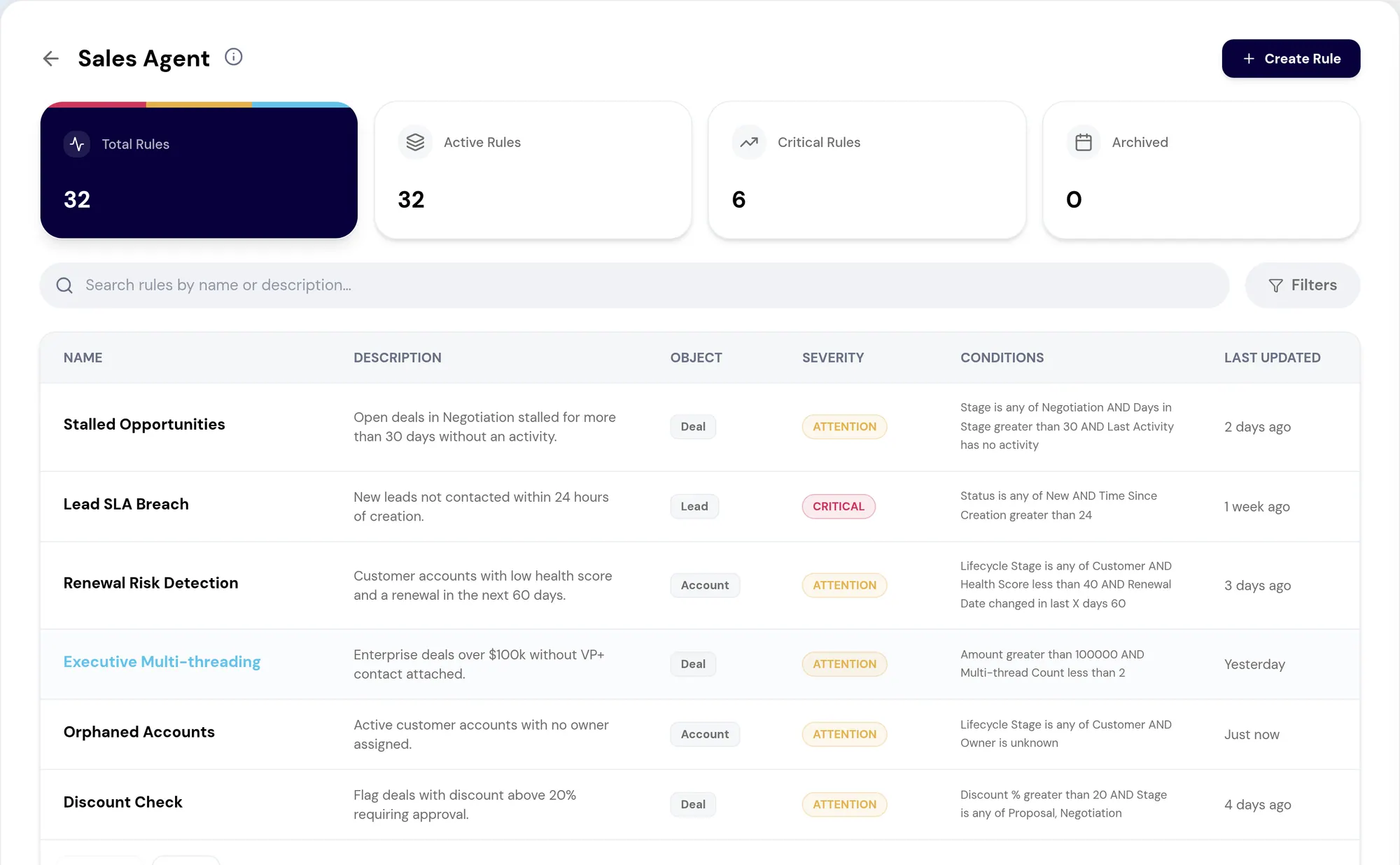
See agents carry the repeatable work of GTM across sales, marketing, customer success, and RevOps. Every action prepared, reviewed, and recorded. Fictional data, real product.
Explore the demo